

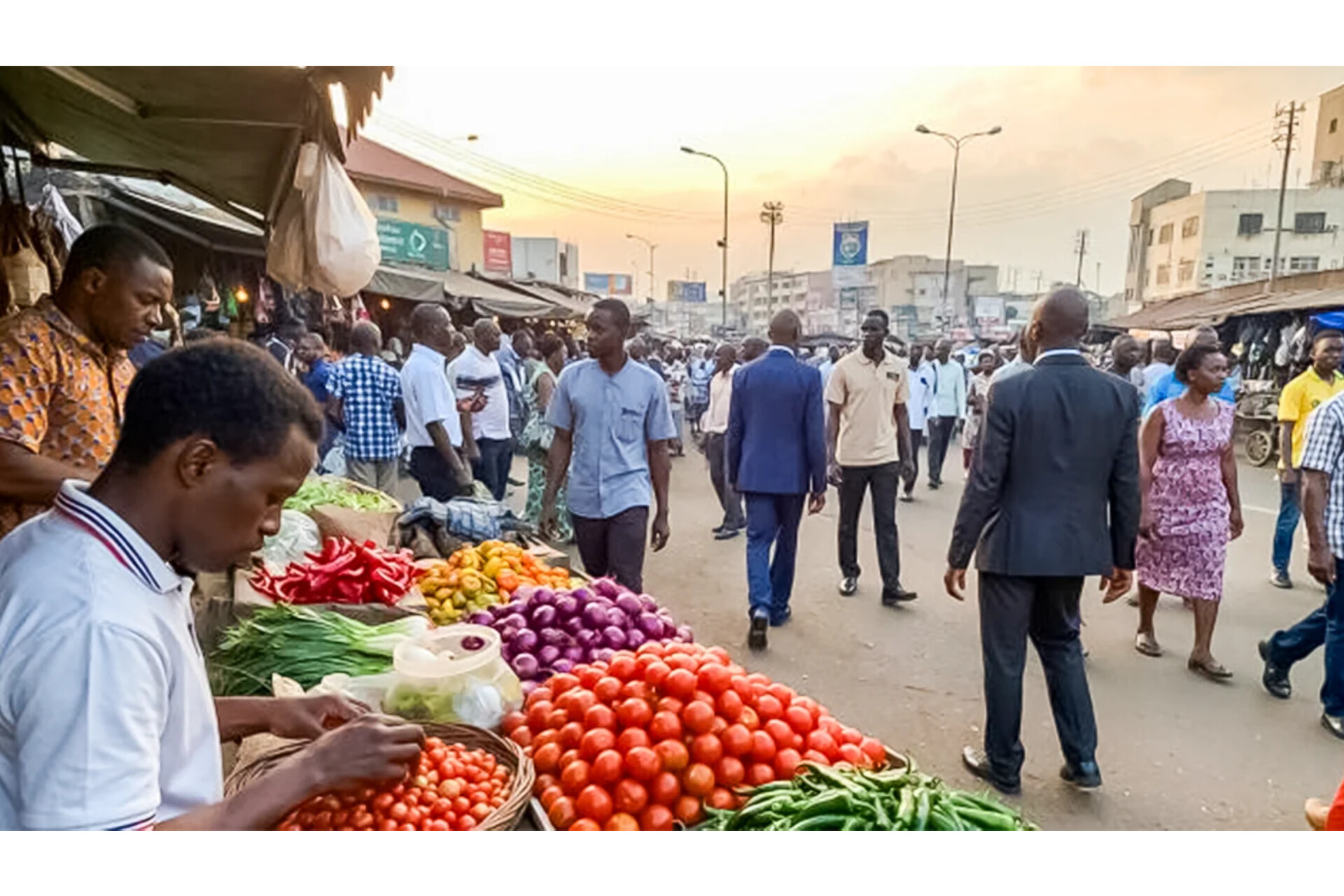
Cost-of-living constraints are dampening this year’s May Day celebrations in Nigeria, where workers are grappling with rising prices despite a recent minimum wage boost.
As the Nigeria Labour Congress (NLC) and the Trade Union Congress (TUC) celebrate the annual Workers’ Day today, demands for salary hikes, far-reaching palliatives and concrete actions to address insecurity are anticipated to dominate proceedings across the country, The Guardian writes.
The Iran-United States confrontation is a long distance from Nigeria, but the dispute has pushed the price of Premium Motor Spirit (PMS) up from about N780 per litre to N1,400, making essential necessities unaffordable to the average Nigerian.
The N70,000 minimum wage that Nigerian workers are grappling with has been decimated by inflation. Rising fuel prices are also a burden for them, since they have pushed up transportation costs and prices of basic food commodities, mainly because of global oil price changes.
Speaking during the pre-May Day celebration in Abuja, President of the NLC, Joe Ajaero, said the worsening economic conditions were harming workers’ welfare and national production.
He said insecurity and poverty have become major hurdles to good work, noting that millions of Nigerians have been locked below the poverty line and quality jobs continue to disappear.
He said that removing insecurity will considerably enhance living conditions and economic activity in the country, especially in agriculture and small companies.
TUC President, Festus Osifo, on his part, urged for more solidarity among workers and stakeholders to address poverty and insecurity.
“Decent work was still a non-negotiable for Nigerian workers. “We need to cooperate more to enhance the working environment in the country,” he said.
“Decent work is a must for Nigerian workers and is not negotiable,” he said, adding “We call for greater solidarity and cooperation towards the eradication of poverty and insecurity in our workplaces, in particular and Nigeria in general.”
The present N70,000 national minimum wage law was put into force in July 2024, when the naira was experiencing extraordinary volatility, with the exchange rate fluctuating tremendously at roughly N1,472 to the dollar rate. At this rate the minimum wage was worth $43.19.
The National Bureau of Statistics (NBS) Consumer Price Index (CPI) which tracks inflation reported that as at March 2026, inflation was at 15.38 per cent year-on-year. Therefore, workers have contended that their living conditions were better in 2019 when minimum wage was N30,000 than now when the exchange rate was hovering between N357 and N360 to the dollar.
A comparison of food commodity prices showed that food inflation was 13.70 per cent in 2019 and grew to 14.31 per cent in April 2026 (under revised standard). While a bag of imported rice that was sold for N7,000 now sells for N57, 000, a bag of local rice, which was previously sold for N12, 000, now sells for between N53, 000 and N95, 000. Prices fluctuate because of high transportation costs and market demand.
The price of a big bag of melon increased from N252,500 in March to N330,000 in April, reflecting a 30.69 per cent rise.
A big basket of round tomatoes climbed from N50,000 to N65,000, while oval tomatoes increased from N35,000 to N40,000.
A 50kg bag of white and yellow garri now sells for N25,000, up from N20,000 (25 per cent).
Likewise, Royal Stallion rice gained 13.2 per cent to N60,000. Mama’s Pride rice surged by 13 per cent to N65,000 from N57,500.
A huge bag of ogbono rose from N246,500 to N300,000.
The price of Honeywell semovita 5kg bag went up by 13.85 per cent to N7,400, while the 2kg variety climbed by about 11 per cent to N3,100.
A 5kg carton of Kings groundnut oil sells for N17,000, 70g Indomie carton sells for N10,000, pasta/spaghetti sells for N19,000.
The World Bank’s Nigeria Development Update of October 2025 welcomed advances in macroeconomic stabilisation, income mobilisation and external balances, but said the benefits were yet to materialize into better living standards.
It underlined high food inflation and widespread poverty and asked for urgent measures to curb inflation, increase the efficiency of state spending and expand social security.
Organised Labour maintained that macroeconomic change is not complete until it is felt in the cooking pot, and emphasised that fiscal adjustment has also been lacking while balance sheets improve and citizens’ living standards decline.
However, economists claimed the rate of decelerating inflation and dropping food costs was not enough to make a major difference in the lives of people.
The data from the statistics office indicated that the average price of local rice reduced 10.94 per cent year-on-year to N1,841.83 per kilogram, while brown beans dropped 48.65 per cent to N1,262.43.
Analysts said the trend of food prices in the first half of 2026 will be dictated by continued policy cooperation, affordable inputs and farmer optimism ahead of the next planting season.
Nigeria’s inflation rate has come down from 18.85 per cent in 2023 when the present administration took over to 15.38 per cent in March 2026. The new standard methodology puts the current unemployment rate at 5.3 per cent, but researchers say it would be close to 40 per cent if evaluated by the old measures.
Take for example a worker in 2015, who earned N70,000 a month, could afford some necessities and still have some modest savings. The buying power has fallen back somewhat today and the incomes are not so comfortable any more.
Labour said there was an urgent need for another pay hike as the rise in energy prices which has also affected the pricing of basic food items and a minimum salary of N70,000 that is no longer enough for Nigerian workers.
The Minimum pay Act of 2024 has provided for the next statutory review in 2027, when President Bola Tinubu cut short the pay review cycle from five to three years to reflect current economic realities.
Labour leaders are set to launch early push from today for better workers’ welfare ahead of the new minimum wage process next year.
This, in the face of increasing expenditures of public transit, healthcare services, rent, among others.
President Tinubu is expected to observe the day with organised labour in Abuja.
Speaking at the pre-May Day lecture, Dr Toyin Olawunmi of the Department of International Relations and Diplomacy, Chrisland University, Abeokuta, said Nigeria’s insecurity and poverty crisis has become a direct threat to decent work, household welfare, productivity and national stability.
“Insecurity, poverty and labour distress cannot be treated as separate policy problems anymore because they have all converged into one national governance crisis that calls for urgent, coordinated and measurable action,” Olawunmi said.
He said the current burden on labor goes beyond formal taxation to insecurity tax, inflation tax, transport tax, electricity generation tax, health care tax, corruption tax and the emotional tax of uncertainty.
“Nigeria cannot build decent work on frightened communities, hungry homes, falling purchasing power and weak public institutions. A country that abuses its workers is creating its own instability. “Any nation that dignifies work is investing in peace,” he remarked.
Rufus Olusesan, President of the Precision Electrical and Related Equipment Senior Staff Association, accused the administration of bribery and corruption, saying there was nothing to celebrate.
He also chastised the government of not taking insecurity seriously enough, of not showing enough dedication to ensuring the survival of the working population.
But the elections in the next year have increased the consciousness of the people of the necessity to pick a government that can defend the workers and improve their welfare,” Olusesan said.
“There is no reason to celebrate. Thank God we are alive. The economy isn’t a pretty picture. At the moment, 7litres of fuel costs N10,000; when you put it into economic indicators vis-avis incomes, it cannot send anyone home. “The only thing that works in this country is bribery and corruption,” he remarked.
The President of the Chemical and Non-Metallic Products Senior Staff Association of Nigeria, Segun David, in a solidarity message, said, in spite of the change mantra and the inauguration of the Tinubu administration, Nigerian workers have continued to face the same challenges, with the sudden removal of fuel subsidy without enough cushioning measures to cushion the consequent hike in transportation and service costs.
He observed that the current minimum wage is not enough to take care of the cost of transportation for a worker and lamented that the renewed hope agenda is fast fading for an average worker who has up to 10 dependants across immediate and extended families without urgent policies and programmes to address the situation.
Organized labor has continued to contend that even at the time of passage of the bill, the N70,000 minimum wage signed into law on July 18, 2024, had been undermined by inflation and the rising cost of living, highlighting the importance of improved welfare measures.
CPPE: Move from wage increases to actual income protection
Meanwhile, Chief Executive Officer (CEO) of the Centre for the Promotion of Private Enterprise (CPPE), Dr Muda Yusuf has called for a paradigm shift in the approach of Nigeria to labour welfare, warning that the country’s preoccupation with wage negotiations has masked deeper structural threats to the living standards of workers.
In a policy brief titled Beyond Wage Increases: Reframing Labour Welfare Priorities in Nigeria, he claimed that periodic wage increases, while vital, are always eroded by the combined pressures of food inflation, growing energy prices and declining public service performance.
Any true labour welfare policy ought to be centred on protecting actual incomes, rather than simply raising nominal salaries, he argued.
“Food and transport alone constitute a large share of monthly expenditure for most low and middle income households,” he said, adding that nominal pay increases are generally erased within a short period.
He defined 10 priority welfare areas to anchor a new national labour agenda. First of all, the cost of living and price stability. He urged for scaled investment in mass transport systems to cut the cost of commuting, stronger policies to enhance agricultural production and limit food inflation, and steps to moderate rental pressures in Nigeria’s major metropolitan centers.
He called for medium and big firms and government entities to offer subsidized staff canteens.
The significant out-of-pocket cost has been identified as a major source of financial vulnerability for Nigerian workers in the healthcare sector. He said health security was as crucial to productivity as it was to welfare and advocated for wider coverage under the National Health Insurance Authority, tighter enforcement of employer-backed health insurance plans and tougher workplace health and safety regulations.
He expressed concern about the retirement instability in the formal and informal sectors and asked for greater compliance with pension payments, expansion of micro-pension programs to informal workers, and enforced punishments for defaulting employers.
The CPPE head worried about the growing normalisation of casualisation and contract employment on job security, which he said has reduced protections for many workers. He advised workers unions to demand stronger regulatory framework and strong redundancy protection procedures especially when there is no unemployment insurance program in Nigeria.
He said the rising energy costs, which he termed as an unsustainable burden, imposed a heavy strain on households through power bills and generator fuel costs. He asked for a more dependable power supply, less reliance on self-generation and a clearer tariff regime, saying lower energy costs would immediately increase disposable earnings.
“Nigeria’s dependence on informal transport systems exposes workers to high and unpredictable commuting costs,” he added, urging investment in affordable mass transit, increased regulatory oversight to prevent exploitative pricing, and policies that incentivize employers to provide transportation for staff.
On housing he called for expanded affordable housing projects and revisions to frameworks for mortgage financing
“Sustained investment in skills development and vocational training is a pathway to long-term income mobility,” he also stressed, pointing to the need for employer-supported capacity building and better public-private partnerships to bridge productivity gaps in the workforce.
He regarded the safety net system in Nigeria as poor and fragmented on social protection and advocated for the implementation of unemployment insurance and increased targeted social initiatives to cushion workers against economic shocks.
He also tackled the issue of the tax load on workers, saying that with little relief for low and middle income earners, many Nigerians lose a considerable share of their earnings to what the centre termed as a regressive tax system. He advocated policies that would increase take-home income, not just gross earnings.
He stated he does not oppose compensation changes but there needs to be a structural rethink of how wages are set. He called for institutionalization of inflation-linked wage adjustments, periodic cost-of-living adjustments (COLA) and more transparent and predictable wage review processes, claiming that episodic, reactive increases are not enough to safeguard real incomes.
The brief’s strategic recommendations included for the government to improve public service delivery in health, education, transportation and power, to prioritize policies that improve productivity in agriculture, energy and logistics, and to accelerate the building of inclusive social protection systems.
He also called for more stringent enforcement of regulations on worker protection, pension compliance and standards in the workplace.
“A comprehensive welfare system grounded in structural reforms and strong institutions is imperative to improve the quality of life of workers and promote inclusive economic growth,” he said.
He said the policy brief became required because labour conflicts exist in Nigeria amid double-digit inflation and a cost-of-living crisis that has considerably diminished purchasing power across income categories.
About the Author