
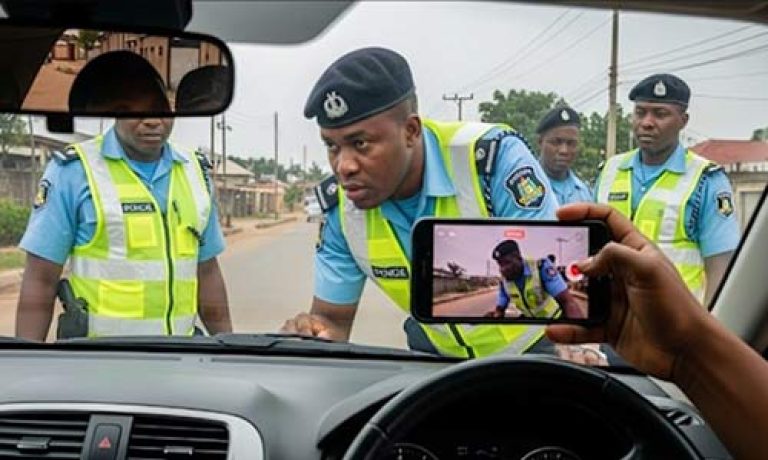
The Federal High Court in Warri, Delta State, has declared that Nigerians have the right to record police personnel doing their jobs in public. This decision is considered as a step forward for civil rights and accountability.
Justice H. A. Nganjiwa ruled yesterday in suit No. FHC/WR/CS/87/2025, which Premium Times got, that police officers must wear name tags that are easy to see, show their force numbers, and not harass, intimidate, arrest, or take devices from people who are recording their activities, according to Vanguard.
The court also gave Maxwell Uwaifo N5 million in damages for breaking his basic rights and N2 million for the cost of going to court.
The applicant got all they asked for, which strengthens the ability of civilians to record police behavior in public without fear of punishment.
Uwaifo called the ruling far-reaching in response to it.
“This judgement has significant implications for policing standards, civil liberties and public accountability across Nigeria,” he said in a statement to Premium Times.
“The court made broad statements about police accountability and citizens’ constitutional rights.”
The lawsuit, which was filed as a public interest case, questioned whether police stop-and-search operations were allowed when the officers didn’t provide valid identification.
The Nigeria Police Force, the Police Service Commission, the Inspector-General of Police, and the Attorney-General of the Federation were all parties in the lawsuit.
The action was filed under the Fundamental Rights (Enforcement Procedure) Rules, 2009, and it used numerous parts of the 1999 Constitution, such as Sections 34, 35, 36, 37, 38, 39, 41, and 46, as well as parts of the African Charter on Human and Peoples’ Rights that were relevant.
The applicant sought the court in the original summons to decide if civilians can legally record police personnel and if being harassed or arrested for doing so is a breach of basic rights.
About the Author