
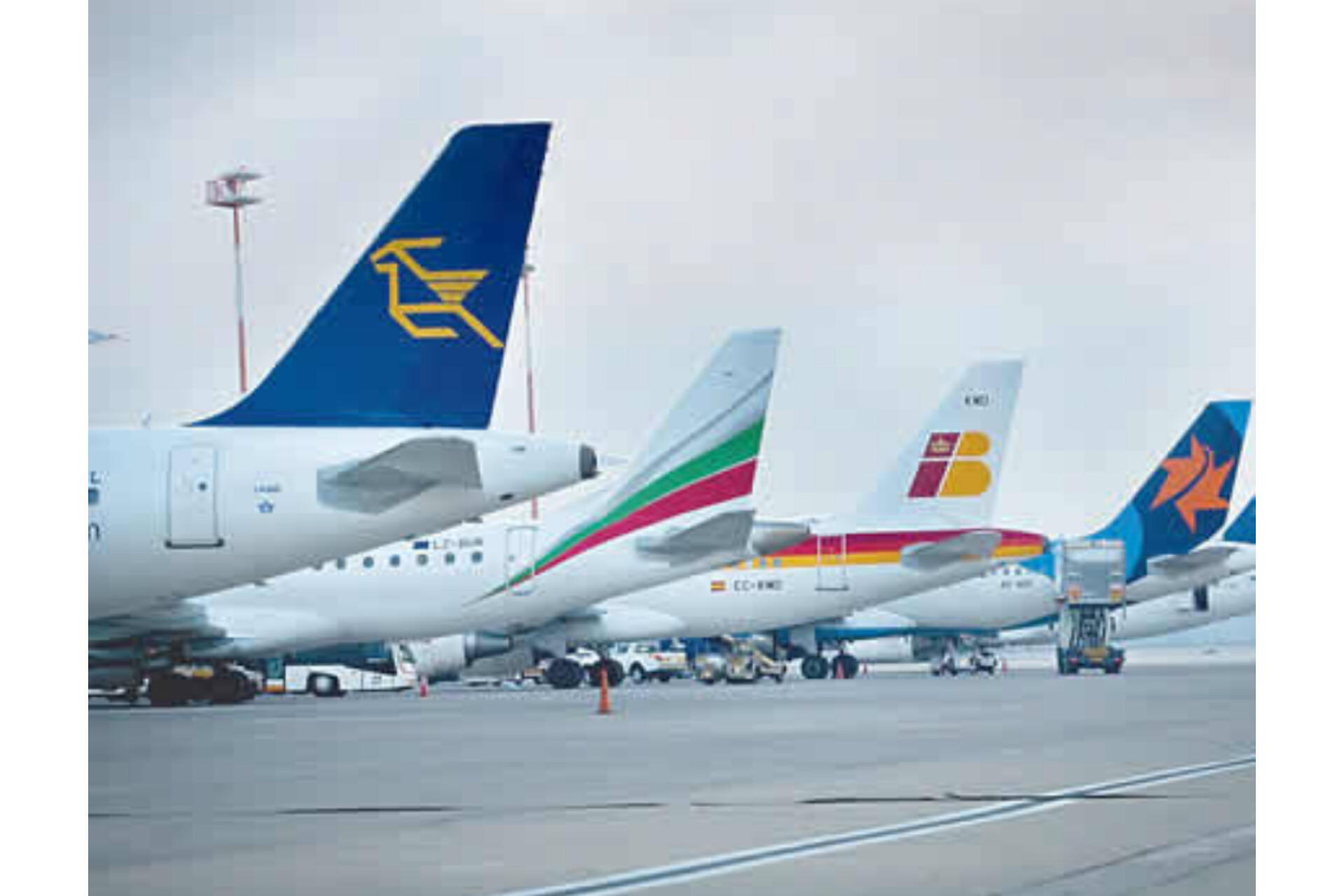
The escalating battle between the U.S.-Israel and Iran is making it hard for people to fly internationally. Average airfares on certain routes went up by more than 100 percent yesterday.
According to The Guardian, demand-pull inflation hit European and American airlines when many flights to and from the Middle East were suddenly and indefinitely canceled.
Safety is still the most important thing for many airlines, but this event has hurt the world economy and ruined millions of travel plans, especially summer trips this year.
The crisis is not only making it harder for people to travel, but it is also making it harder to get important medicines to the Gulf. This is putting cancer drugs and other treatments that need refrigeration at risk of running out and forcing companies to change flight paths and find ways to get into the region by land.
All Middle Eastern airlines, including Emirates, Etihad, and Middle Eastern Airlines (MEA), have stopped flying indefinitely as of yesterday.
Major airports like Dubai (DXB), Abu Dhabi (AUH), Doha (DOH), and Tel Aviv (TLV) are shutting down or limiting their operations. Airlines are running limited schedules and canceling thousands of flights.
Most of the people who had already booked flights to the Middle East are either canceling or putting off their trips. Travel bureaus in the country are receiving cancellations every day.
Additionally, the number of international travelers in Nigeria may have dropped in the past two weeks. Travel agents’ records show that at least 40% to 45% of travelers entering and leaving the country go through the Middle East on their way to their final destinations in Europe and America.
There are two Nigerian routes that four Middle Eastern airlines fly on: Murtala Muhammed International Airport (MMIA) in Lagos and Nnamdi Azikiwe International Airport (NAIA) in Abuja.
Emirates, Etihad, Qatar, and Middle East Airlines (MEA) all fly to the country 47 times a week, with a total of 17,634 seats available each week.
Our reporter found that Emirates flies to Nigeria 21 times a week—14 times to Lagos and 7 times to Abuja—using Boeing 777-300s with a capacity of 451 seats and a weekly capacity of 9,314 seats.
Qatar Airways also flies to Lagos and Abuja with B788 planes. They have 14 flights a week to Lagos and three flights a week to Abuja, for a total of 17 trips.
The planes can hold 335 people and have 5,695 seats available each week.
Etihad Airways, which is located in Abu Dhabi, also flies to Lagos seven times a week on B787-9 planes that can hold 299 passengers and have a weekly seat capacity of 2,093.
Middle East Airlines (MEA), which is based in Beirut, flies to Lagos twice a week on Airbus A330-200 planes that can hold 266 people. This means that the airline can carry 532 people a week.
Also, big airlines including British Airways, Lufthansa, Swiss, Austrian, Air France, KLM, Cathay Pacific, Singapore Airlines, Finnair, and Virgin Atlantic have stopped flying to Dubai, Abu Dhabi in the UAE, Amman, Bahrain, Doha, and Tel Aviv.
Our correspondent spoke with travel experts who said that in the last two weeks of the crisis, airfares on numerous routes had gone up by more than 100%, even though a lot of people had canceled their reservations.
Airlines’ booking sites showed that the prices of plane tickets had gone up.
A booking on British Airways’ website for economy class on Friday, March 20, 2026, with a return on April 1, 2026, cost $2,656, which is nearly N3.6 million. The identical ticket cost $1,050 (N1.4 million) before the conflict started.
A further check on Lufthansa Airways’ website found that a round-trip ticket to Frankfurt for the same dates, March 20, 2026, and April 1, 2026, costs $1,100 to $1,150 (approximately N1.504 to N1.572 million). This identical ticket was sold for $583 to $606 in February of this year.
Bankole Bernard, the Group Managing Director of Finchglow Holdings Limited, said that the war unfolding on right now has unfortunately affected tourism around the world.
In a conversation with our reporter yesterday, Bankole stressed that the continents are connected and that most planes leaving Nigeria go through the Middle East or the Far East to China.
He said that tourism and travel are big parts of the UAE’s economy, making up around 40% of its Gross Domestic Product (GDP).
Bankole said that the war and the closing of the airspace had destroyed its economy. He also said that people who want to go to the Far East now do so with European or African airlines, such as Ethiopian Airlines, Kenya Airways, or RwandAir.
He said that most tourists and leisure travelers preferred the Middle East to Europe and America because it has fewer strict visa rules. However, he was sad that the present issue will hurt tourism and growth in the area and around the world.
“Some of the travelers who couldn’t cancel their flights now use European airlines, which don’t have enough room for luggage like Emirates or other Middle Eastern airlines,” Bankole added. You know that a lot of Nigerians travel.
“Some of them also use established African carriers to get to the Far East. This is a chance for Africa to get ready to take advantage of tourism.
Bankole thought that airfares on most international flights, especially to Europe, America, and the Far East, had gone up because aircraft had to fly longer routes to get to their destinations.
He also claimed that the operators were hiking airfares in the US and that he hoped the problem would be fixed in the next few days to stop the world economies from falling apart even further.
Dr. Yinka Folami, President of the National Association of Nigerian Travel Agencies (NANTA), claimed that the war happening on right now will make travel less common around the world.
Folami said that the Middle East was still the most important place for the travel sector.
Folami said that at least 35 to 40 percent of flights to and from Nigeria would be affected by the disruption.
Folami claimed that travel agency profits have also gone down because of continuous flight cancellations and requests for refunds from travelers, much as Bernard.
He stated, “A large part of Nigeria’s outbound traffic connects through Middle Eastern hubs to Asia, Europe, America, Australia, and other places. The ripple effects are already starting to affect travel planning and distribution in our market.” There are a lot of cancellations and refunds, and the sector’s business is getting smaller. Folami remarked, “We hope the crisis will be over soon.”
Charles Amokwu, an industry analyst, stated that the battle has a psychological effect in the midst of a lot of uncertainty, and it would also make the world less united.
Amokwu said that by mid-March 2026, the conflict had gotten worse, especially with the closure of the Strait of Hormuz and the Suez Canal. This had caused a “dual-chokepoint” issue that was changing trade patterns for Africa and the world economy.
He says that marine rerouting is costing the global shipping industry an extra $2 billion to $3 billion a week because ships are avoiding the Red Sea.
He also noted that going around the Cape of Good Hope adds 12 to 19 days to trips between Asia and Europe.
He added that this delay cuts global yearly shipping capacity by 10 to 15 percent.
He also said that container shipping rates have gone up by 250% to 500% on some routes since the price hike began, with surcharges of $4,000 to $5,000 per TEU (twenty-foot equivalent unit).
He also said that the U.S.-Israel-Iran war had created a paradox of wealth in Nigeria, where high oil prices are bringing in a lot of money to the national treasury.
He did say, though, that the expense of living is getting worse for most families because the country still relies largely on imported refined fuels and supplies.
Emirates confirmed yesterday that all flights to and from Dubai would be put on hold again because of the most recent strikes on its facilities by Iran.
The airline told all of its passengers not to proceed to Dubai International Airport. It added that the suspension of services was based on advice from the Dubai Civil Aviation Authority on Monday morning, which stopped all flights at DXB.
The airline’s most recent bulletin said that all Emirates flights to and from Dubai are still canceled until further notice.
The airline said it was in regular contact with the right authorities to figure out what was going on and help operations resume safely as soon as possible.
The airline warned, “Customers should not go to the airport right now and should keep checking this page for the most recent news.”
“We appreciate our customers’ continued patience and understanding.” “Our top priority is still the safety of our passengers and crew.”
Some executives noted that there aren’t many indicators of big shortages currently, but that might change if the conflict goes on. The Gulf depends a lot on imports, and some medicines don’t last long and need to be stored in a strict cold chain. This makes long overland transit less practicable.
Executives from Western pharma companies said they were looking for other ways to get into the Gulf and were hauling certain drugs overland from airports in Saudi Arabia, such Jeddah and Riyadh. Istanbul and Oman were other choices.
About the Author