
The power shortage in Nigeria could get worse since gas suppliers have cut back on the amount of gas they send to thermal power plants.
It would be remembered that the Nigerian Independent System Operator (NISO) said that thermal power plants need about 1,629.75 million standard cubic feet of gas every day to run at their best.
But as of February 23, 2026, the actual supply was only about 692.00 mmscf per day, which is less than 43 percent of what was needed, according to Daily Trust.
The development is happening while many states are having blackouts, which is hurting businesses.
Dr. Joy Ogaji, the Chief Executive Officer of the Association of Power Generation Companies, said in an interview on Fresh FM in Ibadan that the growing debt in the power value chain is putting the industry on the verge of a serious disaster.
Ogaji said that the problem was caused by the Nigerian Bulk Electricity Trading Plc not fully paying for the electricity that GenCos generated since the sector was privatized.
She says that the government owes generation businesses about N6.8 trillion right now, and about 70% of it is for thermal plants.
About 70% of what the government owes gas-fired power plants is owing to gas providers. This means that gas businesses are owed about N3.3 trillion of the N4.76 trillion that is related to thermal generating.
Ogaji said that suppliers have told generation companies that they will not give gas to power plants unless they were paid.
“NBET buys power from GenCos and sells it to DisCos.” She said, “The goal is that they will pay in full when they buy power, but they haven’t done so since 2013, so this debt is now N6.8tn.”
Ogaji said that the debts had grown a lot over time and gave a breakdown of them.
The debt profile climbed to N4tn from 2015 to December 2024. Every month in 2025, there is a N200bn shortage. If you multiply N200bn by 12, you get N2.4tn, which means that the total debt will be N6.4tn after December 2025.
It’s already March 2026. In January, the debt rose to N6.6tn, and in February, it rose to N6.8tn. “You need to add N200bn again at the end of March to make it N7tn,” she remarked.
Ogaji also said that a large part of the debt is owed to gas providers because thermal plants make up most of the electricity on the national grid.
She remarked, “The generation companies have hydros, and we have thermal power plants.” The plants that employ gas are the thermal ones. Because they use water, the hydro plants don’t owe gas suppliers.
“We have 30 power plants on the grid. About 30% of that is hydro currently because the Zungeru Hydroelectric Power Station has added 700 MW, and there are several smaller hydro plants. The other 70% comes from gas.
“Because of this, gas suppliers get N70 for every N100 that thermal plants bill NBET. So, if we use that ratio, we need to take out 70% of the N6.8tn I’m talking about. That 70% belongs to thermal plants. Then we need to figure out another 70% of that thermal 70%, which belongs to gas providers.
Based on this computation, industry estimates say that gas producers owe around N3.3 trillion of the entire debt. Gas is what fuels most of Nigeria’s energy generating.
The head of GenCo said that the deepening debt problem is directly to blame for the current lack of electricity.
“Yes, it is 120 percent true that the debt is why we are in the dark,” she remarked.
Ogaji also said that gas producers are more and more demanding payment before they give fuel to power plants.
“We can’t get gas because the gas companies told us that we need to put money on the ground to get gas in the pipe.” “We owe them a lot of money,” she stated.
Ogaji said that generation companies are having trouble paying back bank debts they took out during the privatization of the power sector in 2013 because they can’t get paid.
“We owe money to gas suppliers and lenders.” She said, “You may have read in the papers that a bank is threatening to take over Egbin Power Station because of the acquisition loan.”
She also added that the GenCos’ financial situation had gotten a lot worse since they got the loans since the naira had lost a lot of value.
“In 2013, when the GenCos were privatized, they borrowed money from a number of banks so they could make a lot of power available to Nigeria. “But since they haven’t paid, they can’t pay back their loans. Another problem is that they took those loans in dollars in 2013, when the dollar to the naira was N155 to one dollar,” she said.
Blackout and load shedding go on.
People in different sections of the country are complaining about blackouts and load shedding on the national grid.
All around the country, the low supply has had an effect. Electricity distribution firms have announced load shedding in their franchise regions as a measure to restrict electricity to communities.
For example, the Nigerian Independent System Operator’s platform stated that Abuja Disco is getting 539 megawatts from the grid, Ikeja Disco is getting 533MW, and Eko Disco is getting 455MW.
Ibadan Disco is getting 336MW, Benin Disco is getting 227MW, Enugu Disco is getting 218MW, and Jos Disco is getting 159MW.
Kaduna Disco is getting 178MW, Kano Disco is getting 190MW, and Port Harcourt Disco is getting 196MW.
The Nigerian energy Regulatory Commission (NERC) said in a recent study that only 32% of the 13,625 megawatts of installed capacity of energy power plants sent out electricity in February.
NERC reported on its X account that an average of 4,384MW was available for dispatch in February 2026, according to the Operational Performance Factsheet.
It reported that 93% of the available capacity was used, which is 4,102MWh/h.
It found that Ihovbor_2, Kainji_1, and Jebba_1 were the best energy producers since they had high availability and high usage rates.
This means that hydroelectric power plants still make a big difference in the national grid, even though the dry season normally lowers the water levels in hydro dams.
Demonstration in Lagos
Many people in Lagos continued to protest continuous blackouts in the state’s blistering heat yesterday.
The problem is getting worse because the price of petrol has gone up, which has made it very hard for those in the impacted communities to run their generators.
The story is the same in Fadeyi, Mushin, Igando, Ajegunle, Ijanikin, and Badagry.
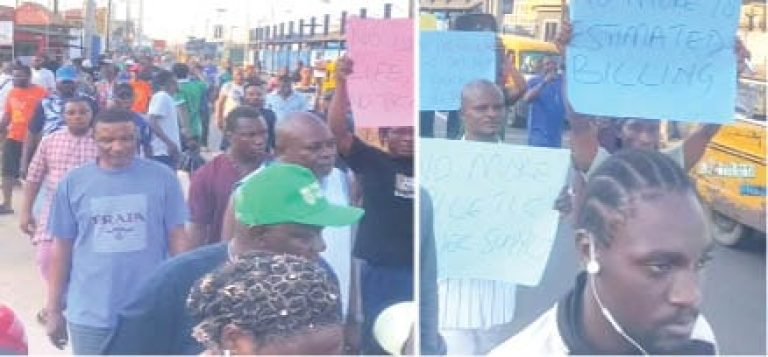
Residents of Fadeyi flocked to the streets yesterday to protest the state’s “epileptic” electrical supply. They were angry about what they called “persistent blackouts.”
They said that even though the power was going out, the company that delivered it still sent them crazy high anticipated bills.
Some of them asked why the DisCos wouldn’t follow the Federal Government’s orders to hand out free meters.
Mrs. Oyinlola, a mother of three who had been having a hard time keeping her family comfortable without power, said that the DisCos were working with generator salesmen and gas station owners to steal their hard-earned money.
“It’s been three weeks now, and it feels like I’m in a different time. “We can’t charge our phones, the food in the fridge is going bad, and the kids are getting restless,” she said.
John Ekanem, who manages a photo studio and business café, said that at night, people in the area set up homemade lanterns, and some of them had bought generators that made a lot of noise.
The power outage is more than just a nuisance for people like Mrs. Oyinlola and Mr. Adeyemi; it disrupts their everyday routines and reminds them how fragile the infrastructure that supports their town is.
A viral video that went around on social media yesterday showed a gathering of demonstrators, mostly young Nigerians, walking through the Fadeyi district of Lagos.
The protesters held signs and chanted to show their anger at what they called the “collapse” of the power sector, which they said was “killing” local companies.
Some of the signs said things like “No more estimated billing,” “No more epileptic power supply,” “No light, no life, no nation,” and “You’re destroying and killing so many businesses; give us regular light.”
One demonstrator could be heard yelling in the video, “We’re not asking for too much.” “Give us light!”
In the same way, there is a lot of tension in the Obadore, Akesan, and Igando neighborhoods of Lagos. Residents have threatened to protest because the area has been without power for months.
The people who live there have said they will march 1,000 people to the head office of Ikeja Electric, the firm that distributes power in the area.
The people who lived there complained about the problems caused by the blackout that lasted more than three months. They said it hurt their businesses, made them less safe, and made their lives harder than they needed to be.
A resident named Shakiru Ojo remarked, “We are tired of living in the dark.” “We pay our bills on time, but Ikeja Electric hasn’t given us the basic service we deserve,” he said.
Dr. Adebola Ademeso, the Chairman of the Electricity Committee and Vice Chairman of the Akesan/Obadore Joint Community Development Association (JCDA), spoke at a press conference in Lagos on Tuesday. He said that they have to let IEKD know how unhappy they are with them because they are treating them like an unimportant community that must live in darkness all the time, even though they are trying to keep a friendly and peaceful relationship.
If there is supply, it won’t last more than 30 minutes or, at most, two hours a week.
“At our last discussion about the project, we all decided that five electric poles would be put up in different places that our community suggested. But sadly, five poles for February have not been put up in March.
“We say no to continuing to pay for darkness. Our 10 main resolutions, which are also requests, are as follows: “We want the November and December 2025 bills to be thrown out and the January 2026 bill to be negotiated,” he stated.
Discos say they’re sorry and blame gas shortages.
Ikeja Electric apologized to consumers in a notice that gave them an update on the power supply problems.
“The current scenario is because of problems with gas supplies that are hurting the national grid. This has caused a big energy shortage, which means that we need to shed more load across all of our feeders.
“We are in touch with all the right people all the time as they work to get generation levels back to normal.”
Eko Electricity Distribution Company (EKEDC) further added, “We completely understand how inconvenient this situation may be and are very grateful for your patience and continued understanding during this time.” Please be assured that all relevant parties are working hard to fix the gas supply problem and get the power back on as soon as possible.
Most of the country is having the same power outage. Just a week ago, artisans and others living in Kano State told Daily Trust that the constant power outages are hurting small businesses and making life harder.
The Kano Electricity Distribution Company (KEDCO) takes care of the power supply in Kano and sections of the North-West. It serves the states of Kano, Katsina, and Jigawa.
Musa Abdullahi, a welder from the Hotoro district of Kano, claimed that he now mostly uses a petrol generator.
“We used to have at least eight to ten hours of power every day before this load shedding got worse.” We can go two days without power now. Every day, I spend between N8,000 and N12,000 on gas. He remarked, “That is eating deep into my profit.”
Aisha Sani, a tailor in Sabon Gari, said that her income had plummeted by almost half in the last two months.
She stated she misses deadlines when there is no energy because she utilizes industrial machines that need stable power.
She said she lost at least five significant orders recently because she couldn’t get them there on time.
People that sell frozen meals and cold drinks are also losing a lot of money. Maryam Ibrahim, who sells frozen chicken and fish at Kurna, said she lost more than N300,000 worth of merchandise after the power went out for 48 hours.
Artisans in Yenagoa complain that rising fuel costs have pushed them to raise their prices, which has led to fewer customers.
Stephen Eddie, who owns a barbershop in Amarata, said he upped his prices from N500 to N800 to cover the cost of running the generator.
Business owners in Kaduna say they have learned to live with unpredictable power by using other sources of energy. Residents claim that even when the light comes back on for a short time, their costs stay high.
The Abuja Electricity Distribution Company (AEDC) said that Nigeria’s power sector is currently facing major problems during the dry season (usually November to April). They also said that they understand how frustrating it is for customers to have limited power.
It also blamed the gas scarcity, saying that hydropower generation frequently reduces this time of year because the water levels in dams are low. Many thermal plants also have less gas because of problems with pipelines, vandalism, and other supply-chain problems.
“These things have caused less overall generation and less power to be sent from the national grid to all Distribution Companies (DisCos), including AEDC.”
About the Author