
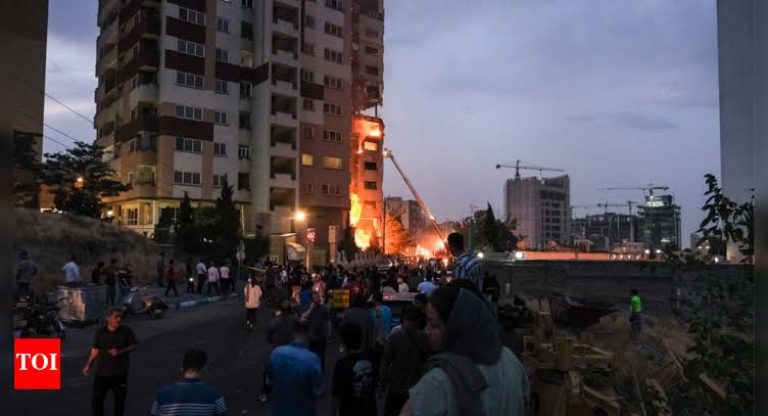
Today, additional strikes shook Iran and a number of Gulf countries. Israel launched a new wave of attacks in a war that has set the Middle East on fire and could sink the world economy.
According to AFP, the war started on February 28 with US and Israeli attacks on Iran. It quickly spread throughout the region, involved major world powers, and caused a significant oil shock.
Today morning, Tehran was shaken by unusually strong explosions. Israel’s military announced it had attacked more than 200 locations in western and central Iran in the last day.
The explosions shook the homes of two of our reporters, who lived many kilometers apart in the north and center of the Iranian capital. Black smoke rose over the city.
Iranians who talked to our reporters anonymously offered a bleak image of life under the bombings, with cities in ruins and money running low.
One 30-year-old lady in Kermanshah, western Iran, told our reporter, “People are desperately trying to get their money out of the banks because they don’t trust them anymore.”
“Now, bread is limited. People are quite angry and tense.
The UN refugee agency says that since the Middle East war started, as many as 3.2 million people have had to leave their homes in Iran.
On March 8, Iran’s health ministry reported that the war has killed more than 1,200 people. Our reporter has not been able to confirm this number on their own.
Iranian state TV showed masses of pro-government protesters in Tehran and other big cities on Quds Day, the last Friday of Ramadan, showing their sympathy for the Palestinian cause.
Protesters brandished Iranian flags and hoisted signs and banners that said “Death to America” and “Death to Israel,” among other things.
Iran’s Revolutionary Guards, which is the country’s military’s ideological wing, said on Friday that any further rallies against the government would be faced with a heavier response than in January, when thousands of people were killed.
“We’re Not Going”
Iran has sent waves of drone and missile attacks on neighboring countries that house US military bases in the area.
The Saudi Arabian defense ministry announced today that its troops had shot down dozens of drones, including one that was headed for the Diplomatic Quarter in the city.
Images showed black smoke over Dubai’s famous skyline after an attack on what was formerly thought to be a safe place in a dangerous area.
State media in Oman say that two people died from drone debris. Early Friday, sirens went off at Turkey’s Incirlik airbase, which is a crucial NATO site where US forces are stationed.
President Emmanuel Macron revealed the death of France’s first soldier in an attack in the Erbil region of Iraq, an indication that the battle was spreading.
Macron didn’t say much about the attack or who was behind it, but the French military stated that drones targeted a camp where troops were training to fight terrorism with Iraqi troops.
A pro-Iranian group in Iraq called Ashab al-Kahf warned that French interests in the area were at risk after a French aircraft carrier arrived, but no one took responsibility for the attack.
A US refueling plane crashed in another part of Iraq, but the US military stated it was “not due to hostile fire or friendly fire.”
Iran’s military, on the other hand, announced in a statement on state TV that an ally group in Iraq had shot down the plane with a missile, killing everyone on board.
Israeli authorities say that a strike on the town of Zarzir in Israel hurt about 60 people. Photos from AFP show burned-out cars and holes in the ground.
The violence has had a big effect on Lebanon. Authorities say that Israeli attacks have killed 687 people, including at least 12 in a hit on Thursday on Beirut’s coastline, where displaced families are sleeping in tents.
Our reporter spoke with Dalal al-Sayed, who said she had set up her tent there after escaping assaults in southern Lebanon. She said her family can’t afford to rent an apartment.
“We won’t leave; we’ll stay here even if we die.”
Pictures from the center of Beirut showed buildings that had been converted into piles of wreckage and burned-out shells of overturned cars, with minor fires still burning after the strikes.
“Bad Empire”
After Iran’s leader promised to block the Strait of Hormuz, a key route for moving energy across the world, the price of crude oil stayed above $100 per barrel.
Since his nomination, Mojtaba Khamenei, who was purportedly hurt in the attack that murdered his father, has not been seen in public. A state television anchor delivered his message demanding for revenge.
The statement claimed that Iran must “definitely use the lever of blocking the Strait of Hormuz,” which means that Iran has effectively closed the canal.
The International Energy Agency says that the war is causing “the largest supply disruption in the history of the global oil market.” This is because energy infrastructure has been targeted in oil-rich Gulf states.
Trump has lifted certain oil sanctions on Russia, which has said that the global energy market “cannot remain stable” without its supplies. This is happening as gas prices throughout the world rise.
Trump added that stopping Iran from getting nuclear weapons and ruining the Middle East and the world was more important than gas costs.
As stock markets around the world fell, experts warned that the suffering would last for a long time.
Matt Weller, head of market analysis at City Index, said, “The default assumption is that stocks will be under pressure, oil prices will go up, and interest rates will go up at the same time as long as the Strait of Hormuz stays closed.”
About the Author