
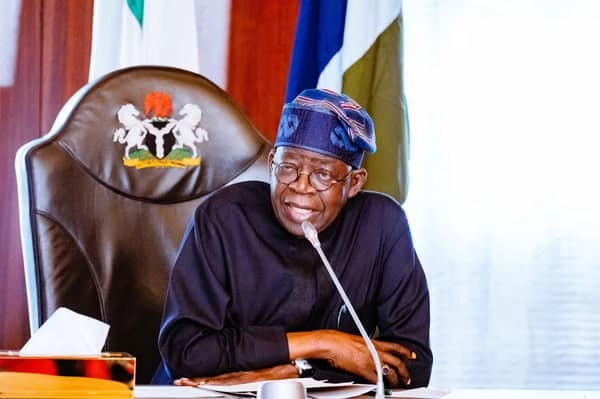
The Independent Media and Policy Initiatives (IMPI) says that President Bola Tinubu turned Nigeria’s economy around by using methods of economic progressivism.
The IMPI, whose Chairman Dr. Omoniyi Akinsiju signed a policy statement that was sent to SINL Nigeria Online, said that this was the greatest approach to get Nigeria off of decades of wastefulness.
It claimed, “Nigeria has had times when public value was low and profligacy was accepted in high offices, just like the USA.”
Before President Bola Ahmed Tinubu’s economic reforms in May 2023, Nigeria’s economy was characterized by a strongly established oligarchy, where a small group of political elites, military officials, and commercial moguls controlled state resources.
“This structure was upheld by a patronage system, especially in the oil industry, which helped a small number of people while most of the population lived in poverty. By 2022, 63% of the population (approximately 133 million people) lived in multidimensional poverty.
“The “pre-reform” economy was made up of a few important oligarchic and structural features: Many members of the oligarchy profited from the gasoline subsidy system, which was said to be full of corruption and utilized as a “feeding bottle” for a small group of people.
“The fact that there were numerous exchange rate windows let “FX subsidy merchants” take advantage of the difference between official and parallel market rates, which hurt the government’s coffers. The petroleum business held a lot of economic power, and only those in authority and their close connections had access to oil earnings.
When Tinubu became president, Nigeria was spending around 97% of its total revenue on paying off its debts. This was called “disastrous.”
“Before the All Progressives Congress (APC) took over the federal government in 2015, we saw the clear destruction of the country’s budgetary substance. This was in addition to the oligarchy’s takeover of the Nigerian state.
“Data reveal that Nigeria’s export profile altered a lot after 2014, going back to a lower range that has stayed the same even though it has recovered from time to time. The largest value of Nigeria’s crude oil and gas exports was $93.89 billion in 2011, which is the highest in the dataset.
“However, we can now say with a lot of confidence that the federal government has really gotten Nigeria out of trouble. The economy is turning around, which is a sign of stability, and the oligarchs no longer have a hold on the country’s economy.
IMPI also pointed out some of the strategies and programs of the Tinubu administration that put the country on the road to economic stability.
“To back up our claim of an ideology-based economic turnaround, we list some of the main weapons of progressivism that the federal government led by President Bola Ahmed Tinubu has used to achieve this goal.
“These include fiscal policy and taxation, redistributive spending, estate and wealth taxes, labor and wealth protection, monetary and financial reforms, infrastructure development, and public investment and ownership,” it stated.
The policy group also talked about how economic progressivism has changed the terrain.
“Allocations from the Federation Account Allocation Committee (FAAC) in 2025 saw a big jump. In the first eleven months, the three levels of government shared over ₦33.27 trillion, which was 30% more than the same time in 2024.
“This surge, which was caused by the end of subsidies and changes to the exchange rate, featured record monthly disbursements, including ₦3.64 trillion in September 2025, which greatly increased subnational revenue.
Inflation is still in the double digits, but it has declined by more than half from a high of 34.6 percent in November 2024 to 15.10 percent in January 2026. This shows that prices have been going down for more than nine months.
“This has mostly brought back real buying power for families and companies, and Nigerians are now enjoying the benefits of the unified currency rate.
In January 2026, Nigeria’s food inflation rate dropped to 8.89 percent year-on-year. This was the first time it had been below 10 percent in 128 months and the lowest level in 174 months. The CPI report for January 2026 reveals that food prices rose by 8.89 percent from January 2025 to January 2026. This is a big drop of 20.73 percentage points over the previous year.
The 8.89 percent reading is the first time since May 2015, when it was 9.78 percent, that food inflation has been less than 10 percent. So, January 2026 marks the end of more than 10 years of food prices rising by more than 10% every year. The January number is also the lowest since August 2011, when food prices rose by 8.66 percent.
The gap between the official and parallel market rates is getting smaller and smaller. As of Tuesday, February 24, 2026, the naira was worth about ₦1,349.24 to the US Dollar in the official market and between ₦1,355 and ₦1,420 in the parallel (black) market.
The policy organization said, “The naira is the second-best performing currency in the world this year, gaining more than 7% against the dollar.”
About the Author