
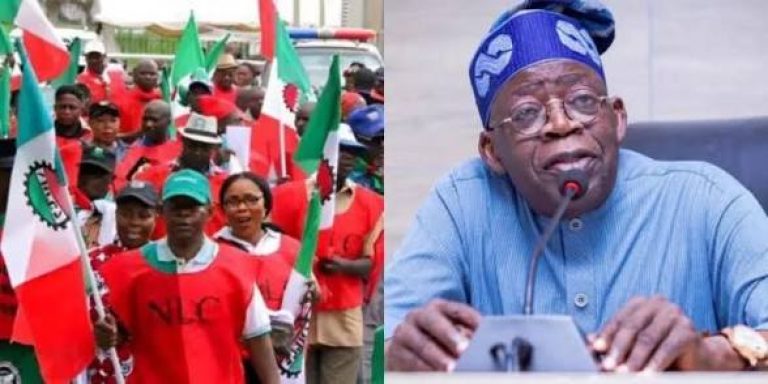
Civil servants under the Trade Union Side of the Joint National Public Service Negotiating Council, JNPSNC, have addressed a letter to President Bola Ahmed Tinubu, urging him to urgently intervene to alleviate rising economic hardship afflicting workers and their dependants.
Workers have demanded that the federal government to stabilise the price of Premium Motor Spirit, PMS, at N500 per litre, approve an urgent Wage Award and upwardly revise pay and allowances across the public service, reports Vanguard.
They also called for the urgent establishment of a commission to negotiate a new National Minimum Wage before January 2027.
In a letter delivered to the president at the State House, Abuja, the workers said the recent hike in petrol prices to N1,430 per litre and above in some places had further worsened the cost-of-living situation.
They warned that the current suffering was building tension among workers and Nigerians and set a deadline for the federal government to act on their demands by Wednesday, September 30, 2026.
The JNPSNC claimed that the elimination of gasoline subsidies three years ago led to exorbitant increases in fuel prices, with multiplier effects on the prices of key items across the economy.
The council said the situation had made life increasingly intolerable for the workers, adding that distribution of food palliatives was not a permanent answer to the economic issue.
“It has dawned on Nigerian workers that the provision of palliatives such as bags of rice, Indomie, vegetable oil, garri, among other edible foods is as good as weaponising Nigerians with poverty because it is a Pyrrhic intervention which is unsustainable, inaccessible to the majority of Nigeria’s population and also limited to political cronies.
The workers said the move would have a multiplier effect on the economy and urged that a more sustainable solution would be to cut the cost of petrol to N500 per litre.
“After the above, it is better that the federal government should bring in an intervention that will trickle down to all Nigerians by making fuel available at an affordable amount as low as N500 (five hundred Naira), the amount at which fuel was being sold when subsidy was first removed in the year 2023,” they said.
Some of the key reasons for their demand for increased remuneration, the council said, include restoration of the workers’ purchasing power, improved productivity and service delivery, promotion of integrity and accountability, and the strengthening of trust and industrial harmony.
The workers said the government should “look inward and stabilise the prices of fuel to affordable minimum” on fuel prices, adding that fuel remained a key commodity with substantial ramifications for the Nigerian economy.
The council said: “As a matter of reality, the current hardship being faced by the hapless Nigerian workers is caused by the astronomical increase in the price of Premium Motor Spirit (PMS) to as much as N1,430.00, or more per one litre (this is a killing amount).
The JNPSNC also advocated for an intervention fund for players in the oil sector to stabilise fuel prices and eventually bring the pump price to N500 per litre.
The council stated the government might use a different descriptor for the action if the phrase “fuel subsidy” was objectionable.
“The fuel intervention fund will provide the opportunity for every Nigerian to benefit from the intervention fund as it will have a multiplier effect in the life of every Nigerian and will naturally trickle down to the downtrodden and all the remotest parts of the country,” the statement said.
The council also supported a stance attributed to Nigeria Labour Congress (NLC) President, Joe Ajaero on the ways to resolve the petroleum issue.
“Nigeria, as an oil producing country, has enough local refining capacity, although this is substantially located in the private sector,” Ajaero was quoted as adding.
He continued: “We as a nation, as a people endowed with enormous fossil resources, deserve a certain level of protection or buffer against the gales from the Gulf and indeed against other gales.”
The council quoted the NLC position which stated that “As part of the process of creating this buffer, government should sell enough crude in Naira to our local refineries; expand our national storage capacity to pursue the meeting of energy emergencies and security. “These measures will create jobs, economic value and also respond to the mutating security challenges.”
“There is nothing wrong with government subsidising the needs of citizens especially during emergency situations like this,” the statement added. “Right now we don’t know of any oil producing country that has not intervened or come up with sustainable palliatives in one way or the other in these perilous times.”
The NLC statement also stated: “The government is earning additional revenue in the international spot market (of between USD35 and 40 per barrel above the budgeted figure). This amounts to trillions of Naira per month.”
‘We are equally worried that domestic refineries are importing crude on a long term basis,’ it continued. This is absurd and unacceptable and defies the logic and purpose of local capacity.
The JNPSNC said it “fully support[s] the submission of NLC leadership” and called on the government to fast track the measures for execution.
On wages the council called for the prompt promulgation of a Wage Award for Federal, State and Local Government employees.
It said: “Wage Award as an urgent intervention and upward review of salaries and allowances of all serving Public Servants in the Nigeria Public Service should be provided with immediate effect to cut across all Federal, State and Local Government workers.
The council said the Wage Award would be a forerunner to the substantial New National Minimum Wage expected to come into effect in January 2027.
The workers also asked the quick setting up of a committee to negotiate the new National Minimum Wage, arguing that early initiation of the process would prevent delays in implementation.
“There is urgent need to immediately set up committee for the negotiation of New National Minimum Wage to accelerate the commencement of the New National Minimum Wage before 2027 so that it can take effect from January, 2027,” the council said.
The JNPSNC proposed that the minimum compensation payable to an officer on Grade Level 01, Step 1, under the 2027 salary pattern should be N500,000 per month.
The council also advocated for harmonisation of wages across Ministries, Departments and Agencies (MDAs), while suggesting that the review be promoted at the State and Local Government levels.
It also urged regular adjustments of salaries and allowances to take into account inflation, and welfare measures like subsidised transport and reasonable housing for civil servants.
Public servants were the “backbone of governance and national development” and the “live wire of any administration,” the council stated. It said that workers were responsible for policy formation, the implementation of government programs and the supply of critical public services.
Rising inflation, gasoline prices, transport costs and the rising cost of food, housing, health care and education have undermined the real worth of workers’ pay, it claimed.
“Many workers are now finding it difficult to meet basic financial obligations and this has inevitably impacted on morale, motivation and overall productivity within the Public Service,” it said.
The JNPSNC urged the President to direct the National Salaries, Incomes and Wages Commission (NSIWC) to commence negotiations with the Nigeria Labour Congress, NLC, Trade Union Congress of Nigeria TUC, JNPSNC and other stakeholders on the Wage Award and upward review of salaries and allowances.
“Your Excellency, we trust that this request will receive the prompt attention and action it deserves in the interest of Nigerian workers and their dependants, the Public Service as an age-long institution and the nation at large on or before Wednesday 30th September, 2026 to douse the palpable tension that may erupt,” the council said.
Also, it hoped the president will use his Independence Day message to address the issues presented by workers.
“Our sincere hope as Nigerian workers and all patriotic Nigerians is that your Independence Day broadcast will take cognisance of our suggestions to bring succour and life back to all dying Nigerians,” the council added.
About the Author