
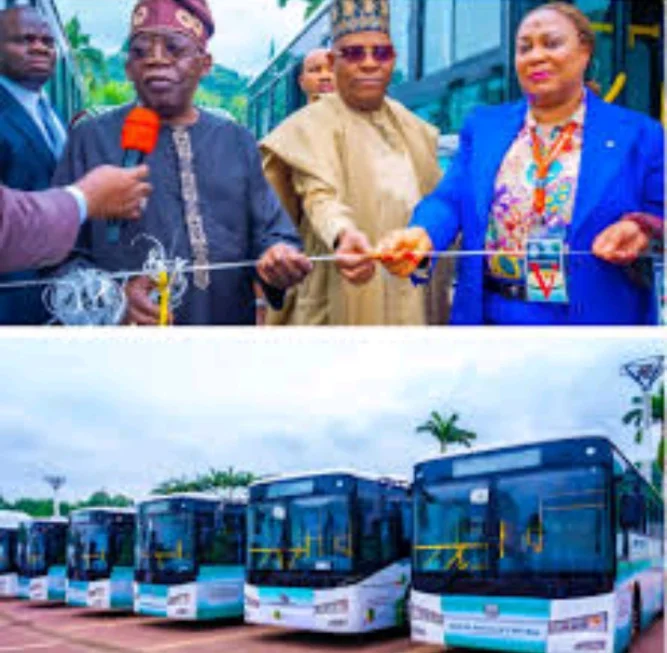
President Bola Tinubu has declared that Nigerians will get to feel tangible drops in transport costs by October 1, 2026 as the deadline for the National Affordable CNG Transit Program but the statement has met with a fierce backlash from citizens who say the relief is not trickling down to their daily commutes.
On Saturday, Tinubu said he met with the 36 state governors on August 27, and they agreed that more Nigerians should begin to witness cheaper transit rates from October.
Later, an implementation committee of the program was constituted under the Nigeria Governors’ Forum and chaired by the Kwara State Governor, AbdulRahman AbdulRazaq.
The President said that the fare reductions previously achieved in seven states and the Federal Capital Territory were between 31 per cent to roughly 83 per cent.
He said the cost of travelling on the Borno State’s CNG and electric public transport services ranged between N50 and N100 on routes where commercial carriers charge N300 to N600.
CNG buses deployed to Pacesetter Transport in Oyo State have brought down Lagos-Ibadan fare from N8,000 to N3,200 while 100 CNG buses in Enugu have brought down the Enugu-Nsukka ticket from N2,500 to N1,500.
Abuja has a cooperation with the National Union of Road Transport Workers which has allowed passengers of CNG-converted cars to enjoy 40 percent ticket reduction on some routes.
“These aren’t predictions. “Nigerians are already enjoying these savings,” stated Tinubu.
In the last three years, the President noted, more than 120,000 vehicles have been converted to CNG, with over 400 recognised conversion centers and more than 90 refuelling stations across the country.
He dismissed requests to revert to the petrol subsidy regime which he said “consumed trillions of naira and left our economy open to every movement in international oil prices”.
But the response from Nigerians online was quick and strongly sceptical. Auwal M. Haruna questioned the president’s words asking “What manner of speech is this?”
“Is that a normal person talking?” Sani Abdullahi Tanko said in surprise. Steeve Taylor just enquired, “Where in Nigeria?”.
“We can solve this at the polling unit in January,” said Muhammad Bello Adamu, a political call to action, referring to the 2027 presidential election.
A user on Nairaland said: “That nonsense that you and your president will amount to nothing. “You tell me how you will make transport cheap from Delta to River State or to Benin.
Economist Dr Marcel Okeke criticised the October 1 deadline, saying there is no “magic” that can make the directive happen without extra financing.
“I don’t know what magic they are going to perform but you know the presidential election campaign has started,” Okeke stated.
He said that while state governors were getting more money from the Federation Account, the gain had been wiped out by the crash in the naira’s value, with cement going from N3,000-N4,000 per 50kg bag in May 2023 to N12,000-N15,000 currently.
BusinessDay said it was concerned at the short notice between the announcement and the scheduled date and that the membership, responsibilities, funding arrangements and implementation timetable for the joint federal-state committee have not been clearly spelt out.
That is well under one percent of the national fleet, with roughly 120,000 vehicles converted versus Nigeria’s estimated 21 million registered vehicles, the outlet said.
Nigeria can’t control international oil markets but may limit its risk by using domestic petrol as global energy crises renew pressure on petrol and diesel prices, Tinubu said. Our approach at a time like this cannot be to return to the catastrophic petrol subsidy regime,’ he said.
About the Author