

Victor Umeh, the Senator representing Anambra Central, has described the view that the Nigeria Democratic Congress (NDC) presidential candidate, Peter Obi, is largely rejected in the north ahead of the 2027 election as “make-believe” and “propaganda”.
Umeh, a major backer of Obi’s presidential bid, said the former Anambra State governor has shown in the 2023 election that he can get votes outside the Southeast and will be able to grow his support base in the North in the next election.
In an appearance on Channels Television last nite, the senator reacted to worries over Obi’s acceptability in northern Nigeria, an area generally considered crucial to any presidential contender hoping to obtain the countrywide spread required to win the presidency.
“No, he is accepted. Peter Obi is feared by many. That is a make-believe, it is a propaganda,” Umeh said.
He cited Obi’s showing in the 2023 presidential elections, saying the results proved the former Labour Party candidate could get major support beyond his core constituency.
“He got good votes in Adamawa State, he got good votes in other parts of the North in 2023,” he said.
The final results of the 2023 presidential election showed that Obi scored 6,101,533 votes, which was 25.4 per cent of the total votes cast.
He won 11 states and the Federal Capital Territory and scored at least 25 per cent of the votes in 16 states and the FCT.
Umeh said the political environment has altered since then, particularly among young Nigerians, whom he claimed were increasingly questioning conventional party affiliations.
He said: “The youths who own Nigeria and tomorrow’s Nigeria have seen that they cannot continue to live with the prejudices and misdirection of their leaders in the past because the things that have happened in the past have not helped them.”
“It is on the basis of his programs and policies that Obi’s campaign should be judged not on ethnic or regional considerations,” the senator said.
“No One Should Feel Intimidated”
The Anambra senator said there should be an atmosphere where political candidates are able to openly campaign in all parts of the country, saying Nigerians should be given the chance to hear differing opinions before making their decisions at the polls.
We want to be able to sell through to the voting public this interchange of ideas and the policies and programs we want to put in place. “No one should be scared,” he remarked.
His words come days after Obi’s vehicle was blocked while on a visit to Benue State where the NDC presidential candidate had planned to visit Yelewata to mourn with families affected by the 2025 killings.
Some youths stopped Obi’s convoy near the Makurdi-Gboko federal route on September 8. The Benue State Government disowned the act. The state police command later announced it had detained 46 persons allegedly involved to the obstruction.
Umeh criticised the incident, saying political players should not be stopped from moving freely or seeking support anywhere in the country.
He also warned that the 2027 election should not be permitted to replicate the controversies that dogged the 2023 presidential elections.
The senator appealed for “a more transparent, credible, free and fair electoral process,” adding that Nigerians still have concerns about the integrity of polls and the conditions surrounding the 2023 exercise.
He called on the Independent National Electoral Commission (INEC) to cut down on its dependence on ad hoc staff and establish a corps of permanent and well-trained election officials.
Umeh also urged punishment of electoral criminals, adding that those who subvert the democratic process must be punished.
He advised Nigerians against the abuse of artificial intelligence in the 2027 poll, stressing that INEC must first explain the challenges that hampered the 2023 election.
The senator stated the result of a genuinely free and fair election in 2027 could not be predicted in advance and called on political parties and their supporters to let voters decide freely without intimidation.
“It’s not all way out,” he remarked, reflecting on Obi’s performance in 2023 and the prospect of a better showing in 2027.
Obi’s Quest For Northern Backing
Obi, however, has always worked to dispel the notion that his political support base is predominantly based in the Southeast.
In July 2025, the former governor of Anambra State, while speaking on Channels Television’s Sunday Politics, called for Nigerians to look beyond ethnicity and religion when electing their leaders but to consider ability.
“We have voted for incompetence, we’ve voted for tribe, (and) we’ve voted for religion, let’s vote for competence,” Obi remarked.
The presidential aspirant noted that northern Nigeria has huge economic potentials notably in agriculture, and promised to fight insecurity and unleash the region’s productive capacity in his administration.
“I want them to believe in me. The country’s best resource is in the north, the uncultivated areas in the north. I’ll deal with the criminality we have in the north today
“If I’m president, the North will drink to me. “I have an idea of the problem,” he continued.
Obi has also recently asked Nigerians to engage fully in the 2027 election and ensure their votes are protected from the polling unit to the collation process.
The focus on the North is politically important because the region continues to be a critical part of Nigeria’s electoral map. Winning nationwide requires a presidential candidate to develop support across geography and politics, and northern voters are going to be a significant constituency in 2027.
Obi earned national recognition during the 2023 presidential race, creating a solid base, especially among Nigerian youngsters, with his platform of fiscal austerity, accountability and sustainable development.
Obi, who contested the 2023 presidential election on the platform of the Labour Party, is fighting for the presidency for the second time, this time, on the platform of the Nigeria Democratic Congress (NDC).
Obi was ratified as the presidential candidate of the NDC at its special convention held in Abuja on May 30, 2026, with former Kano State Governor Rabiu Kwankwaso as his running mate.
Given Kwankwaso’s political base and influence in Kano and parts of the North, the move has added a major northern dimension to Obi’s 2027 campaign.
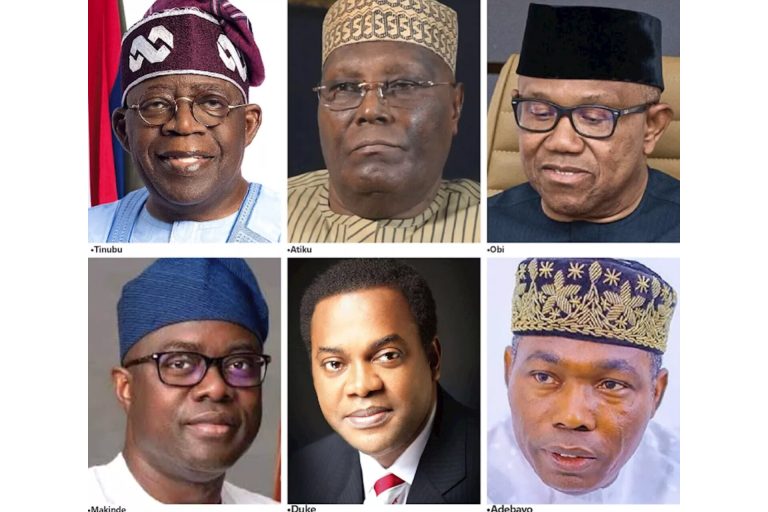
Obi came third in the 2023 presidential election behind Bola Tinubu of the All Progressives Congress and Atiku Abubakar of the Peoples Democratic Party.
Tinubu got 8,794,726 votes, Atiku got 6,984,520 and Obi got 6,101,533 votes.
Obi and the Labour Party took the result to court, saying the election was rigged. The petition was struck out by the Presidential Election Petition Court in September 2023 and Tinubu’s victory was later affirmed by the Supreme Court.
But the political landscape has shifted quite a little for 2027.
Obi is now contesting for president on the platform of the NDC with Kwankwaso as his running mate, while Atiku is gunning for the presidency for the seventh time on the platform of the African Democratic Congress (ADC).
President Tinubu is also seeking a second term in the country’s top office.
A total of 21 political parties registered but INEC has officially cleared candidates of 19 parties to contest the presidential election.
And with presidential and National Assembly elections set for January 16, 2027, the battle for northern support is likely to be essential to the campaigns.
About the Author