
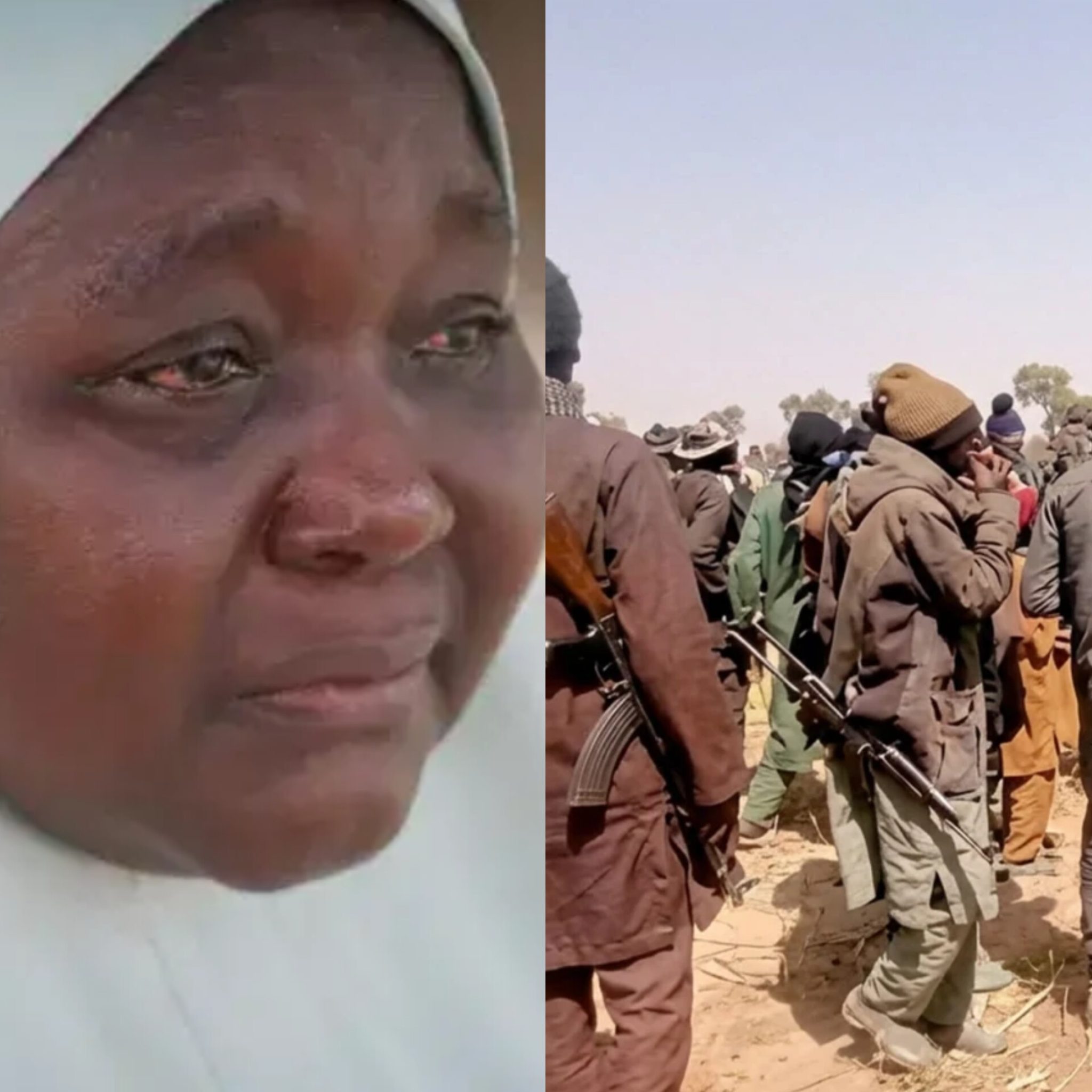
“We are always left with the grim choice of being shot if we flee or abducted if we stay,” Fatima, a 55-year old woman, has narrated the horror of bandit raids in Zamfara State.
“An entire village near here has been deserted,” she claimed. There’s not even a chicken left there,” she said.
Fatima, who spoke to the BBC Hausa service, claimed the bandits assaulted her hamlet at 2am, dividing themselves into three groups to successfully encircle the village.
“One group positioned themselves at the entrance of the village, another entered the community, while the third positioned themselves behind the village to prevent residents from escaping,” she said.
“They set the room on fire if you run into a room, and if you come out and try to run, they shoot you,” she claimed.
They fired without mercy, fired at random.
Fatima added that the assailants occasionally come in their hundreds, estimating that up to 100 motorcycles can be observed in an attack, each carrying roughly three persons.
She said roughly 70 people, including children, were killed in the village of Bia Buki in June.
She said six of her seven siblings, including her husband, were among the dead.
Some children had been hurt trying to flee through the jungle and had fallen into holes, she said.
After the attack, Fatima said, she ran with other residents and their children into a neighbouring woodland, which became their sanctuary.
“The woods were our refuge. We took the kids for a run. “If you couldn’t find your own child, you took your neighbour’s child,” she claimed.
Fatima now lives with her seven children aged between nine and 30 years in a makeshift camp in Gusau, the state capital, where the displaced citizens eventually arrived.
Conditions at the camp were extremely difficult with hardly adequate shelter, insufficient food and occasional support, she said.
“We were rich when it was peace but things changed and we became beggars,” she cried.
Sometimes children who were relocated were dispatched to pick firewood to sell to get money to buy food but 22 of the youngsters involved were allegedly taken by bandits,” Fatima said.
She said the danger of bandit attacks still lingers, despite the camp being around 25 miles away from her home community.
“When I came to the camp at first, the sound of gunfire at nite kept me awake,” she claimed.
She said there had been a modest improvement in security from patrols by military and government-backed vigilantes but residents still lived in fear.
The BBC article says Fatima was among an estimated 800,000 people displaced by the insurgency in north-western Nigeria, with violence and insecurity being among the key reasons for the displacement.
In regions of the Northwest, banditry has become a major security concern as armed groups regularly utilise motorcycles to start attacks on villages and highways before fleeing before security authorities reach.
The assailants are also suspected of taking citizens hostage for ransom, robbing towns and taxing farmers before they can access their farms.
In other locations, residents are forced to hand over enormous quantities of money to armed organisations, giving criminals de facto control over villages.
Data provided by the BBC suggested that attacks in Nigeria’s Northwest have grown dramatically this year.
Attacks in the Northwest climbed 78% in the first half of 2026 compared with the same time last year, according to the Armed Conflict Location & Event Data project, ACLED.
SBM Intelligence also anticipated that 7,825 persons were kidnaped between July 2025 and June 2026, a 66 per cent increase from the previous year.
The organization also said kidnappers collected nearly N7.8 billion in ransom over the period.
“There is no part of northern Nigeria that is fully free from large-scale kidnapping at the moment,” said Malik Samuel of Good Governance Africa.
“There is no place in northern Nigeria where there is no mass kidnapping going on at this time,” he claimed.
The worsening security situation has also forced thousands of Zamfara citizens to join government-backed vigilante organisations to augment the traditional security services.
But fears remain about the growth of armed gangs of vigilantes and the difficulty of disarming them after the security crisis.
Samuel said the situation was a “time bomb waiting to explode”, asking how authorities would govern the armed groups once the current battle is over.
One member of the vigilante groups, who spoke on condition of anonymity, said the state government had recruited the organization to safeguard villages.
Sometimes the vigilantes were tipped off to the whereabouts of bandits and would confront them, he claimed.
“With God’s help, we fight them and defeat them,” he added, adding he had fought bandits in at least 20 gunbattles.
He added the vigilantes continued to receive calls from communities whenever they came under attack.
Abducting people has been on the increase in sections of Nigeria outside Zamfara, where the government is still battling terrorism in the Northeast, separatist unrest in the Southeast and communal disputes in parts of the Middle Belt.
And schools have also been targets of kidnappers.
The trend garnered widespread notice in 2014 when Boko Haram kidnaped more than 200 schoolgirls from Chibok in Borno State. Bandits have attacked schools multiple times since then, kidnapping pupils and instructors.
Security personnel and vigilante groups were deployed but Fatima said she was not sure if she was going home.
She said she heard that bandits had set up a base in her hamlet and that one of their leaders had become a de facto authority in the area, with families occasionally making their way to him to settle domestic problems.
Some adjacent communities were left totally vacant, she claimed.
The surrounding village has been virtually deserted. “There’s not even a chicken left there,” she remarked.
Fatima said that coming back without enough protection would mean more suffering for the residents.
“Come back, and you will find nothing but trouble. Nothing there. No food. “You farm but when it’s time to harvest, they deny you from harvesting or they abduct you,” she claimed.
The desire to return home still runs strong for Fatima, but fear of further attacks has kept her and thousands of other displaced Nigerians from their villages.
About the Author