

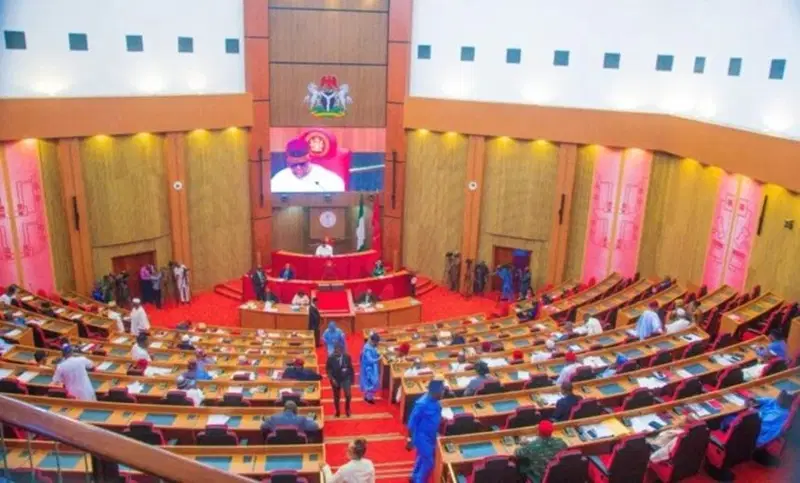
The Senate said the Federal Capital Territory, Abuja was not included in the proposed state police setup because it has no governor or State House of Assembly. State
The Senate said the FCT remains directly under the administration of the federal government.
Chairman of the Senate Committee on Media and Publicity, Yemi Adaramodu, yesterday explained the development to our reporter yesterday, amid questioning why FCT was not included in the constitutional framework for the establishment of state police, reports Saturday PUNCH.
“The administrative structure of the FCT is quite different from that of the 36 states. The FCT is headed by a minister who operates under the Federal Executive Council,” Adaramodu stated.
“The National Assembly is constitutionally empowered to legislate on matters affecting the FCT as opposed to the states that have governors and Houses of Assembly,’’ the Ekiti lawmaker said.
“I have heard a lot of people asking a lot of questions on why the Federal Capital Territory is not in the plan for state police. The FCT problem is not the same. It is under Federal Government.
Again, the FCT does not have a governor. It is headed by a minister who is a member of the Federal Executive Council. The FCT gets its directions and its administrative importance from this FEC. The Government
“Thus there is no assembly in the federal capital. The FCT is legislated for by the National Assembly. And that’s why it cannot be otherwise than what the Federal Government does.” “Therefore the federal police are in charge.”
The clarification is coming as the Federal Government is trying to put in place a new policing architecture following increasing requests for the decentralisation of policing and constitutional backing of state police.
The presidency said President Bola Tinubu was due to receive the draft Executive National Policing Bill on September 3 as part of attempts to restructure the country’s police system.
This was announced by the Chief of Staff to the President and Chairman of the Presidential Working Group on the National Policing Bill, Mr Femi Gbajabiamila, during the group’s meeting at the Presidential Villa, Abuja.
He also established a webpage for public information thru which Nigerians can send memoranda and position papers to influence the proposed legislation before it is sent to the President and eventually transmitted to the National Assembly. Africans and the Diaspora
The legal underpinning for state police is provided by the constitutional amendment while the Executive Bill is expected to provide the operational framework for the implementation of the new policing architecture.
But the new structure has sparked discussion about the funding and administration of state police.
The constitutional modifications would empower the state Houses of Assembly to pass laws on the establishment, organization, administration, funding and control of state police.
The framework would make the states the primary source of finance but would also allow for federal grants or help.
Section 216 A. The federal government shall, on the recommendations of the National Police Council and with the agreement of the National Assembly, make grants or help to the state police.
But the provision does not provide a minimum federal contribution, budget formula or guaranteed cash stream for state police.
The structure would see states expected to bear the main financial burden for their police forces, but access to federal help would be dependent on a recommendation by the National Police Council and subsequent acceptance by the National Assembly.
The National Police Council, chaired by the president and including other senior federal and state officials, represents the potential for the proposed funding mechanism to become a significant element of the interaction between state governments and the federal government once the new policing system is in place.
But the FCT would be excluded from such arrangement under the current constitutional arrangement, Adaramodu said. This is because the territory is under the direct administration of the Federal Government and does not have the institutional structures of a state.
Since the planned state police framework is anticipated to go thru more harmonisation and legislative processes, the question of how policing would work in the FCT is likely to remain related to the territory’s distinctive constitutional and administrative position.
About the Author