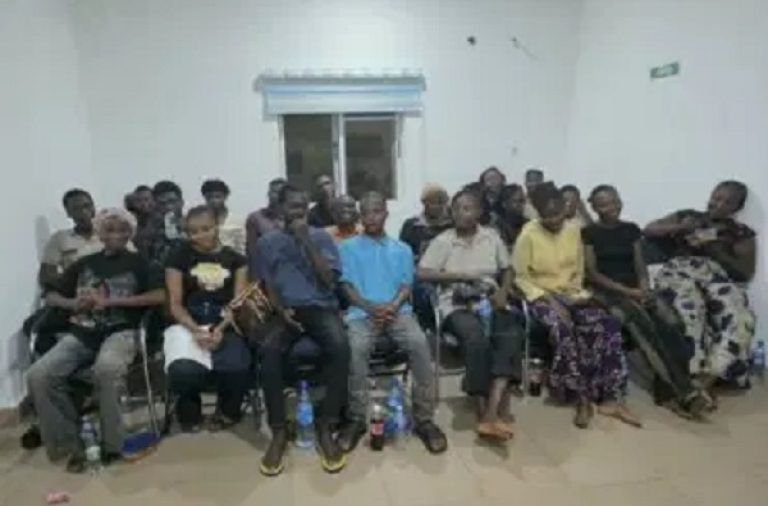

Another school was attacked days after security forces freed 39 students and seven instructors from Oriire, Oyo State.
According to Sunday Vanguard, armed men attacked Government Secondary School, Olowa in Dekina LGA of Kogi State on July 14 as pupils were taking the NECO exam.
They fled with two pupils, the principal, and a NECO ad hoc official.
The event raised concerns about another long-term school kidnapping.
Before those anxieties could grow, the Kogi State government stated on Thursday that all victims had been rescued and reunited with security services for debriefing and medical treatment.
The news relieved relatives and bolstered calls for intelligence-driven rescues. But it also showed a terrible truth.
While the Oyo and Kogi victims have been released, hundreds of Nigerians are still held in jungles and kidnappers’ camps, some for over five months.
Our correspondent found at least 529 Nigerians seized in eight major kidnapping episodes remaining in captivity based on newspaper reporting, community records, and civil society documents.
Schoolchildren, worshippers, farmers, traditional leaders, villagers, commuters, and security officers have not been released despite nationwide military operations.
Only February–July 2026 unresolved cases are included.
It eliminates isolated kidnappings, victims whose families avoided exposure while negotiating ransom payments, and many unreported occurrences.
Security experts and CSOs fear there are many more Nigerians in captivity.
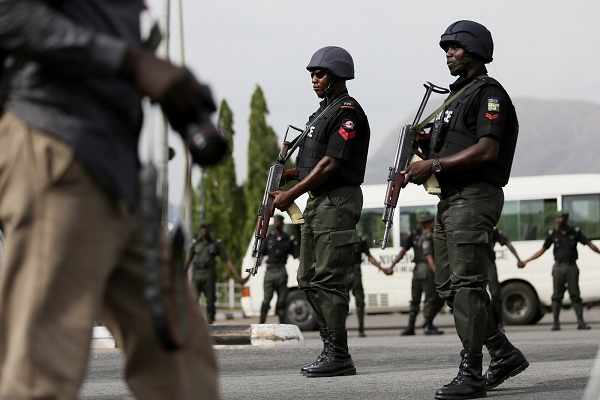
DHQ: 1,764 saved in six months
The latest discoveries coincide with increased military rescue operations.
DHQ reported that between January and June, troops rescued 1,764 kidnapped and abducted people in several theatres.
A military monthly analysis reveals 284 victims rescued in January, 450 in February, 79 in March, 188 in April, 221 in May, and 542 in June.
The numbers show that military actions against terrorists, bandits, and other criminals are accelerating.
But they also show another troubling tendency.
New hostages are abducted even though security authorities rescued hundreds.
The Oriire schoolchildren’s rescue and the four Kogi victims’ speedy release show that coordinated intelligence and rapid response work.
Despite those gains, security specialists say the abduction networks in many parts of the country remain strong.
Three recently discharged soldiers from Zaria to Zamfara State were kidnapped hours after the Kogi school attack and demanded N50 million.
The incident reminded us that kidnapping is no longer limited to schoolchildren, commuters, and rural areas.
Armed forces personnel are increasingly targeted.
Months of waiting
The largest unsolved case seen by our correspondent concerns 176 Woro residents in Kaiama LGA, Kwara State.
After a huge raid on the agrarian settlement earlier this year, the villagers had been kept for over five months, marking them the country’s longest-held kidnap victims.
Community leaders say many afflicted families have spent all their funds, sold cattle, and stopped farming while trying to free their loved ones.
Extended cases have also occurred in Kaduna State.
More than 80 days after gunmen attacked Easter congregations in Ariko town, 37 Christians are still being held by their abductors, according to the Kaduna State CAN branch.
Another 11 Awon residents have been held for over two months. Family members say repeated security agency appeals have generated little information on their whereabouts, causing weeks of worry and emotional suffering.
Kids in captivity
The liberation of the Oriire students has been highly lauded, but another set of schoolchildren remains captive.
Since the school attack, 42 children, mostly between two and 14, have been kidnapped in Mussa community, Askira-Uba LGA, Borno State.
Education experts warn that extended imprisonment at such young ages could cause psychological damage and discourage school attendance in vulnerable areas.
Zamfara’s constant nightmare
Zamfara may best demonstrate Nigeria’s kidnapping crisis.
After armed men raided Kurfa Danya and Magaji villages months ago, 150 women and children are missing.
Another 92 Anka and Tsafe LGA residents have not been released.
An attack on commuters on the Abuja-Sokoto motorway left 18 passengers missing.
The latest abduction of three young soldiers heading to Zamfara raises concerns that criminal groups are targeting civilians and security personnel.
The recent kidnapping of the three soldiers and the unresolved cases in Kwara, Kaduna, Borno, and Zamfara leave at least 529 Nigerians in limbo.
Number likely far higher
Our journalist found 529 unresolved cases, but security experts and CSOs say the number of Nigerians kidnapped is much higher.
More than 1,100 people were abducted in northern Nigeria between January and April 2026, according to Amnesty International Nigeria. Kidnapping has spread rapidly across the country.
A coalition of civil society organisations estimates that at least seven states may hold over 7,000 Nigerians in jungles, kidnappers’ camps, and insurgent-controlled territory.
These figures include victims who never made headlines, highway travellers abducted, farmers kidnapped, rural residents, and families who negotiate ransom without contacting security services or the media.
Lack of a national kidnap database makes it hard to estimate the number of Nigerians in captivity. Many victims disappear from public view as media interest diminishes, leaving their relatives to hunt with little official rescue information.
The afflicted families see the numbers as more than statistics.
In Woro community, relatives of the 176 villagers kidnapped this year have spent months searching for information.
Some families have sold farmlands, cattle and other valuables to earn ransom, while others say they have heard nothing from the abductors for weeks.
The relatives of the 37 Easter Sunday attack victims in Ariko, Kaduna State, are counting the days since their kidnapping.
Community leaders say many families have depleted emotional and financial resources waiting for news that may never arrive.
Parents of the 42 abducted students from Mussa, Borno State, suffer differently. Most of the youngsters are between two and 14 years old, therefore psychologists and education advocates worry that extended confinement could leave lasting emotional scars.
Repeated attacks have traumatised people across Zamfara, forcing many to forgo farming, close local markets, and relocate to adjacent towns for safety.
Why kidnappings continue
Sam Otoboeze, a security analyst and kidnap incident management specialist, blames policy direction and political commitment for mass kidnappings.
He said Nigeria has the technology to track and rescue many victims but hasn’t used it.
“The problem is not entirely with security agents. Kidnapping politics. He said federal and state officials must invest in technology and integrate it with response teams.
Otoboeze wondered how big numbers of abducted victims, especially youngsters, could stay in kidnappers’ camps for months without detection by technology and intelligence.
It’s hard to envision youngsters being in kidnappers’ camps without technology to track them. Nigerians seem to misunderstand situations, he remarked.
“Government support and clear directives are essential for security agencies to function. Government must make the right investments and policies to stop this threat.”
He advised against letting politics overshadow national security.
Attacks on schools and disadvantaged populations appear to be rising as political activities ramp up before the next elections. Government must prevent politics from compromising citizen safety, he said.
Coordination crisis
Alfred Ononugbo, a forensic and criminal intelligence specialist, feels Nigeria’s biggest problem is poor stakeholder cooperation.
“Every Nigerian should be concerned because only collective action will solve this problem. Although non-state entities are organised, our institutions generally work alone. He claimed that lack of coordination allows criminal gangs to carry out successful strikes.
Ononugbo said the Oyo students’ and Kogi victims’ rescues showed that intelligence-led operations may work when coordinated.
He believes the Kogi victims’ timely rescue should restore public faith and show what security forces can do.
Security agencies can succeed with technology, intelligence, and coordinated engagement, as shown by Oyo and Kogi rescue operations. The challenge is applying the same dedication to the hundreds of other Nigerians still held.”
He warned that the recent abduction of three troops travelling to Zamfara shows criminal networks’ resilience.
If the intelligence-driven methodology utilised in those rescue operations is continuously used to kidnapping hotspots, we should see similar results. Otherwise, the public will doubt security services’ capabilities.”
Human cost
Long-term imprisonment has a huge human cost beyond statistics and security briefings.
Residents of Kwara, Kaduna, and Zamfara have avoided farms, forests, and distant settlements where kidnappers operate, slowing economic activity.
Despite recent rescues, parents worry sending their kids to school.
Churches, mosques, and community meetings are now more secure, and travellers often change routes or postpone trips out of fear of abduction.
Also heavy is the emotional strain.
Abducted families live from phone call to phone, praying for rescue but fearing further ransom demands. After failing to release loved ones, many have spent their life savings, borrowed extensively, or sold property.
Analysts warn that prolonged confinement allows kidnapping syndicates to negotiate ransoms, shift captives, and expand their operations.
They see the 529 unresolved cases as proof of a nationwide kidnapping economy.
They suggest that the government must dismantle the criminal networks, finance mechanisms, and intelligence systems that have made kidnapping one of Nigeria’s most profitable organised crimes.
Not one rescue is enough.
The successful rescue of the Oyo pupils and Kogi victims shows what security agencies can do when intelligence, coordination, and politicians work together, according to RULAAC Executive Director Okechukwu Nwanguma.
Successful rescues in Oyo and Kogi are encouraging. They show that security organisations can succeed with coordination, intelligence, and political will. He added that they should not be taken as the end of the story but as a reminder of the work ahead.
He said celebrations of the rescues should not overshadow the hundreds of Nigerians languishing in captivity across the country.
Security agencies must now work harder to free all remaining Nigerians. The severity of the problem is shown by reports that hundreds or thousands are still held. Every kidnapped individual requires the same urgency and commitment, regardless of where they were kidnapped or media coverage.
Take down criminal infrastructure
Nwanguma stated that solo rescue efforts would not eliminate the kidnapping problem unless the government dismantled its criminal infrastructure.
He advocated better intelligence gathering, security agency collaboration, disrupting bandit finance and logistics, and protecting schools, highways, and vulnerable rural villages.
The rights advocate also called for thorough medical, mental, and economic care for survivors after their release, adding that many are traumatised and unable to return to normal life.
He also pushed for a national kidnap database to help authorities find missing people, educate relatives, and promote rescue openness.
He said “success should not be measured only by high-profile rescues but by the government’s ability to prevent kidnappings and ensure that every victim is safely reunited with their family.”
Unsettling national reality
Conflict Adviser at CISLAC, Mr. Salaudeen Hashim, said the recovery of the Oyo and Kogi victims should give optimism but also highlight Nigeria’s kidnapping crisis.
He said, “The schoolchildren’s rescue is a major victory, but it also highlights a troubling national reality.” Hundreds of Nigerians are held at various locations. Some high-profile rescues garner national attention, while many casualties linger in forests, bandit enclaves, and insurgent terrain with minimal public notice.
One of the most concerning themes, according to Hashim, was victims’ increasing imprisonment.
More victims are held for weeks, months, even years. Long-term imprisonment burdens victims and their family physically, psychologically, and economically.
He said Nigeria’s anti-kidnapping program is measured by its ability to permanently dismantle kidnapping networks, not rescue operations.
He highlighted that Nigeria’s security forces’ success will depend on the thorough destruction of kidnapping networks, the safe return of those still detained, and a continuous decline in abductions nationally.
“Until then, every rescue should give hope and remind us that many Nigerians are still waiting to return.”
Missing national database
Security experts and CSOs have frequently called for a national kidnap database. Nigeria has no publicly available mechanism for tracking abducted, rescued, released, or missing hostages, unlike other countries.
Since media coverage fades, many victims disappear from public view, making it hard to assess the country’s kidnapping epidemic.
Our correspondent determined that the 529 people remaining in custody are those victims whose incarceration could be verified by press reporting, community records, and civil society documents.
Numerous isolated kidnappings, victims whose families shun publicity while negotiating ransom, and insurgent organisations holding people in distant North East areas where independent verification is difficult are excluded from the statistic.
Analysts believe the number of Nigerians in jungles and kidnappers’ camps may be much greater than reported.
About the Author