
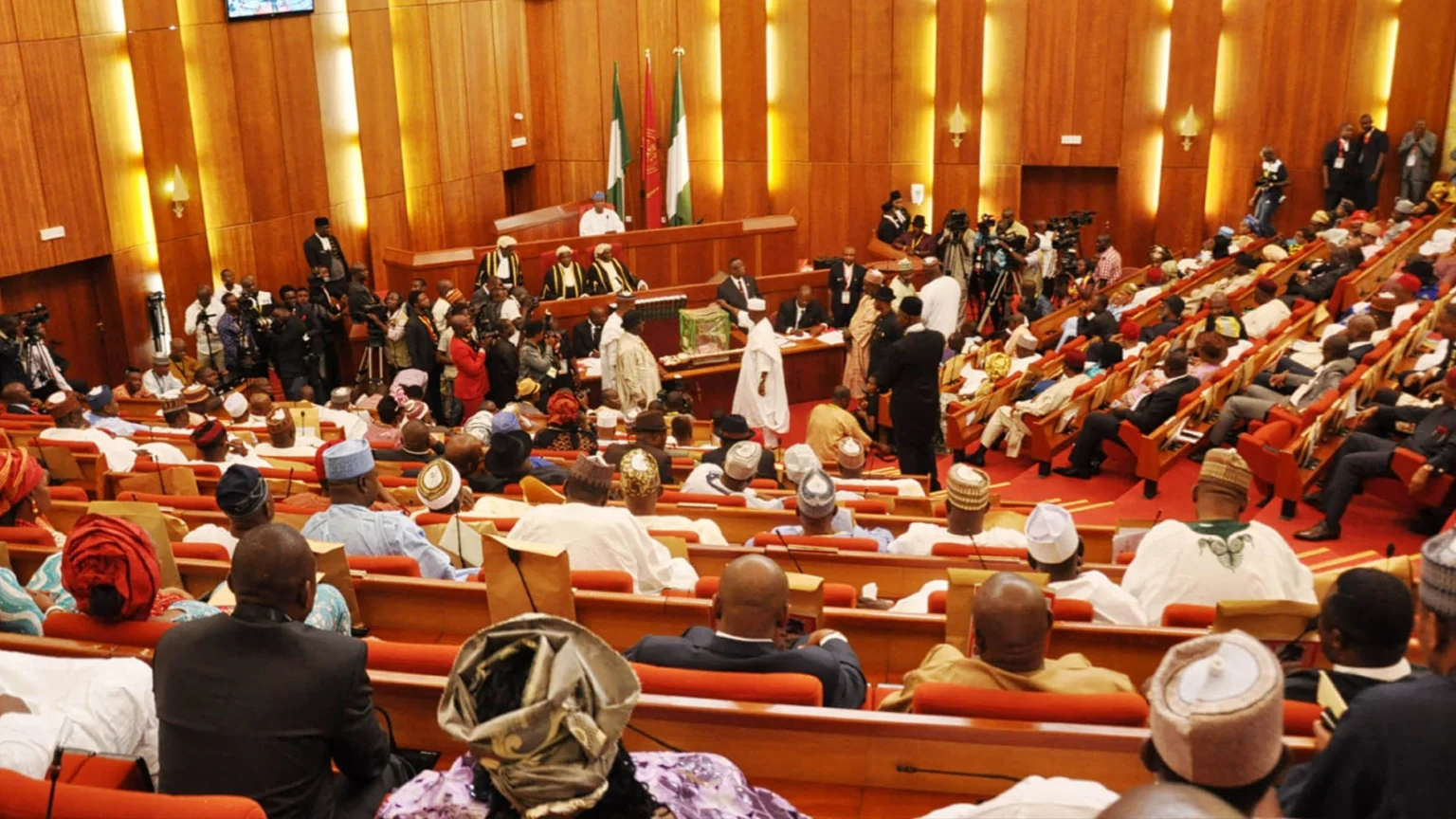
A single term for the president and state governors would be considered by the 11th Senate, Senate Leader, Opeyemi Bamidele, stated on the floor of the Senate yesterday.
He also defended the National Assembly’s rejection of a motion to pursue a new investigation into military spending in the war against terrorism while announcing plans for massive constitutional and governance reforms, including the creation of state police.
According to The Guardian, the Aare Ona Kakanfo of Yorubaland, Iba Gani Adams, also called on President Bola Tinubu and the National Assembly to swiftly adopt a framework for the establishment of state police as part of measures to bolster the nation’s security architecture.
Meanwhile, the Open Alliance, a coalition of civil society organisations has urged for increased attention to accountability, transparency, human rights protections and citizen involvement in continuing debates around the proposed devolution of policing in Nigeria.
Bamidele said the objective of suggesting a single term of six years for the President and the governors is to make them put in their best from the moment they are voted in.
He said, “Now I understand why one of the first set of bills that I look forward to moving by God’s grace when we come back for the 11th Senate is for a bill that will only make it possible for anyone who wants to be President of this country or governor in any state of this country to spend only one tenure of six years.
So you don’t have to worry about spending about a year and a half of your first term worrying and suffering and looking ahead to how you will be re-elected. “If you know you’re there for six years, only one tenure, you give your best from day one.” you realise this is all the chance you get.”
The Senate Leader also stoutly defended the 10th Senate from the toga of a rubber-stamp legislature, insisting the upper chamber intentionally chose the path of constructive engagement with the executive to address Nigeria’s economic and governance challenges, rather than seeking public confrontations.
Speaking in Abuja during an interactive session with journalists to mark the 3rd anniversary of the 10th Senate, Bamidele said many of the disagreements between the National Assembly and President Bola Tinubu’s administration were resolved behind the scenes in the interest of the country. “To me, true legislative independence cannot be measured by quarrels in public.
He said the collaborative approach of the Senate allowed for significant reforms including the passage of tax reform legislation and interventions on appointments and policy ideas before they reached the chamber floor.
For the past three years we have been working in tandem with the executive branch of government. Some of our coworkers were called rubber stamps for doing this. “But let me be clear, we knew we weren’t a rubber-stamp Senate,” he continued.
“Having a public probe against the military at a time when the country is fighting a war against terrorism would weaken national security efforts,” the Senate Leader said.
“Our service men and women are doing their best in incredibly difficult circumstances,” he said, adding that existing legislative oversight systems already ensure accountability for military expenditures without endangering critical security activities.
Bamidele said Senate committees on defence, army, navy and air force should constantly check budgets, audit military procurements and monitor spending.
He said he was confident that security authorities were achieving notable wins against terrorists and criminal groups, despite the increase in insecurity in sections of the country.
Adams reiterated his call for the creation of state and local council police to address the growing insecurity in Nigeria, during a virtual international conference on ‘Changing Face of Insecurity in Yorubaland’, hosted by Yoruba One Voice (YOV).
He said the current centralised method of policing was not sufficient to deal with localised and growing threats to security.
Decentralised policing would allow states to better protect their citizens, increase intelligence gathering and foster a trust between law enforcement organisations and local communities, he said.
The Generalissimo of Yorubaland is concerned about the recent rise in violent crimes in the South-West, especially the unprecedented mass kidnapping of 39 kids and seven instructors from three schools in Oyo State on May 15, 2026.
He also stressed the need for more cooperation between government agencies and private security stakeholders.
The keynote speaker at the conference, Maj-Gen. Ishola Williams (rtd) stated Nigeria’s biggest difficulty was not lack of security structures but lack of public safety.
He said there were a number of security outfits already in existence such as the Amotekun Corps in the South-West and the Neighbourhood Watch in Lagos State, which should be complementary to the efforts of the Nigeria Police Force (NPF).
But he said the groups are ill-equipped to collect and exchange intelligence effectively and to tackle terrorists who are better armed.
Williams also underscored the need for residents to hold state governors responsible for the management of security votes provided for their states.
He appealed for unity in Yorubaland especially between traditional rulers and urged for a bigger role for royal fathers in combating the ongoing insecurity at the grassroots level.
This call by the coalition followed a stakeholder dialogue on ‘Devolution of Policing in Nigeria: Pathways to Effective and Accountable State Policing’ which held in Abuja on the 13th of May, 2026 to bring together civil society organisations, governance institutions, development partners, legal practitioners, security experts, media professionals and policy actors to discuss the opportunities and challenges of state policing.
The discussion comes on the back of rising security difficulties, eroding public faith in the law enforcement agencies, concerns over police accountability and mounting requests for reforms in the country’s security architecture. State police has emerged as a central idea in national talks. But, stakeholders highlighted, questions persist about governance, finance, accountability and institutional capability.
Participants underlined that the efficiency of any policing system depends not only on its structure, but also on strong supervision structures and safeguards for citizens’ rights.
They highlighted that state police should not be perceived as a panacea but as part of wider changes for increasing confidence, service delivery and legitimacy in policing.
Open Alliance calls for evidence-based policy-making, open discourse and rigorous accountability mechanisms to establish a policing system that is effective, transparent and responsive to the needs of Nigerians, as discussions on constitutional amendment and security sector reform continue.
About the Author