
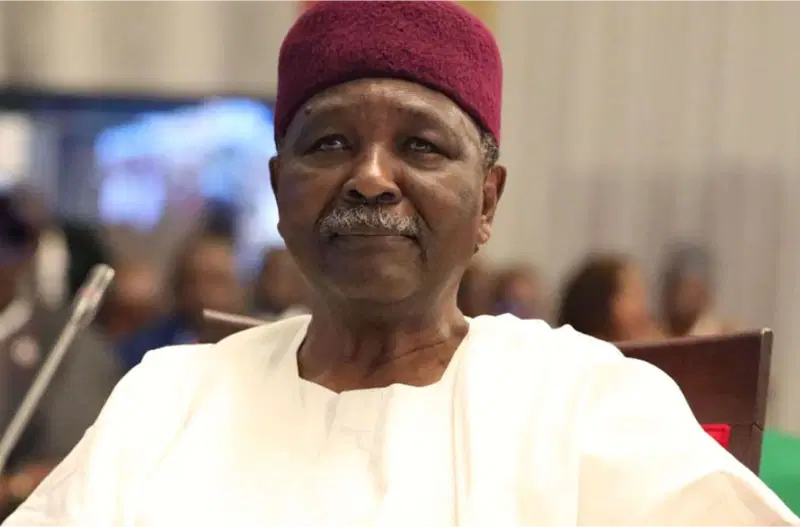
More than five decades after Nigeria’s civil war, the country’s oldest living former military Head of State, General Yakubu Gowon, has reopened discussion on one of the most contentious issues among the country’s military elite – the question of seniority between him and the late Biafran leader, Chukwuemeka Odumegwu Ojukwu.
The 92-year-old elder statesman says he is senior to Ojukwu, then governor of the Eastern Region, saying he was commissioned into the military before him.
This was disclosed by Gowon in his 859-page autobiography, ‘My Life of Duty and Allegiance,’ Saturday Guardian writes.
Gowon’s comments reawakened historical memories of political tensions that led to Nigeria’s 30-month civil war, waged between 1967 and 1970, after Ojukwu’s declaration of the Republic of Biafra.
In the 37-page chapter, his historical account and personal reckoning of the Aburi meeting in Ghana, Gowon faults the conduct of Ojukwu in the months leading up to the meeting.
The disclosures are in the ninth chapter of the book, ‘Aburi and the road to nowhere’.
He accuses Ojukwu of “personal ambitions” while accusing him of conducting a mind game with him in the prelude to the 1967 civil war.
“He refused to meet me and other members of the Supreme Military Council anywhere in Nigeria where there are Northern troops and turned down almost every proposal.
He confesses that there were mutual mistrust for one another, recalling how Ojukwu used to label him as a ‘Bible-thumping ‘Jack’ who would select his Bible and pray rather than stand up to fight.’
On the topic of seniority, the former military dictator contends that the matter should not have been a contentious one in military circles. He argues that by the established order in the Nigerian Army at the time, he plainly outranks Ojukwu.
Gowon said he was commissioned before the former Eastern Region governor and had ascended through the ranks before him, noting that the documents were clear on the topic.
He said the disagreement over hierarchy was one of the reasons that increased mistrust within the Supreme Military Council after the January and July 1966 coups. He argues that Ojukwu’s inability to accept his appearance as Head of State as a fait accompli made efforts at restoring unity within the country in the shaky post-coup period difficult.
He says: “Ojukwu based his objections to any meeting with me in ‘Nigeria’ on his discomfort with the presence of ‘Northern’ soldiers in the Eastern and the Western Regions.
But under that was his fear of being seen to be taking orders from his ‘junior’ in the military hierarchy, something he openly spoke about in our heated telephone conversation in January 1966.
‘He liked to think he was my senior, never mind I was commissioned two years before he got his commission. I was commissioned in 1956 with service number N/20. He was commissioned in 1958 with service number N/29 and was one of the first batch of university graduates to be directly recruited from outside the army.
“As it happened, we both were promoted to the rank of Lt. Col on the same day, April 1, 1963. He was the Quartermaster General of the Nigerian Army and later I was promoted as Adjutant General. We kept these duties till May 1965 when I went to the JSSC Course in Latimer, UK and Ojukwu was deployed as Commanding Officer of the Fifth Battalion, Nigerian Army in Kano. After the January 15, 1966 coup, he was made the Governor of Eastern Region while I was made the Chief of Staff (CoS) to the GOC, General Ironsi. I was senior to him by my appointment in strict military rank thus, but Ojukwu refused to accept me as such.”
He also discloses that some of the Nigerian military officers were university graduates before Ojukwu entered the Army.
He says that Colonel Victor Banjo was already a competent mechanical engineer and degree holder when Ojukwu joined the Nigerian Army. “By 1963, the military already had more than six graduate officers in different disciplines,” he continues.
He mentioned famous officers at the time, including Colonel Olufemi Olutoye, Brigadier Oluwole Rotimi, Colonel Austen Peters and Dr. Ahmadu Ali, whom he listed as medical professionals along with Peters. Others cited were Majors Adewale Ademoyega and Emmanuel Ifeajuna.
He also looks back at the Aburi Accord talks, which he characterizes as a wasted chance to save Nigeria’s unity peacefully. “There were agreements coming out of the meeting,” he says, “but different interpretations and rising suspicions on each side eventually brought the country closer to war.”
So far, at least three other former Nigerian leaders have written memoirs chronicling their personal experiences and years in power, providing rare insight into some of the country’s most defining political moments.
Among them is former President Olusegun Obasanjo, who in his sprawling three-volume memoir, ‘My Watch’, details his military career, presidency and opinions on national affairs.
Former military president, Ibrahim Babangida, also made the list with his autobiography, ‘A Journey in Service’, a book that attracted considerable notice for its observations on government, military rule and the June 12 crisis.
Similarly, former President Goodluck Jonathan wrote ‘My Transition Hours’, a memoir that chronicles his presidency and the historic 2015 elections that witnessed the first democratic transfer of power from a ruling party to an opposition in the history of Nigeria.
About the Author