
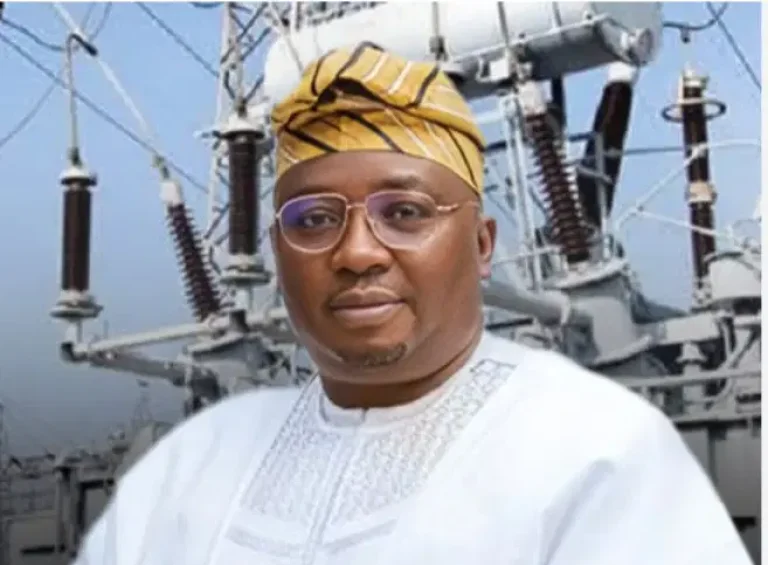
Two weeks after Minister of Power Mr. Adebayo Adelabu promised citizens that the power outages would soon end, a check around the country shows that for many homes and companies, things haven’t altered much.
This comes after President Bola Tinubu recently announced that N3.3 trillion would be used to pay off debts in the country’s power industry. The news has been met with varied reactions, according to Sunday Vanguard.
Some experts believe the whole statement, while others doubt its truth and call it a story that keeps coming up and becoming popular.
On March 24, when talking to the press in Abuja, Adelabu publicly apologized for the blackouts that had spread over the country. He said that the situation had made life worse at a time of extreme heat.
He admitted that families, schools, and businesses were under a lot of stress, and he said that the problems were mostly caused by gas supply problems and technical concerns that the government couldn’t fix very away.
The Minister added, “I want to apologize to Nigerians for this temporary problem that is causing hardship.” He also said, “We should start seeing improvements in supply in two weeks.”
That deadline ran out on Friday.
But many Nigerians argue that the anticipated improvement has not yet happened, from Abuja to Lagos and in many other states.
Things are getting worse
People in Utako, a neighborhood in Abuja, said that there were extensive power outages and short, unpredictable power supply.
Ekwa Mbuk, one of the impacted residents, said he was angry over what he considered a growing situation.
“Why do we have to spend another night in the dark in Utako District?” The heat is making me sick. Your consumers’ lives are getting worse because of these frequent power outages. Do you care? In a complaint to the Abuja Electricity Distribution Company, he added, “Please give us light.”
He also said that the power supply in the area had been unreliable, with whole days going by without power and then only a short time of restoration.
“Since last night, there has been no light. We’ve barely had an hour of light. He said, “Are we getting what we paid for?”
Types
In Lagos, Iyke Oscar asked why tariff classes that promised longer supply made sense, and others agreed with him.
“Why are we still paying as Band A if we can’t have light for 24 hours?” he said, pointing out the growing gap between pricing structures and actual service delivery.
Pattern that is familiar
The stories are similar across the states.
Abednego Emonena in Delta was very forthright about the situation: “Electricity in Nigeria is still a joke.”
Akin Muyiwa added that people in Akure had almost given up hope of getting a steady supply in Ondo. He said, “We don’t know what electricity is.”
Mary Blossom from Imo said that areas of Owerri have been almost completely dark for weeks. She said, “No light for the last four weeks.”
Diana Efe said that power shortages in Edo State might last for days.
“This is the fifth day we haven’t had electricity since it rained,” she added. Another resident, Aino, said that villages only got two hours of electricity a day.
In other places, the anger is mixed with acceptance. Mr. Awo Adekunle put it best in Ekiti: “No light, we just dey pay bill.”
Cynthia in Ogun State said there was a trend that had to do with the weather. She stated, “Once it rains, there is no light for the next 12 hours, sometimes 24 hours.” This suggests that outages are getting worse because the infrastructure is so fragile.
For some, the situation has become nearly unreal.
Abolanle Ajirowo asked out loud if the official promises were about a different reality.
She said, “Maybe there is another Nigeria we don’t know about.”
Problem with structure
There is a bigger structural problem behind these reactions. Nigeria’s power generation has stayed around 4,000 megawatts, which is not enough for a country with more than 200 million people. The International Energy Agency says that per capita energy use is still between 144 to 165 kilowatt-hours, which is much lower than the African average of 617 kWh.
The effects are clear in everyday life. Because the grid supply is not always stable, homes and businesses have to employ other options including generators, inverters, and solar systems. These cost a lot of money, which makes a parallel, self-funded energy system.
Renting a power bank
Obinna Eze remarked, “Electricity is still unreliable, so people have to rely on generators, inverters, or solar setups.” “So you pay for power, even when it’s not always there.”
New micro-businesses have sprang up to fill the void, which shows how much the crisis has changed the way people do business every day.
For example, power bank rentals are now accessible in sections of Kaduna, Sokoto, Kano, Plateau, Niger, Nasarawa, Delta, Edo, Anambra, Imo, and Lagos. They can be rented for a day or a week to charge phones and other small gadgets.
The federal government says that improvements are coming, but only when important gas infrastructure is fixed and producers are forced to meet their supply responsibilities.
Adelabu was sure that restoring gas flow, especially from plants connected to big operators, would stabilize generation.
But as the date he set passed without a discernible improvement across the country, it seems that people’s patience is running out.
What is left is the same old loop of promises and delays. Millions of Nigerians are still waiting, frequently in the dark, for a change in the power sector that has been expected for a long time but has not yet happened.
Experts talk about the N3.3 trillion for the power sector.
People have had varied reactions over Tinubu’s statement that the government will pay off N3.3 trillion in debt in the power sector.
Some experts agree with the whole assertion, but others doubt its truthfulness, calling it a story that keeps coming up and is now a trend.
Before the President’s most recent announcement, Minister of Power Adelabu had already said that the same amount will be paid out in 2024. The Debt Management Office (DMO) had also already secured roughly N4.5 trillion to pay off the same power sector debt.
Because of this, some observers think that remarks from the Presidency are just sound bites used to score political points at the expense of Nigerians, their businesses, and the economy as a whole.
Nigerians have to deal with unreliable power, which costs the country over N40 trillion per year.
A study from the Nigerian Independent System Operator, a federal government organization, said a few weeks ago that ongoing power outages are still costing businesses and households a lot of money, and many of them have to make their own electricity.
The research says that stable energy is still one of Nigeria’s most critical economic goals. It also says that power disruptions cost the country up to $29 billion a year.
At the current exchange rate of N1,385 to a dollar, this means that the economy loses almost N40.1 trillion every year.
The operator also said that the impact is felt in all areas, pointing out that businesses, manufacturing, and individuals spend billions of dollars each year making their own electricity.
The lack of supply has made electricity shortages even worse, forcing families and businesses to rely more on alternative energy sources as operating expenses rise and the weather gets worse.
The paths
Adelabu said on his Facebook page on March 29, 2024, “During my recent visit to the Egbin Power Plant, I reiterated that we have conducted a thorough diagnosis of the challenges currently facing our power sector in Nigeria.”
These problems include problems with infrastructure and the supply chain, and we are taking immediate steps to fix them and improve the power supply across the country.
The federal government is completely committed to taking decisive steps to achieve this goal. Starting in April, we will make it a priority to pay off any obligations that power plants like Egbin Power still owe. We want to encourage these important facilities to keep running and make them more efficient by doing this.
The Minister was also quoted as saying on October 7, 2025, “To stabilize the market, Mr. President has approved an N4 trillion bond to pay off verified GenCo and gas supply debts.”
But the Presidential Power Sector Financial Reforms Program comes after Tinubu approved a N3.3 trillion payment plan to pay off old debts that were built up between February 2015 and March 2025.
A statement from last Sunday said that implementation has started, with 15 power stations signing settlement agreements worth N2.3 trillion.
The federal government stated it has already raised N501 billion to pay for these.
It was stated that N223 billion had been paid out, and more payments were on the way.
In the meantime, stakeholders have asked if earlier permissions were really carried out or just political declarations. They point out that three years later, nothing major has been done, and the country’s national grid is still having problems with grid breakdowns.
Report from the President
A document titled “A Financial Reset for Nigeria’s Power Sector: The Presidential Financial Reforms Programme (2015-2026) – a chronological overview of efforts to resolve the power sector’s liquidity crisis and transition to a sustainable market-based framework” shows where the N4.7 trillion debt came from. It lists a decade of tariff shortfalls, liquidity constraints, and structural inefficiencies that led to huge unpaid debts across the power value chain.
It says, “The vicious cycle of not having enough money—unpaid debts to GENCOs that cause gas suppliers to fall behind—has made generation impossible and made the sector unbankable, resulting in an N4.7 trillion deficit.”
It says that in 2024–2025, even though GENCOs claimed N4.7 trillion, the Federal Executive Council (FEC) set a limit of N4 trillion, saying, “The FEC approved a settlement framework with a prudential ceiling of N4 trillion to ensure fiscal discipline.”
The report claimed, “N3.3 trillion: The final negotiated figure, after rigorous verification, reduced the initial N4.7 trillion claim by 30 percent through the removal of inflated, unsupported, or non-compliant charges.”
“The market-based settlement mechanism includes tariffs that reflect costs, faster metering, and better operational efficiency to stop future debt from building up.”
GENCOs’ reality and denial
Some GENCOs were sure about the program, but others disagreed, saying that earlier experiences may have made them less trusting of the system.
Dr. Joy Ogaji, Executive Director of the Association of Power Generation Companies (APGC), said that the N3.3 trillion will only have an effect on the power sector on paper.
The government stated it approved N3.3 trillion, but we don’t know what it covers or if it includes the time from 2015 until 2024.
“All the news we have is political.” It is hard to believe that it is up to date because the invoices from 2015 to March 2025 have not been reconciled yet.
“The bill for March 2025 wasn’t included, and maybe the bill for February 2025 wasn’t either because the billing cycle is 45 days long.”
Another unnamed operator added, “Power sector issues need to be put into groups.”
“Yes, this is a time before the election, so it’s easy for the government to push liquidity solutions for debts that have already been paid.”
“But we can’t say that the debt that GENCOs say they owe doesn’t exist.
“All provisions of the contract, including interest on late payments, must be followed.
“The GENCOs borrowed money when the exchange rate was around N155 to the dollar, but now it is over N1, 300.” Who pays the difference?
The insider also said that billing and collection methods aren’t very clear and called for changes and more supervision.
Some people view things differently.
Another insider said, “I think the government is honest.” The money will be paid, and it’s crucial to keep your word. “Haircuts forced by the government should not become the norm.”
Prof. Wumi Iledare, an energy economist and Executive Director of the Emmanuel Egbigah Foundation, also responded by saying, “The power sector is not only not doing well, it is also having financial problems.”
“Over N4 trillion in old debt is still choking the whole value chain.”
“What’s worse is that most of the solutions we’ve tried in the past have only been temporary fixes that didn’t fix the underlying problems.
“At the heart of the problem are tariffs that don’t reflect costs, insufficient contract enforcement, and poor coordination across institutions.
“The end result is a cycle of debt recycling, not resolution.”
Electricity is becoming a campaign issue—CPPE
Dr. Muda Yusuf, Chief Executive Officer of the Centre for the Promotion of Private Enterprise (CPPE), said, “This is a pre-election period, and electricity is becoming a campaign issue.” The government will probably work hard to keep its commitments.
“However, the sector may go back to its old ways if fundamental problems aren’t fixed. The most important thing is to make sure that the industry can make its own money and draw in smart investors. “Tariff reform is necessary, but it must happen slowly to avoid causing too much trouble.”
Independent Power is a step in the right way.
However, Mr. Seyi Sobogun, the Managing Director of First Independent Power Limited, said that the development was a very important step in restoring stability.
“We’re happy with the work that’s been accomplished so far. He said, “Dealing with old debts is important for making the system work better.”
He said that the complete subscription of the N501 billion bond issuance shows that the market is becoming more confident.
He went on to say, “We will keep working with stakeholders to make the sector stronger and improve the supply of electricity across the country.”
About the Author