
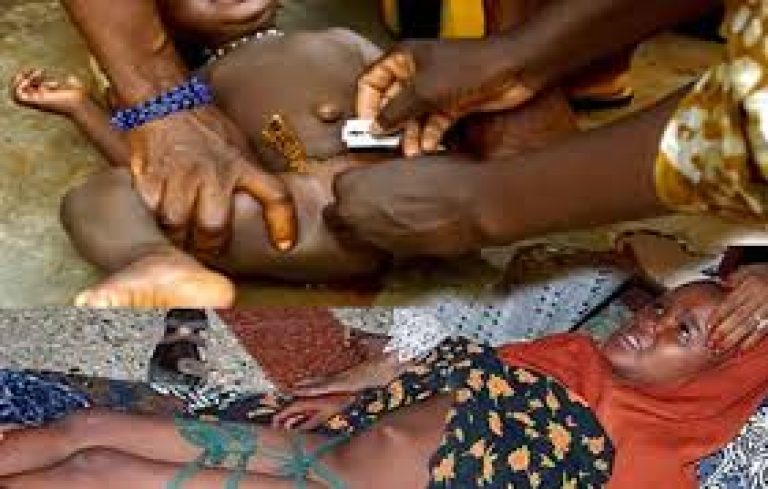
FGM, or female genital mutilation, is still one of the most traumatic cultural traditions that women and girls in Nigeria have to deal with.
Survivors, cutters, and advocates shared their very personal stories, showing the grief, regrets, and scars that will last a lifetime, according to Vanguard.
Osaretin says that FGM damaged his relationship with his daughter.
Tradition and ignorance molded Osaretin’s journey from victim to cutter. She is a 56-year-old mother and survivor. She started holding newborns down for her grandma during cutting rites when she was 11 years old.
“I didn’t know how to cut back then,” she said.
“They would bring the kids to cut before I went to school in the morning.” That was how I began my training.
In the end, she got the practice as an inheritance. She can’t remember how many girls she’s chopped today.
“I was doing it for my family.” She added softly, “It was our tradition.”
But Osareti’s personal life was full of scars.
She said, “My past relationships failed because I became emotionally numb.”
“I didn’t want to be close to anyone anymore.” I couldn’t keep a marriage.
The tipping point came when her daughter turned on her.
“FGM made my daughter and me enemies.” I didn’t want to lose her because she is my only girl. At that point, I stopped chopping. “I gave up.”
She still remembers the horrible process very well: a lot of blood, a lot of agony, and using razor blades that weren’t clean.
“It was hard,” she said.
FGM took away my sex life, says Doris Ahkere, a survivor.
For Doris Ahkere, a 43-year-old teacher and mother of five, FGM took away something very important: pleasure.
“I was hurt when I was only eight days old,” she stated.
“I didn’t find out till I was 15. My life has changed since then.
She said that it took the fun out of her marriage: “Most of us think that marriage is not just for kids, but also for friendship and closeness.” But because I was hurt so badly, I couldn’t have sex anymore. “It’s not easy.”
Doris now tells parents and young girls openly to oppose. “Parents say we live in the computer age, but some still want to hurt people.” Think of a girl getting a razor blade cut on a sensitive part of her body. It is evil. Stand your ground and say no. Even if you feel like you have to, tell the police, female lawyers, or health care centers. “FGM will change your appearance for the rest of your life.”
Josephine: I almost cut my daughters for money.
Josephine, who has six kids, almost went through the same thing with her younger girls because she was short on money.
She said, “Three of my five daughters were circumcised.”
“I planned to circumcise my fifth and sixth children when they were born, but I couldn’t get the N12,000 that the nurse wanted.”
At first, Josephine assumed it was just a matter of money.
“I was still planning to do it this year.” But I learned about the dangers after going to an awareness program. “I’m glad I didn’t go through with it.”
Her older girls, who have been circumcised, often complain of pain and itching. The two younger ones, who have not been cut, have been healthier.
She said, “That’s when I knew the truth.”
“Parents need to stop this.” We are ruining our kids.
Pastor Ken Izah says that the Bible does not support FGM.
Faith leaders are also coming out against this. Pastor Ken Izah says that FGM is not in the Bible.
He said, “God told Abraham to circumcise boys, not girls (Genesis 17:23).”
“FGM is not part of God’s plan. It is not a heavenly command, but a cultural habit. It must be gotten rid of.”
Breaking the cycle
Survivors and cutters’ stories reveal that FGM is not merely a cultural custom; it breaks trust, health, sexuality, and family ties.
Experts from UNICEF respond
Mr. Denis Onoise, UNICEF’s Child Protection Specialist, told our reporter that FGM takes away girls’ basic rights to bodily autonomy and dignity.
“It is the child who feels the pain of the cutting.” As she gets older and gets married, she finds out that the area that was cut or deadened no longer serves its natural purpose of providing pleasure or lubrication. He remarked, “This takes away her right to enjoy her own body, which is not okay.”
He said that the cultural idea that daughters should “marry well” is a form of systemic assault against girls.
“When cultures say they cut girls so they can marry well, they are just making gender-based violence a part of their culture. By denying her happiness and limiting her sexuality, you are getting her ready for marriage. But what about the males who marry these women?
Onoise said, “They also lose because the relationship won’t be what it should have been if the woman hadn’t been hurt.”
He talked about how FGM can cause problems with reproductive health in addition to sexual and mental impairment.
“We’ve heard from hospitals that ladies who had their genitals sliced bled extensively during childbirth or got growths like keloids. UNICEF also paid for operations for certain survivors who had these kinds of problems. He remarked, “This is why the practice must be stopped—it’s a direct attack on women’s health.”
Onoise also talked on how important it is for males and community leaders to help end the practice.
“Women aren’t the only ones that suffer. The effects are felt by husbands, brothers, and whole communities. That’s why men need to step up and say that our sisters and prospective wives shouldn’t be cut. Communities must proclaim their liberation from mutilation and gender-based violence. “Many have already given up on it, but many more still need to do so,” he said.
He said that everyone needs to work together to keep Nigeria’s promise to abolish FGM by 2030.
“It won’t be easy, but it’s possible if we raise awareness and enforce the rules.” The VAPP Act and other regulations already make FGM illegal. We need greater enforcement, more community involvement, and more media support right now. “This practice is not only harmful, it is also discriminatory against the female child,” Onoise said. “Every member of society has a role to play.”
Cultural beliefs and myths
Mrs. Aderonke Olutayo, a Sexual Reproductive Health Specialist and FGM Consultant for UNICEF, noted that FGM is still quite common in Nigeria, even though there are laws and campaigns against it.
She told Vanguard that “the practice, which was once thought to be limited to parts of the South-West and South-East, has now spread to states in the South-South and even the North.” “People are becoming more aware, but we are also finding more communities where it is still happening.”
Olutayo said that myths and deeply held cultural beliefs are what keep FGM going. Some people think that cutting girls makes them ready for marriage, while others see it as a rite of passage into womanhood.
“Some families think it makes the genitals clean or pretty, while others think it’s a tradition that has to go on because it’s always been done,” she said.
She said that grandmothers often push for the practice, which makes it harder to resist. She noted that survivors have to deal with shame and emotional scars in addition to the suffering.
About the Author