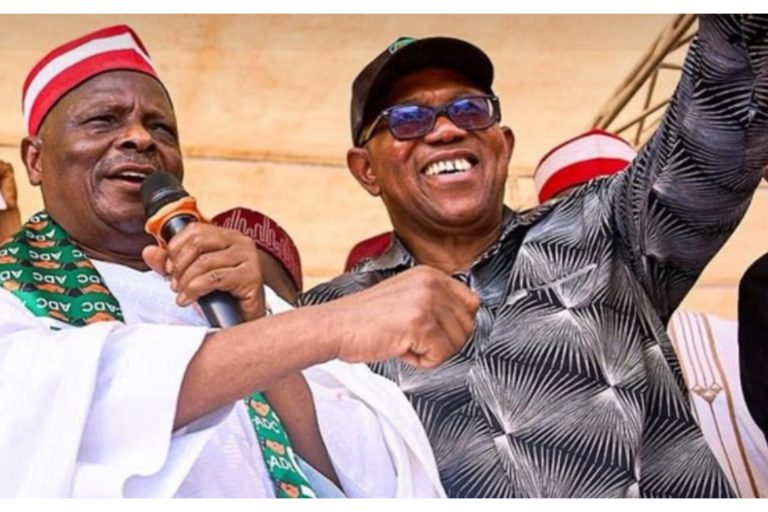

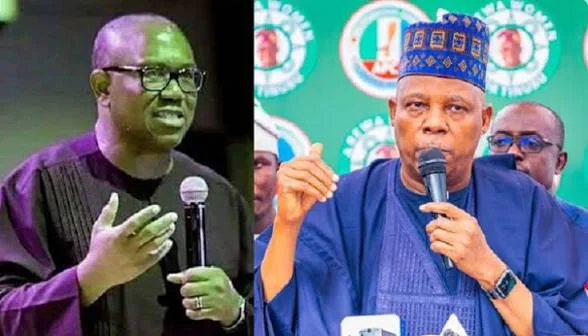
The Nigeria Democratic Congress (NDC) has condemned the Vise President, Kashim Shettima, and the Federal Government led by the All Progressives Congress (APC) for attacking its presidential candidate, Peter Obi, for referring to data of Nigeria’s economic and social circumstances.
The party said the administration was attacking Obi instead of addressing the economic realities raised by the former Anambra State governor, saying that statistical facts should form the basis of public policy and governance.
The NDC, in a statement signed by its National Campaign Council Spokesperson, Dr Chiogo Constance Ikokwu on Thursday, November 12, 2026, termed the government’s reaction to Obi’s deployment of data as disturbing and revealing.
“Statistics are not political weapons or insults, but tools to measure progress, expose failures and guide public policy,” the party said.
It challenged the Federal Government to provide credible data, explain its approach and offer facts to rebut Obi’s assertions instead of resorting to personal attacks.
The NDC contrasted the prices of basic commodities in May 2023 with their reported values in 2026 to show the economic problems facing the country.
The party said fuel, which sold for an average of N238.11 per litre in May 2023, is currently selling for between N1,300 and N1,435 per litre.
It also said that the price of a 50kg bag of rice rose from between N35,000 and N40,000 in mid-2023 to between N50,000 and N90,000 or more in 2026, depending on the brand and market.
It added that the price of a 50kg bag of cement ranged from N10,500 to N15,000, compared to N4,010 and N5,300 in 2023.
It said a loaf of bread that used to sell between N500 and N700 now sells for between N1,200 and N2,000. It said urban dwelling rents in big cities such as Lagos and Abuja have risen by an estimated 80 to 120 per cent.
The opposition further said that Bangladesh is likewise a developing country that had made considerable progress in poverty reduction through intentional economic policies.
It stated Bangladesh pulled nearly 34 million people out of poverty between 2010 and 2022, cutting extreme poverty from 12.2 per cent to 5.6 per cent.
The NDC credited the country’s progress to five main pillars: agricultural expansion, export-oriented manufacturing, microfinance and non-governmental organisations, social safety nets, and investment in human resources and infrastructure.
It stated that Nigeria might replicate the outcomes by researching and applying effective development tactics employed in countries like Bangladesh, Vietnam, Rwanda, Morocco and India.
But the party accused the APC administration of its unwillingness and inability to learn from the experiences of other growing countries, stating that it was more interested in political control and access to national resources than enhancing the welfare of the public.
“The NDC also said Nigeria’s poverty rate was around 63 per cent with over 140 million people living in multidimensional poverty.
It also quoted a recent assessment by the United Nations Development Program (UNDP), which it stated had shown that past successes in poverty reduction in Nigeria had been reversed.
The party said the country’s poverty situation was unacceptable and the government should take responsibility for the deteriorating living conditions.
In a better structured society the APC government should be resigned,” the statement said.
As the 2027 general election draws near, the NDC has called on the Tinubu government to reply to Obi’s economic figures with verifiable proof and not political assaults.
It further challenged Nigerians to judge the performance of the government by looking at the living conditions, education, business possibilities, security and poverty levels since the administration came into power.
Nigeria required leaders with humility to learn, skill to implement successful policies and guts to be held accountable, the party said.
It said Obi’s call for evidence-based governance was an invitation to Nigerians to look at the available facts, evaluate the development outcomes and demand better leadership.
The statement ended with a promise that a productive and successful Nigeria is achievable. “Nigeria will be OK,” it said.
About the Author