
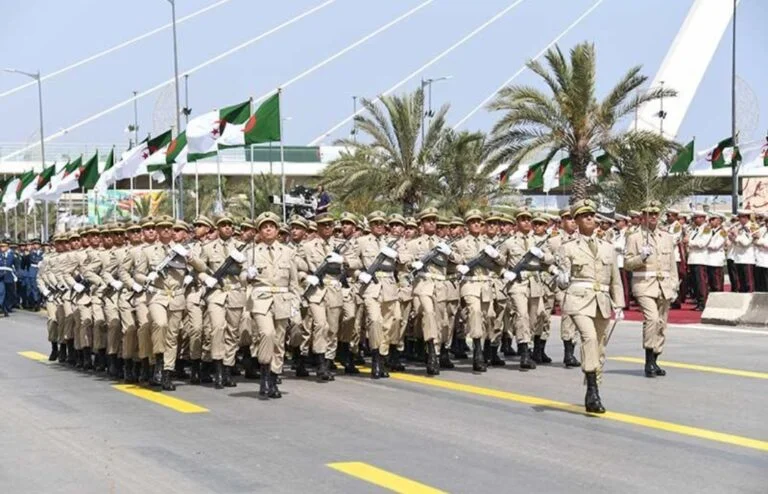
Algeria’s parliament has voted to send military forces to neighbouring Niger, in a shift for the North African country’s long-standing reluctance to send troops overseas, and its first such deployment since 1973.
The authorisation, issued on Sunday October 25, concerns the deployment of elements of the Algerian army in Madama, in northern Niger, close the Libyan border. The size of the contingent and the date it will be sent have not been formally disclosed, however.
The deployment will take place at a former French military post used during campaign Barkhane, France’s counterterrorism campaign in the Sahel, according to Reuters.
Algerian Senator Belkacem Boulghiti said the objective was not to fight but to preserve the country’s economic and geopolitical interests, particularly its oil installations in Niger.
“We are not sending our soldiers to wage war in Niger but for a mission to secure economic infrastructure,” Boulghiti told reporters following the parliamentary vote, the Associated Press reported.
It is Algeria’s first foreign military deployment since it dispatched troops to help Egypt in the 1973 Arab-Israeli war. Traditionally, the country has been a champion of diplomacy, national sovereignty and non-intervention in crises beyond its borders.
The deployment comes against a backdrop of escalating insecurity across the Sahel, where Niger, Mali and Burkina Faso have been plagued by repeated attacks by armed groups affiliated to Al-Qaeda and the Islamic State. All three countries are also ruled by military leaders who have seized power in coups in recent years.
Algeria shares a long desert border with Niger and has increasingly seen instability in the region as a direct security risk. The planned expedition is also intended to safeguard investments in the energy industry, especially projects tied to Algeria’s state-owned energy company Sonatrach.
Algeria’s Sonatrach is collaborating with Niger and Nigeria on the planned Trans-Saharan Gas Pipeline, a project that would carry Nigerian natural gas through Niger and Algeria to worldwide markets, especially Europe. Algeria is also interested in exploring for oil in Niger.
The vote of parliament follows an improvement in relations between Algiers and Niamey following a period of diplomatic tensions. Algeria had denounced Niger’s military coup of July 2023, and ties worsened further after a falling-out over the Algerian forces’ shooting down of a Malian drone in April 2025. Then Niger, Mali and Burkina Faso recalled their embassies from Algiers.
Since then, relations have improved, with Niger President Abdourahamane Tiani visiting Algeria in February 2026 and Niger’s Defence Minister, Salifou Mody, going to Algiers in October for security talks. The two countries also inked a treaty on military cooperation, without giving details.
Algeria also dispatched military planes to Niger in August, following what its officials characterised as an attempt to undermine the country’s military-led administration. It reflected the expanding security cooperation between the neighbours.
This current move could herald a major shift in Algeria’s military stance in the region as it strives to safeguard its borders, energy assets and strategic interests in the Sahel. The exact scope and implementation of the mission remain to be confirmed.
About the Author