

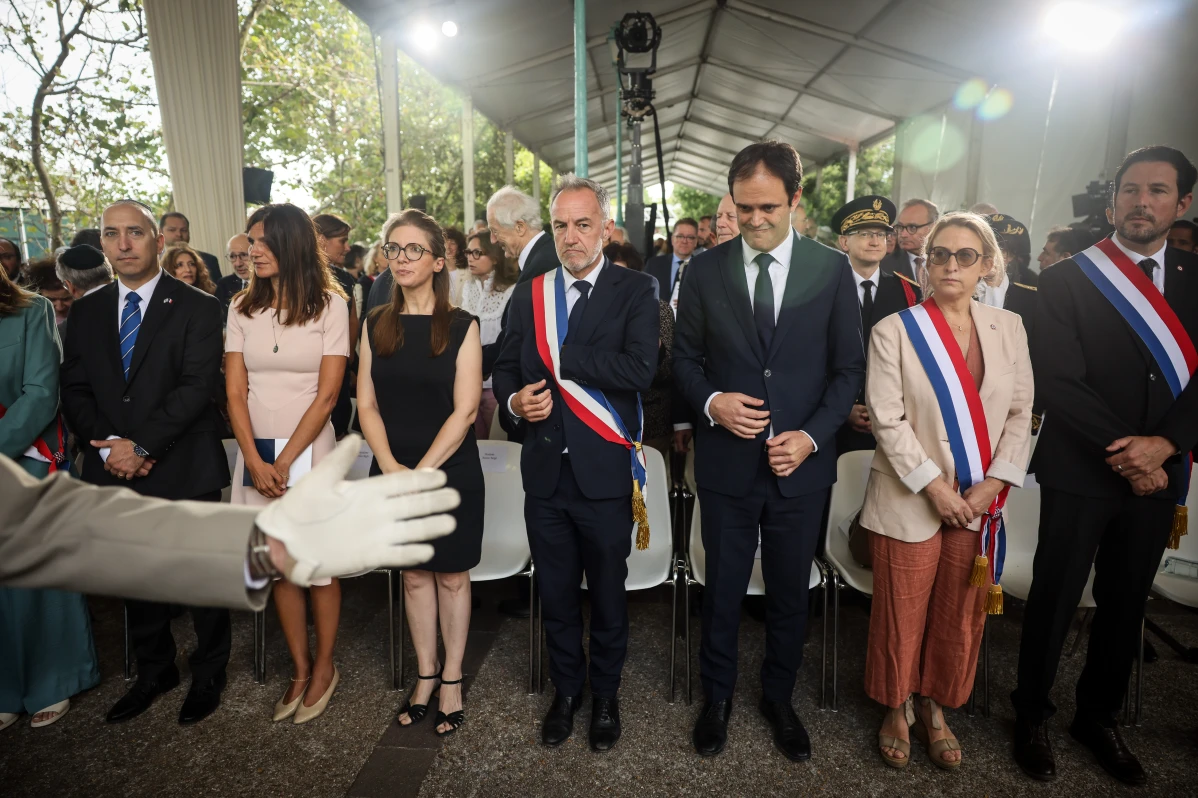
France marked the 84th anniversary of the Vel d’Hiv roundup, one of the darkest episodes in the country’s history during the Holocaust, amid renewed alarm over a rise in anti-Semitism after a memorial in Paris, honouring those who helped save Jews during the Nazi occupation, was vandalised. Government officials, Holocaust survivors, Jewish community leaders and members of the public gathered at the yearly ceremony to commemorate more than 13,000 Jewish men, women and children arrested by French police in July 1942.
The memorial comes days after unknown vandals desecrated a plaque along the Wall of the Righteous at the Shoah Memorial in Paris. The monument honours the French civilians who put their lives at risk to hide and rescue Jews from deportation in WWII. The authorities condemned the act as an attack on the collective memory of France and launched a criminal inquiry to identify those involved.
During the ceremony, President Emmanuel Macron underlined France’s commitment to remembering the victims of the Holocaust and fighting anti-Semitism everywhere. “The desecration of the memorial is an attack not only on Jewish history, but also on the values of the French Republic,” he said, adding that recollection is crucial to ensure hatred does not take root once again.
During the Vel d’Hiv roundup of July 16 and 17, 1942, French police, under orders from Nazi Germany, arrested more than 13,000 Jews, including more than 4,000 children. The inmates were detained in horrible conditions at the Vélodrome d’Hiver, an indoor cycling stadium in Paris, before being transferred to the Auschwitz-Birkenau death camp. Less than 100 survived the war. Historians describe the roundup as one of the clearest collaborations between the wartime Vichy government and Nazi forces in France.
For decades following World War II, French governments refused to acknowledge the state’s role in the roundup, blaming instead the occupying Nazi authority. This changed in 1995, when President Jacques Chirac officially recognised the French state’s guilt, describing the roundup as a “irreparable” crime committed by France against its own people. The speech was a watershed moment in the country’s dealing with its wartime heritage.
The latest act of destruction comes amid increased concern about anti-Semitic acts across France. Jewish organisations have reported a spike in hate crimes, threats and attacks since the commencement of the Israel-Hamas war, leading authorities to beef up security near synagogues, schools and Holocaust sites. Protecting sites of historical significance has become an increasingly crucial issue, say officials.
The desecration of the plaque was especially painful for representatives of the French Jewish community and Holocaust remembrance groups because it targeted a memorial honouring the “Righteous Among the Nations,” ordinary French citizens who defied Nazi orders to shelter Jews, often at great personal risk. They asked for prompt justice and a fresh commitment to educate the young about the Holocaust and the perils of bigotry.
Sunday’s service was a memorial to the victims of the Vel d’Hiv roundup, but also a reminder that the struggle against anti-Semitism is now an ongoing responsibility as France commemorated one of the darkest chapters in its history. The vandalism of the Paris memorial reminded us of the continuous significance of safeguarding historical memory and upholding the values of tolerance, justice and human decency.
About the Author