
The Universal Basic Education Commission (UBEC) has claimed significant progress in Nigeria’s basic education sector, saying more than ₦100 billion in untapped matching grants has been raised and funnelled into school upgrades across the country.
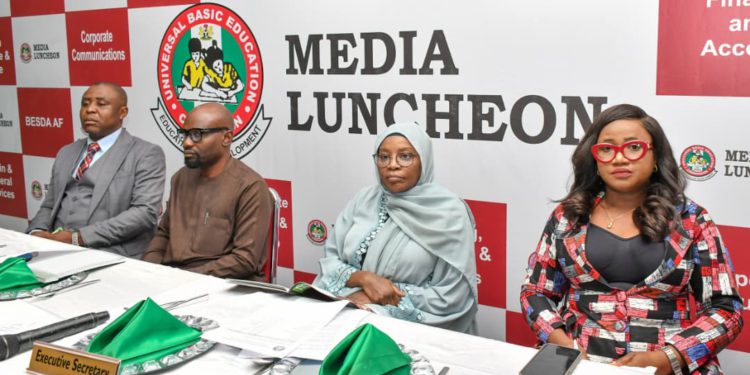
The UBEC Executive Secretary, Dr Aisha Garba, told education journalists during a media luncheon on Thursday that the commission’s work is now driven by its 2025-2031 Strategic Blueprint, and aligned with the Federal Government’s Renewed Hope Agenda.
“We are going beyond reforms to delivering measurable results,” she told reporters. She highlighted infrastructure, teacher development and digital learning projects that have been impacted by recent investments.
Hajia Garba said the money mobilised in conjunction with state governments and the FCT are already showing obvious benefits as over 4,600 new classrooms have been constructed, over 6,100 classrooms repaired, 2,780 toilets provided and 678 boreholes sunk.
She said UBEC has also supplied over 334,000 pieces of school equipment and helped build over 2,300 Early Childhood Care Development and Education Centres. K-12 (Primary & Secondary Education)
The Executive Secretary of UBEC stated that the Commission has committed over ₦20.4 billion on professional development initiatives and stressed that teacher development is key to sustainable improvement.
These expenditures support initiatives like the Effective Schools Programme and strengthened School-Based Management Committees to promote classroom practice, school leadership and accountability.
Hajia Garba also addressed UBEC’s commitment towards digital transformation in basic education.
The commission is expanding e-Learning Centres, improving Smart Schools and rolling out training in artificial intelligence, coding and robotics to develop future-ready skills among learners.
UBEC has also disseminated over 7.8 million instructional resources around the country to promote literacy, numeracy and foundational learning.
The Executive Secretary noted the commission’s strategy is not solely about bricks and mortar initiatives. UBEC is also extending access through Open Schooling, merging Qur’anic and Tsangaya education and implementing girl-child and inclusive education projects. Special Education
She added institutional reforms are under way to improve transparency, project monitoring and data-driven decision-making to guarantee every investment is delivering value for children.
In her goodwill message, the Chairman of the Nigeria Union of Journalists FCT Council Comrade Grace Ike, while addressing the role of the media described journalists as key partners that promote transparency, keep duty-bearers responsible and publicise triumphs and inadequacies in the education system.
She emphasised the importance of sustained contact between journalists and UBEC through briefings, project visits and joint storytelling that reflect both achievements and ongoing issues.
“The timely data, the access to schools and the capacity-building for the education correspondents is very important,” Ike underlined.
She applauded UBEC for its dedication to open discussion and called for stronger partnerships to increase the quality of education reporting.
UBEC can also provide education correspondents to strengthen this partnership: quarterly or biannual briefings and press kits, capacity-building workshops on interpreting education data and child-friendly reporting, organised field visits to UBEC-funded projects’ she added Primary& Secondary Schooling (K-12)
“Also collaborative awareness campaigns, more transparency around projects and procurement, small investigative journalism grants, and feedback channels for journalists”
She called on the government, communities, teachers, development partners and the media to collaborate to ensure that every Nigerian child enjoys safe, inclusive and quality basic education.
“Together, we can ensure that the story of every Nigerian child’s right to quality basic education is told accurately, in context and with a sense of urgency,” she added.
Chairman, Education Correspondents ECAN, Chux Ukwuatu, in his remarks, called for more robust engagement with UBEC to include some selected education correspondents in local field trips and project inspection visits outside Abuja, so that journalists can see UBEC interventions at first hand; provide logistical support to enable accurate reporting during official assignments; and make the Commission activities more accessible to enable reporting to be fuller and fairer. Ukwatu’s requests were couched as a cooperation.
“If journalists see projects on the ground their stories will better reflect both successes and gaps, informing the public, improving scrutiny and ultimately strengthening programs,” he added.
This is the first collaboration with interested parties with UBEC in over nine years. K-12 (Primary & Secondary Education)
Dr Aisha Garba is committed to changing the narratives and correcting the irregularities in the sector to promote access to quality universal education in Nigeria.
The cooperation has also gained impetus after the assumption of office of Mr Ikharo Attah, Special Adviser on Media and Communications to the Minister of Education.
About the Author