
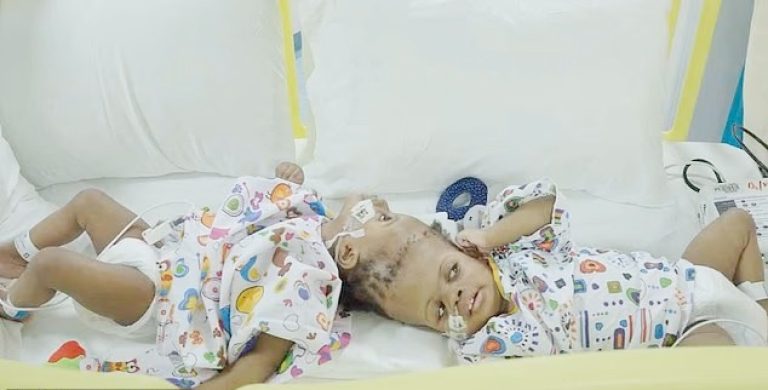
A surgeon has successfully separated 19-month-old conjoined twins connected at the skull after a gruelling operation.
The complicated treatment has been successfully performed and Mercy and Goodness, who were born in Ekiti State, have both made full recoveries and gone home, according to London’s Daily Mail.
The 12-hour operation took conducted in the Sheikh Khalifa Medical City in Abu Dhabi and was led by Prof Noor ul Owase Jeelani, paediatric neurosurgeon at London’s Great Ormond Street Hospital.
He earlier assisted in separating one-year-old twins Minal and Mirha from Pakistan in 2024.
The last operation, performed last year, was carried out by an international team of medics from the UAE, the UK, Brazil and Nigeria.
It is thought to be the fastest ever separation of vertically conjoined twins at the head.
The girls and their parents flew to Abu Dhabi for the life-changing operation, which was carried out under the guidance of specialists from UK-based charity Gemini Untwined and UAE healthcare provider PureHealth.
The separation of Goodness and Mercy is a historic case which was planned and completed with a precision not seen before, said Prof Jeelani who led the operation and is the founder of Gemini Untwined.
We managed to give these girls and their family a new future, employing fresh approaches and strategies and learning from our experience with our prior eight instances.
The complete treatment took four months and four days, with four separate operations, more than 40 hours in theatre and more than 60 healthcare workers from 20 different nationalities involved.
The treatment was of particularly high risk because the twins shared crucial blood arteries and brain tissue due to fused heads — an uncommon abnormality known as craniopagus.
The separation was months in the making, with 3-D imaging, virtual reality simulations, augmented reality overlays and ultrasound-guided tissue expansion.
These technologies enabled doctors in many nations to map the twins’ intricate vascular and brain systems in a combined virtual environment.
It has been regarded as one of the most complicated surgeries of its kind, using techniques developed over 18 years of similar instances.
One of the important improvements used was the ‘open book technique’ that uses gravity rather than steel retractors to prevent brain collapse and lessen trauma.
Doctors placed silicone expanders under the twins’scalps to stretch the skin, to make sure there would be enough to cover their heads after they were separated before the last stage.
Thanks to the help of AI modelling, these expanders were inserted earlier than in previous cases, doing away with the requirement for skin grafts.
Mercy and Goodness were born in June 2023 in Ekiti State, Nigeria, and were referred to Gemini Untwined at six months old.
The charity is the only one in the world dedicated purely to the treatment of Craniopagus twins.
The surgery was carried out by a team of 12 surgeons from Great Ormond Street Hospital and other specialists from the UK, Brazil and the UAE.
Conjoined twins occur in one in about 2.5 million births, and only five per cent are fused at the skull.
Great Ormond Street Hospital said 40 per cent of craniopagus twins were stillborn or died in childbirth and a further third died within 24 hours.
About the Author