
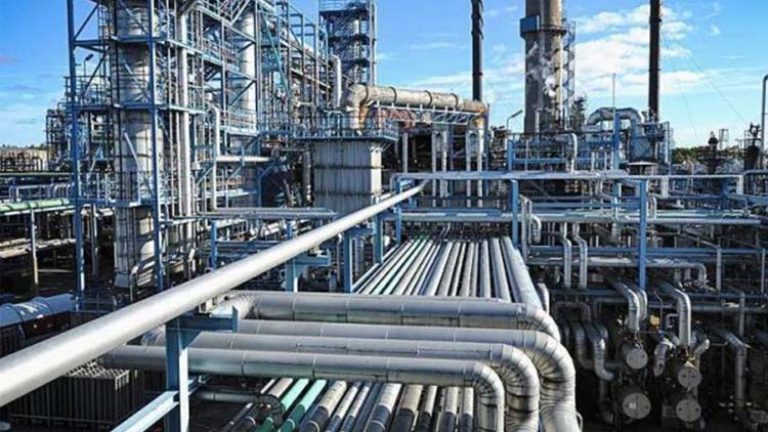
The Nigerian National Petroleum Company Limited is planning an NLNG-type equity partnership, which may see Chinese investors acquire roughly 51 per cent controlling ownership in the Port Harcourt and Warri refineries, as part of a bigger strategy to rehabilitate and commercially reposition the refineries.
The arrangement came to the limelight after the national oil company, NNPC, signed a Memorandum of Understanding with Chinese companies, Sanjiang Chemical Company Limited and Xinganchen (Fuzhou) Industrial Park Operation and Management Co., Ltd. for what was described as a “potential technical equity partnership,” reports The PUNCH.
The MoU was signed in Jiaxing City, China on 30 April 2026, by Group Chief Executive Officer of NNPC Ltd, Bayo Ojulari; Chairman of Sanjiang Chemical Company, Guan Jianzhong; and Chairman of Xinganchen Industrial Park Operation and Management Co. Ltd, Bill Bi.
Our correspondent’s findings yesterday indicated that the planned framework is not just the usual refinery rehabilitation contracts and may include the long-term equity participation of the Chinese partners in both the refining plants.
Sources at the national oil company privy to the MoU informed our reporter the potential cooperation was being constructed on a “NLNG-type model” with equity participation, joint governance structures and long-term operational involvement.
They said structure might be similar to NLNG where investors have 51 per cent equity, are involved in governance and share operational responsibility in the long run. Under the proposed cooperation, the Chinese enterprises are intended to help complete pending projects at the Port Harcourt and Warri refineries.
The agreement also includes operations and maintenance services to deliver what NNPC characterized as “best-in-class, sustainable performance”.
The anticipated expansion would also increase refinery capacity, boost refinery profitability and enhance fuel standards to cleaner requirements, the report says.
The parties are also jointly studying the potential of expanding into petrochemicals and gas-based industrial projects through the construction of co-located industrial hubs around the refinery complexes.
“The scope is expanding to capacity expansion, yield optimisation, petrochemical integration and compliance with clean fuel standards and exploration of gas-based industrial projects in Nigeria,” said a NNPC official who declined to be named because he was not permitted to speak to the media.
Ojulari who spoke after the signing ceremony said the agreement is a huge milestone after over six months of engagement between NNPC and the Chinese enterprises.
“All parties appreciate the mutually beneficial opportunities for the development and long-term sustainable profitability of NNPC’s refining assets in Nigeria and the collective weight required for success,” he said.
Ojulari said the arrangement was a crucial stage in locating technical equity partners who might restart and develop the refineries. “The MoU is a major milestone on the path to identifying potential technical equity partner(s) to restart and expand NNPC’s refineries and to explore opportunities in co-located petrochemical and gas-based industries,” he said.
The MoU is simply an indication of the parties’ desire to continue conversations in good faith, and the definitive agreements are subject to regulatory and customary approvals, the correspondent understands.
Also it has been found that the implementation process would start with technical, operational, financial, commercial and legal due diligence before binding agreements are signed.
“The agreement is a non-binding framework and not yet a final commercial contract. Rather, it is a foundation for cooperation and a direction for future definite agreements. Both facilities are expected to engage in four important operational areas and complete excellent engineering, procurement and construction work at the Sanjiang/Xinqianchen cooperation. The goal is on enhancing the dependability, safety and efficiency of the refinery to ‘best-in-class’ levels.
The MoU hints at possible equity participation through an NLNG-style shared governance arrangements and long-term partnership framework, rather than a traditional contractor approach. It so implies Sanjiang/Xinqianchen could take ownership or operational participation rather than just EPC contractor. But everything is on the table.
“There is also the possibility of converting the refineries into commercially run industrial assets like petrochemical and gas,” the insider stated.
The move to an equity partnership structure could reflect growing concerns within NNPC over the viability of prior refinery restoration agreements, analysts said.
Speaking on the MoU, the Executive Secretary of the Major Energies Marketers Association of Nigeria, Clement Isong, said in an interview with our reporter that bringing in technically capable partners with equity holdings will ensure efficiency and sustainability.
“The key difference in the structure of the deal is that the Chinese partners are taking equity in the assets as part owners and would want the refinery to work so they get returns on their investments,” Isong said.
“This is a groundbreaking way of getting the assets to work in an efficient and sustainable way. The difficulty that we were aware of was that NNPC did not have the internal competency or expertise to run those refineries efficiently. Now they’ve brought in a third party, and the crucial difference is that the third party they’ve brought in is taking equity. He is a part-owner of the refinery and thus would like to see the refinery work so he can obtain returns on his investment,” Isong said.
“The model is innovative and every Nigerian will be happy if the facilities work again,” he said. According to him, the NNPC does not have the internal knowledge and capacity to run the refineries without a technical partner.
The Port Harcourt refinery restoration project had already been awarded to Italian engineering firm Maire Tecnimont, and separate rehabilitation efforts had also begun at the Warri plant.
If the talks yield formal commercial arrangements, the suggested arrangement might also boost Chinese involvement in Nigeria’s downstream petroleum and gas sectors.
About the Author