
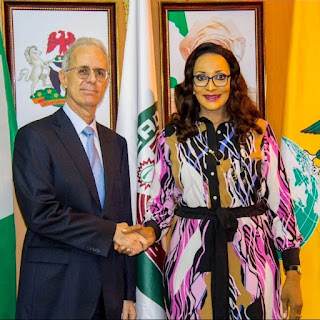
Minister of State for Foreign Affairs, Ambassador Bianca Odumegwu-Ojukwu, has said that Nigeria wants to put its agreements and Memorandum of Understanding (MOUs) with Turkey into action.
The minister said this when Mehmet Poroy, the Turkish Ambassador to Nigeria, came to her office to pay her a visit.
Bola Ahmed Tinubu, the President of Nigeria, went to Ankara on January 27, 2026, at the invitation of Recep Tayyip Erdoğan, the President of Turkey. The visit was meant to improve ties between the two countries even more.
The group, which included at least six ministries and the National Security Adviser, among others, saw the strengthening of several important agreements between the two countries.
They include an Agreement on Cooperation in Education, an MOU on Cooperation between the Foreign Service Academy of the Federal Republic of Nigeria and the Diplomacy Academy of the Ministry of Foreign Affairs of the Republic of Türkiye, a Joint Declaration on the Establishment of a Joint Economic and Trade Committee, and a protocol on Military Cooperation.
Others are working together on Halal Quality Infrastructure, Media and Communications, and a Memorandum of Understanding to make Social Services better for Women, Children, People with Disabilities, and Older People.
Odumegwu-Ojukwu reminded the envoy that President Tinubu had talked a lot about making the most of the recent visit by telling Ministries, Departments, and Agencies (MDAs) to come up with plans for how to put the MoUs agreed in Ankara into action.
She stated that the president also said that the political talks between the two countries that will take place in Abuja later this year will be beneficial.
The Minister, through Dr. Magnus Eze, the Special Assistant on Communication and New Media, said that MoUs are only pieces of paper and that what matters is that the parties can carry out the letters to help their people.
“Over the years, Nigeria and Türkiye’s relationship has grown in every way, and their political ties are still friendly.” “The minister said that Nigeria and Türkiye have the same ideas about how to deal with current global issues like the war on terrorism, climate change, and human migration. They also want to promote international peace and security and call for the global governance system to be reformed to be more inclusive so that all interests from all over the world can be heard.”
Odumegwu-Ojukwu added that trade between Nigeria and Türkiye was continuously improving, with the total amount of trade reaching about 2 billion USD if the informal sector was included in the official numbers.
She said that the January 2026 trade summit in Ankara was a practical motor for the “Renewed Hope Agenda,” turning diplomatic aspirations into a clear plan for realizing a $5 billion trade goal between the two countries.
The Joint Economic and Trade Committee (JETCO) was the main focus of the event. It was meant to go beyond traditional diplomacy by giving the private sector a permanent way to deal with trade impediments and take advantage of Nigeria’s recent economic changes.
The forum’s main goal was to modernize Nigeria’s energy and agriculture sectors with the help of Turkish technical know-how. This was done by using new Halal quality standards to make it easier for Nigerian exports to reach European and Middle Eastern markets.
The Turkish Ambassador talked about how the two countries work together to defend each other and how important it is for them to meet in Abuja to talk about fighting terrorism.
Amb. Poroy was hopeful that the Joint Economic and Trade Council will improve trade between the two countries. He urged them to use it to reach their goal of $5 billion in trade.
About the Author