
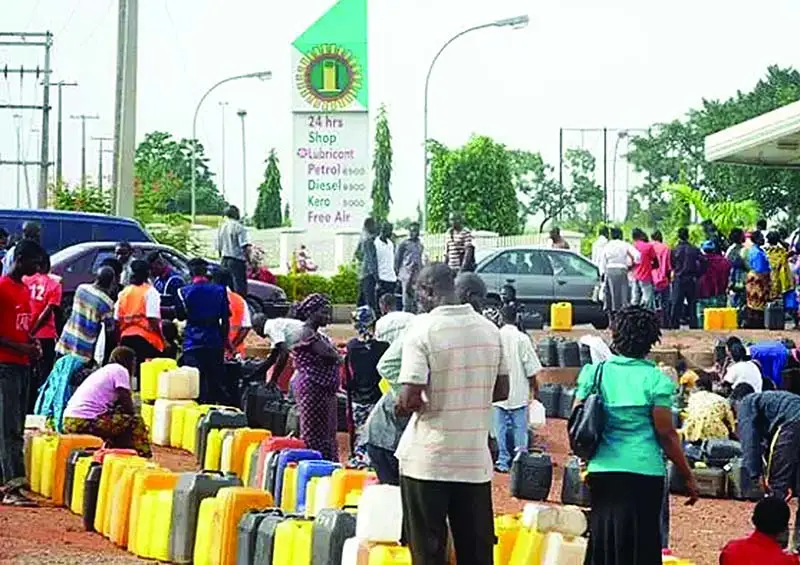
The current rise in gas prices isn’t simply a market change for millions of Nigerians; it’s a daily economic fact that is changing how people travel, spend money, and the cost of living across the country.
According to Saturday Guardian, commuters and transportation companies have seen a rise in fares.
Abdulrahman Oyedele, who drives a commercial bus in Igando, told our reporter that they need to raise the fare so they don’t lose money.
“We have to hike fares because gas is getting more expensive. People’s income is now being eaten up by even short travels. He said, “Nigerians are having a harder time than ever just getting to work or school.”
People who own their own cars also feel the pain.
Kunle Adeyemi, who lives in Lagos, said, “My gas costs have gone up by almost 40 percent in a few weeks, not up to a month.”
He also said that this makes it harder to buy groceries and other necessities, which has been a daily problem for weeks.
For traders, the price rise has increased their costs of doing business, especially for enterprises that rely on transportation.
According to Sade Olatunji, a textile merchant in Oshodi Market, the price of moving products from suppliers has gone up a lot.
“We have to raise prices for customers, but sales are already slow because people are spending less.” She said, “This is the time when we should be having even more sales because of the upcoming Eid celebration, but the rise in gas prices has hurt our business.”
Students are also feeling the effects of the economy because they rely on daily transportation and have had to make big changes to their budgets.
Chinaza Okoro, a senior at Lagos State University (LASU), said, “My allowance barely covered food and transportation before.” Now that gas prices are higher, I spend more money just getting to class and my part-time job.
In the meantime, Dangote Petroleum Refinery has raised the price of Premium Motor Spirit (PMS), which is also known as petrol, from N1,075 to N1,175 per liter. This has caused depot operators in important supply hubs to stop selling.
Our correspondent also found that loading operations at the refinery have been put on hold for a short time.
An insider at the refinery said that the price increase is due to the rise in global crude oil prices, which went beyond $100 per barrel over the weekend.
It was learned that the change was needed to reflect the current expenses of refining, which are affected by changes in the price of crude oil around the world.
The spike comes as global crude prices have been going up steadily. On Friday morning, the global benchmark Brent crude rose to $101.30 per barrel, and West Texas Intermediate (WTI) rose to $96.30 per barrel. Prices were below $90 per barrel earlier this week, so these levels are a big jump.
The rise was caused by the ongoing war between the US, Israel, and Iran, which has blocked supply lines like the Strait of Hormuz, which is a key route for oil to move across the world. The disruption has made supply problems worse and raised oil prices around the world, which has a direct effect on refining expenses.
Since the start of the Middle East conflict on February 28, 2026, PMS prices in Nigeria have gone up several times. The series of price changes add up to a rise of approximately 47 percent over six weeks, showing how changes in the price of crude oil throughout the world affect fuel prices at home.
A few depot owners said that sales have stopped so that prices can be adjusted at retail stations without losing money.
Before the current rise, some marketers were selling gas at retail rates as high as N1,330 per liter in some sections of Lagos and Abuja. This shows that local market actors had started to take global crude pressures into account.
Some depots are selling diesel at more than N1,620 per liter, which puts more strain on businesses and industries that need it.
Transport companies have said that prices will keep going up, which will mean higher fares.
The Nigerian Economic Summit Group (NESG) says that Nigeria could make a lot of money from the war between the US/Israel and Iran. If the conflict lasts a long time, the country could make anywhere from N2.3 trillion to N30 trillion.
The NESG said in a policy brief released on Friday that this will depend on how the country reacts to the crisis.
The federal government said this week that it is keeping a close eye on the rising geopolitical tensions in the Middle East and that it is still dedicated to protecting Nigeria’s economic stability.
The NESG noted that the rising tensions between the US/Israel and Iran have caused the biggest global energy shock since the Russia-Ukraine war. They also said that the effects on Nigeria are ambiguous.
The group says that “higher global oil prices could lead to a big budget windfall and boost foreign exchange (FX) inflows.” At the same time, higher energy prices around the world could lead to inflation in the US by making fuel and shipping more expensive.
It said that Nigeria’s location as an Atlantic crude exporter protects it somewhat from problems in the Strait of Hormuz, which is one of the world’s most important energy chokepoints.
“This means that Nigeria can take advantage of increased oil prices without having to deal with the supply problems that Gulf producers have to deal with.
“Under realistic scenarios, Nigeria could see an extra N2.3 trillion in oil revenues if the shock lasts for a short time, or as much as N30 trillion if the conflict goes on for a long time.” It said, “But the upside is not guaranteed.”
It said that structural problems in the oil industry, inflationary pressures from rising energy costs, and expenditure pressures during election cycles might all restrict the gains if policy solutions are not well thought out.
The NESG said that Nigeria might turn the crisis into a chance to improve macroeconomic stability if policymakers act responsibly.
It said that the country should conserve the extra money, keep its money under control, enhance its external buffers, and help needy people through targeted support instead of broad price controls.
It concluded, “If handled well, the crisis could strengthen Nigeria’s recent reform progress.” On the other hand, a weak policy response could lead to a recurrence of the country’s boom-bust pattern, in which oil windfalls lead to rapid spending increases that break fiscal discipline and upset the macroeconomy.
Dr. Muda Yusuf, the Chief Executive Officer of the Centre for the Promotion of Private Enterprise (CPPE), said in a related brief that Nigeria has to improve its ability to refine oil locally.
He noted that for many years, Nigeria relied largely on imported oil products, even though it is a big producer of crude oil. He claimed this dichotomy put the country at a lot of risk in the supply chain and often led to gasoline shortages and long lines at gas stations when there were problems with global supplies.
He said that refining oil and gas at home is an important way to protect against problems in the global energy supply chain. He stated that because refining in Nigeria is so important for the country’s energy security, external sector stability, and industrial growth, it is important that the policy environment stays friendly to investment in the industry.
He said, “Government policy should continue to encourage domestic refining through a coordinated mix of trade policy, fiscal policy, and monetary policy measures.” He also said that priority areas should include making sure that crude supply arrangements are reliable, improving the infrastructure for distributing petroleum, introducing tariff protection, encouraging more investments in refining, and making refined petroleum products more competitive in exports.
Mr. Wale Edun, the Minister of Finance and the Coordinating Minister of the Economy, announced the government’s response to the crisis. He said that the Economic Management Team (EMT), which he chairs, was keeping close coordination between fiscal, monetary, and energy policy institutions. They were also constantly reviewing policy options to reduce volatility and protect households and businesses from outside shocks.
He said that careful policy calibration would continue to be a key part of the government’s response, making sure that recent progress in stabilizing and growing the economy is not hurt by events outside of the country.
He told the public that the government is still watchful and aggressive, and that it will do everything it can to keep Nigeria’s economy stable and on the path to progress.
About the Author