
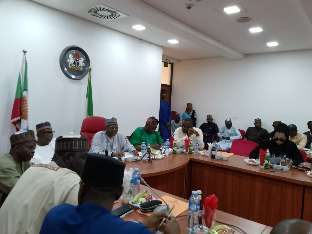
On Thursday, Nigeria’s fiscal managers were put under a lot of pressure by the Senate Committee on Finance. They questioned the Accountant-General of the Federation (AGF), Dr. Shamsedeen Ogunjimi, about what lawmakers called “embarrassing” failures to implement the budget, the fact that most Ministries, Departments, and Agencies (MDAs) would not get any capital in 2025, and the growing number of unpaid contractor claims.
The argument started when the Office of the Accountant-General was defending its 2026 budget proposal, but it swiftly turned into a larger investigation into how the Federal Government makes and spends its money.
At the center of the storm are reports that agencies that bring in money sent back around ₦28 trillion, but capital projects are still on hold and contractors haven’t been paid.
“We Will Not Take Your Money”
Senator Sani Musa (Niger East), the head of the committee, started the meeting with a frank warning: the AGF’s 2026 proposal would not be considered without good reasons.
Musa said, “We won’t give you your budget until we are sure that your office is ready to do things that will make governance work better for Nigerians.”
He said that the envelope budgeting framework is a structural issue that has never worked and called for a move to performance-based budgeting.
He remarked, “One of the things that needs to be fixed right away is the yearly envelope budgeting system, which isn’t working as planned.”
Contractors are attacking lawmakers.
Senator Danjuma Goje (Gombe Central) painted a grim picture of the country’s declining budgetary credibility, saying that contractors now come to the National Assembly every week to ask for help with unpaid contracts.
Goje remarked, “We’ve never had contractors bombard us every week for non-payment here at the National Assembly.” “This is very embarrassing.”
After big changes like getting rid of fuel subsidies and making foreign currency rates more equal, which were supposed to bring in more money, he questioned the government’s financial story.
“The impression presented to Nigerians was that more revenue will come in. Where is the money now? Why do contractors owe money? “Why was there no money set aside for capital votes for most MDAs in 2025?” he queried.
Senator Muntari Dandutse (Katsina South) made the questioning more intense.
He said, “What happened to the money if ₦28 trillion was made?” “Why do 85 percent of contractors owe money, and why was there no money set aside for capital expenses for most MDAs?”
Lawmakers said the situation was confusing because stated revenues were going up while development spending was going down.
The committee also criticized the federal government’s Centralized Payment System, with Dandutse calling it “compromised” and bad for the integrity of public finances.
“The system isn’t helping things at all. He remarked, “It is seriously hurting the integrity of government operations.”
Abdul Ningi (Bauchi Central), Asuquo Ekpenyong (Cross River South), Adams Oshiomhole (Edo North), Aminu Abbas (Adamawa Central), and Patrick Ndubueze (Imo North) were among other Senators who told the AGF to tell President Bola Tinubu about the dangers of fiscal sabotage and systemic leakages.
In response, Ogunjimi placed some of the blame on MDAs, saying they gave out contracts without having the money to pay for them.
He remarked, “The directive became necessary because contracts were being given out without cash backing.”
“As the Accountant-General, I am supposed to give out money at the right time, but I need to have the money first.”
He admitted that the Centralized Payment System has certain operational problems, saying that some of them were unexpected but are being worked on.
The AGF also justified the decision to stop using the Ways and Means facility, which had been used to fill in budget shortfalls, saying that stopping it was important for the stability of the economy as a whole.
He said, “The Ways and Means that were used in the past are no longer needed for the good of the economy.”
After the heated arguments, the committee met with the AGF behind closed doors.
We don’t know what happened during the executive meeting, but MPs have hinted that the Office of the Accountant-General’s 2026 budget proposal could be delayed until more explanations are given about how money comes in, how capital is allocated, and how contractors are responsible for their debts.
The fight shows a growing disparity between headline revenue numbers and real capital deployment, which could hurt infrastructure delivery, private sector liquidity, and overall economic confidence for both investors and contractors.
As the 2026 budget cycle moves forward, the Senate’s requirement is clear: fiscal improvements must be matched by fiscal transparency, otherwise it may be hard to get the bill passed.
About the Author