

King Solomon, who was the richest man in the world around 3,000 years ago, stated, “All is vanity.”
He was very successful in real estate, and people loved him for his very high IQ. He had 700 wives and 300 mistresses, one of which was the famous beauty Queen of Sheba.
But he nonetheless wrote Ecclesiastes, one of the most depressing texts ever written. He said that everything was bad. Feel bad for the rich person.
Elon Musk, who commented on X this week, “Whoever said ‘money can’t buy happiness’ really knew what they were talking about” (with a sad face emoji).
Of course, Musk is the richest person in the world and the richest person in history. Last week, SpaceX, the firm that makes rockets, bought his AI and social media startup xAI. This made his already huge personal worth even bigger, reaching a record high of $852 billion (£625 billion).
It’s not surprising that his “poor me” tweet struck a chord with his 234 million X followers.
Some said something like, “Give me your money and let me try.”
Others correctly pointed out that being very poor makes people much more unhappy than being very rich. And a lot of other people used it as a chance to spread their religious beliefs, saying that only God, Jesus, or Allah can make you joyful.
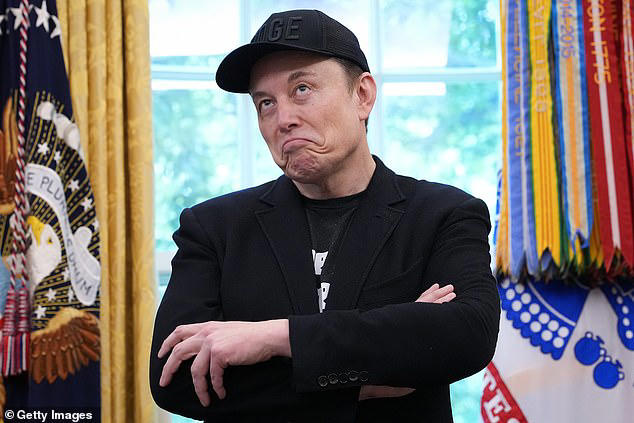
Elon Musk (in the picture) has said in public that money can’t buy happiness.
Musk’s post on his platform X saying “money can’t buy happiness” was seen 106.9 million times.
As a Christian, I have never seen that as a promise of faith. After all, our man died in the worst way possible. He didn’t run around the Galilean hills singing a first-century version of Bobby McFerrin’s “Don’t Worry Be Happy” to get people to follow him.
But he did say, “Look at the lilies in the field.” Even Solomon, in all his majesty, was not dressed like one of these. Happiness and glory are not the same thing. And Jesus did answer, “What good is it for a man to gain the whole world and lose his life?” That’s a good question.
But majority of the responses to Musk’s tweet show that people are quite disappointed that money isn’t the key to a happy existence. For some people, it feels like more than just disappointment; it feels like the start of a crisis of worldview.
Think about how it would be to be one of those people who has done everything they can to get affluent. They’ve given up relationships with partners and kids, spent their life with spreadsheets instead of going for long walks in the rain, and can’t fully remember the simple pleasures of having a coffee alone, reading a book, or playing football with friends.
From your Gulfstream, it’s hard to stop and smell the flowers. If you’ve put all your time, energy, and passion into getting rich, the thought that $800 billion isn’t enough to bring you there is like a slap in the face.
There are now a lot of specialists that can advise you how to be happy. For a long time, the happiness business has been growing. Richard Layard says that although while we in the West have more money than our grandparents did, we are also far more unhappy.
I wonder whether the connection we often draw between happiness and having more stuff and money is one of the reasons we are so miserable in the first place.
For example, think about how ads function. I’m sitting on the couch and having a really relaxing afternoon. The sun is shining, the birds are chirping, the kids are playing beautifully, and Chelsea is winning. And then the ads start to play.
It’s a story that has been told over and over again since money was invented. Three thousand years ago, King Solomon stated the same thing: “All is Vanity.”
It’s a story that has been told over and over again since money was first made. “All is Vanity,” stated King Solomon 3,000 years ago.
To encourage you to buy a new car or sofa, they need to make you unhappy with the one you already have. So they find cunning methods to whisper in your ear that your life isn’t that great right now.
You may be a lot more than you are now. If you only had this new thing, your partner would be hotter, you’d go to fancier locations, and your life would be more fun and intriguing. In order to sell you a new life, they have to first make you unhappy with the one you already have.
This is how you can be tricked into spending money you don’t have on things you don’t need. Being happy is terrible for business and bad for the economy.
The happiness experts’ answers go from the obvious (relationships and meaning are important) to the very scary (we need to establish objective techniques to quantify happiness and then use that metric to make political decisions).
Jeremy Bentham famously said in the 19th century that what was morally decent was what made the most people happy. It looked like a nice way to objectively decide what was right and wrong.
But it didn’t take long for people to say that this formula could have some really bad effects. Could a surgeon take the organs of a healthy guy to save five other people’s lives? Or could a judge send an innocent guy to jail if it would quell a violent riot outside the courthouse where people were calling for his blood?
Caiaphas argues in the Bible that it is better for one man to die for the people than for the whole nation to be destroyed.
The greatest happiness for the largest number makes justice fall apart.
So maybe we should stop worrying so much about our own happiness. Or maybe happiness is something you only find when you’re not really looking for it.
Jeremy Bentham, a British philosopher, famously said that what was morally decent was what made the most people happy.
Yes, there are some things you need to be happy: a certain level of financial security, good health, people you love who love you back, and doing something you think is significant with your life.
But these things might not make you happy. When happiness isn’t the main goal, but rather a nice side effect of living a good life, it often happens.
The issue with setting happiness as a goal is that you are making everything about you. The trouble is that the more you think about yourself, the less pleased you are.
On the other hand, the happiest people I’ve known don’t really care about their own happiness. Trying to make yourself happy is like trying to tickle yourself: it doesn’t really work.
Solomon learned that if your life is all about you, then death is the end of everything that matters to you, no matter how rich you are. There are no pockets in shrouds.
And if you think it’s all about money, you’ll always be bothered by this. When you understand it in Hebrew, the phrase makes more sense.
The Hebrew term “hevel” means “vanity,” although it is better translated as “shortness of breath.”
This life is short, and if this is where you put your center of gravity, you will lose everything one day. But if you have put your heart outside of yourself, you have put it out of reach of your own death, and you can live without fear. This is what Solomon, who was once the richest man in the world, said.
Michael Argyle, an old friend and former parishioner of mine who was a professor of psychology at Oxford and has since passed away, once told me that there were two ways to be happy: religion and Scottish country dance. I laughed.
Country dancing because we all need to feel the warmth of someone other in our arms. And religion, because it’s not always about you. He wasn’t too far off when he said that.
About the Author