
The Africa Development Studies Centre (ADSC) has asked the federal government to move some government offices and spread out administrative tasks as part of urgent steps to fix the growing traffic problems in the Federal Capital Territory (FCT).
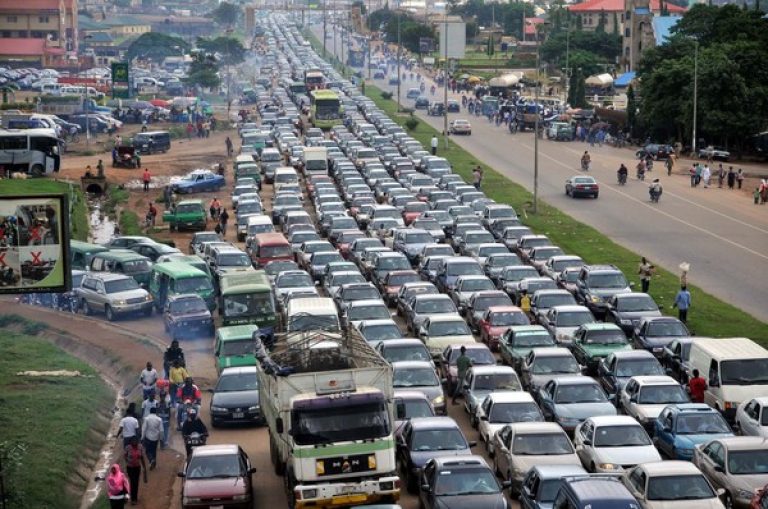
The Saturday Guardian reports that the center’s policy research and urban systems analysis show that Abuja’s constant gridlock is no longer just a transportation problem, but a structural governance problem caused mostly by the fact that there are too many public institutions in the city center.
Victor Oluwafemi, the president of the ADSC, said in a statement yesterday that the daily traffic pattern in Abuja is now a threat to national productivity, public service performance, staff health, investor confidence, and the long-term livability of the city.
Oluwafemi said that every weekday, a lot of cars head into the same central corridors in the morning since government offices, service stations, and busy institutions are all in the city center. In the evening, though, the traffic goes the other way.
He said that ADSC’s research showed that the main cause of the problem is not a lack of road infrastructure, but rather a concentration of institutions.
He remarked, “The more Abuja keeps putting all of its government work in the same small area, the more traffic will get worse, no matter how many interchanges are built.”
“While expanding roads and improving corridors are still necessary, they are not enough on their own to solve the problem.
“Global urban planning evidence shows that when concentrated destinations create traffic demand, adding more lanes often only provides temporary relief before congestion returns as demand rises to match the new capacity.”
“Abuja must therefore move from a road-led response to a governance-led, spatial planning strategy that cuts down on the need for people to commute to the city center every day.”
He asked President Bola Tinubu and the Minister of the FCT, Nyesom Wike, to start a decongestion program based on evidence that would speed up the construction of satellite towns and move government functions to smaller areas.
Oluwafemi said that towns like Kwali, Gwagwalada, Kuje, Bwari, and Abaji have a lot of land and room to grow, but they are mostly residential spillovers, which makes the city center busier for commuters.
He remarked, “The answer is to make them useful municipal centers where people can work, get services, and live without having to go to central Abuja every day.”
The president of the ADSC suggested moving non-sensitive and high-traffic government functions to these satellite towns in stages. These functions include back-office directorates, training institutions, conference facilities, records and archives, logistics centers, procurement and compliance units, and other service points that get a lot of foot traffic.
He also underlined the need for faster digitization of government operations to cut down on the requirement for physical mobility that comes with approvals, file routing, and coordination across agencies.
Oluwafemi also suggested moving federal institutions that are suitable to other states to make things easier for the capital in the long term and encourage balanced growth across the federation.
“Abuja should not wait until it is permanently gridlocked to make changes to its structure. He said, “Now is the time to act.”
About the Author