
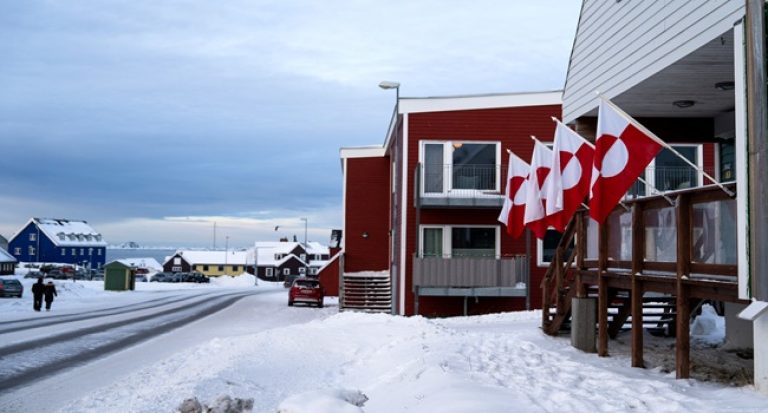
Canada and France, both of which are against US President Donald Trump’s claim to Greenland, will open consulates today in the capital of the Danish autonomous territory. This is a powerful show of support for the local administration.
Trump has been saying since he got back to the White House last year that Washington needs to control the important, mineral-rich Arctic territory for security reasons, according to AFP.
Last month, Trump backed off his threats to take over Greenland after stating he had made a “framework” arrangement with NATO commander Mark Rutte to give the US more power.
A working committee made up of the US, Denmark, and Greenland has been set up to talk about Washington’s security concerns in the Arctic, but the specifics have not been made public.
Denmark and Greenland have both acknowledged they agree with Trump’s security concerns, but they have also made it clear that sovereignty and territorial integrity are “red lines” in the talks.
Jeppe Strandsbjerg, a political scientist at the University of Greenland, stated, “In a way, it’s a victory for Greenlanders to see two allies open diplomatic offices in Nuuk.”
“There is a lot of gratitude for the help against what Trump has said.”
French President Emmanuel Macron said he will open a consulate in Nuuk during a visit in June. He also said that Europe stands with Greenland and criticized Trump’s proposals.
Before he became consul in France, Jean-Noel Poirier was the ambassador to Vietnam.
Poirier told our reporter before departing Copenhagen for Nuuk, “The first thing on the agenda will be to listen to Greenlanders, to hear them, to let them explain their position in detail, and for us to confirm our support to them, as much as they and the Danish side want.”
In late 2024, Canada said it would open a consulate in Greenland to help the two countries work together better.
French researcher and Arctic expert Mikaa Blugeon-Mered told our correspondent that the decision “came as Canada was choosing to strengthen its Arctic strategy when Trump’s return was expected.”
Ulrik Pram Gad, an Arctic expert at the Danish Institute of International Studies, told our correspondent that the opening of the consulates is “a way of telling Donald Trump that his aggression against Greenland and Denmark is not just a question for Greenland and Denmark; it’s also a question for European allies and Canada as an ally, as a friend of Greenland and the European allies.”
“It’s a small step in a plan to make this problem European,” said Christine Nissen, a security and defense analyst at the Europa think tank.
“The effects are clearly not limited to Denmark. It’s European and worldwide.
Acknowledgment
Strandsbjerg said that the two consulates, which would answer to the French and Canadian embassies in Copenhagen, will allow Greenland a chance to “practice” being independent. The island has long wanted to break free from Denmark.
Nissen noted that the choice to open diplomatic offices is also a sign of Greenland’s rising independence, as stated in its 2009 Self-Government Act.
She added, “In their own quest for sovereignty, the people of Greenland will want to have more direct contact with other European countries.”
Pram Gad said that this would make it possible to lessen Denmark’s involvement “by diversifying Greenland’s dependence on the outside world so that it is not solely dependent on Denmark and can have more ties for its economy, trade, investments, politics, and so on.”
Greenland has had diplomatic relations with the European Union since 1992, with the United States since 2014, and with Iceland since 2017.
In 2013, Iceland opened a consulate in Nuuk. The US, which had a consulate in the capital of Greenland from 1940 until 1953, revived its post in 2020.
In 2024, the European Commission opened an office.
About the Author