

“Shipbuilding, cars, and semiconductors have made South Korea what it is today.” “Physical AI” is the next big thing that will happen in the 21st century, I am sure of it.
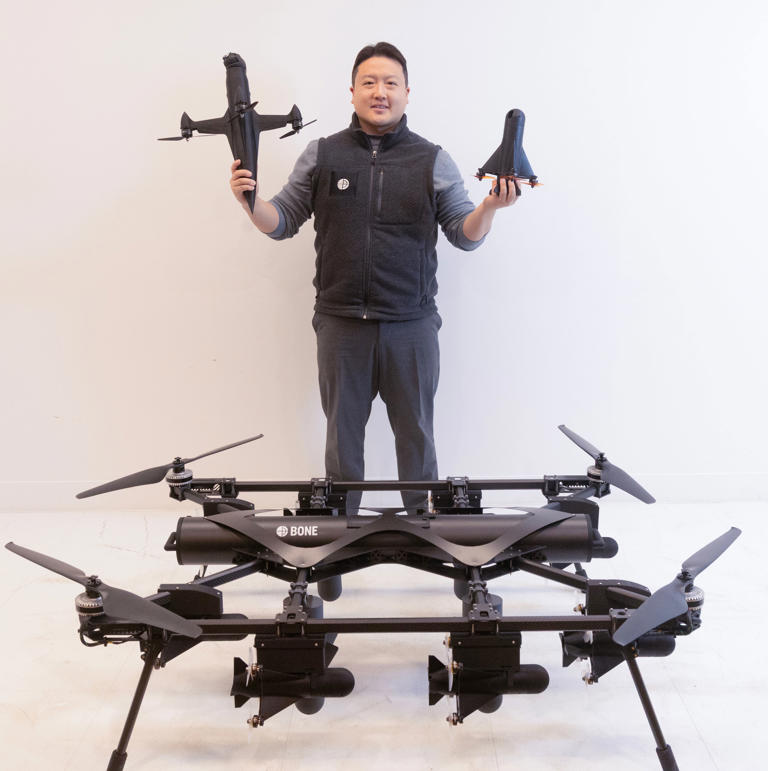
Lee Do-kyung, the CEO of BONE, a drone AI business, said these statements during a presentation of the company’s self-developed drones on the 6th. Lee said at BONE’s headquarters in Teheran-ro, Gangnam-gu, Seoul, “This drone system has a ‘mother ship’ and ‘child ships.’ One mother ship can carry up to 12 child ships.” While in the air, these drones can do reconnaissance, surveillance, interception, and other things.
Lee started BONE in January of last year with the purpose of making the Physical AI business in South Korea stronger. He went to Cornell University in the US to study business administration. In 2020, he helped start MarkVision, a digital startup that checks to see if things bought online are real. He decided to start BONE after meeting Sam Altman, the founder of OpenAI, when Altman visited to South Korea in 2023. “Altman held an event where he talked to AI business owners. That experience made me even more sure that generative AI, which started with large language models (LLMs), would eventually relate to Physical AI, like robotics.
At the moment, humanoid robots are the most important part of Physical AI. Lee said, “I think it will take at least another ten years for humanoid technologies, which companies like Tesla and Hyundai Motor Group are working on, to be used in homes or businesses.” He went on to say, “On the other hand, drones for military and public use are a Physical AI sector where results can be seen in a shorter amount of time.”
On the 6th, CEO Lee Do-kyung shows off the company’s drone control equipment at the Gangnam-gu, Seoul headquarters office.
Chinese business DJI has a 90% dominance of the worldwide commercial drone market right now. Lee said, “DJI is often called the Apple or Tesla of the drone industry because it completely controls the market.” It’s hard to be successful in business, but there are clear ways to drive demand in the defense and governmental sectors because people are worried about Chinese brands.
Within a year of starting, BONE made 3 billion Korean won in sales from projects with Sangju City, the Ministry of Land, Infrastructure and Transport, and other clients. Lee said, “We are using our drone AI system to keep an eye on forest fires in Sangju City and are also taking part in the Ministry of Land, Infrastructure, and Transport’s drone demonstration city initiative.” The company has also sold agricultural drones and sent spy drones to the military.
As of last year, BONE had raised 17 billion Korean won in investments, including a recent multi-billion-won investment from the worldwide venture capital firm Ora worldwide. There are about 30 people working for the company right now. Lee said that reading the autobiography of Chung Ju-yung, the late Honorary Chairman of Hyundai Group, who started his career in the shipbuilding business while serving in the military in 2012, motivated him to become an entrepreneur. He said, “If you ask me what industries will define the 21st century, like semiconductors, shipbuilding, and cars did in the 20th, I am 100% sure it will be the robotics industry based on Physical AI.”
Lee thinks that the government’s aim to train 500,000 drone experts will change the business for the better. He said, “South Korea only has 1–2% of the global drone market, mostly because drones haven’t been taken seriously or actively developed.” The confrontation between Russia and Ukraine showed the world how important drones are. He went on to say, “It’s not okay for a country that makes a lot of artillery and tanks to rely only on drones made in the U.S. and Europe.”
Lee wants to make 30 billion Korean won in sales this year and set up a method for making tens of thousands of drones in mass production within the next two to three years. He said, “A lot of physical AI will be made and used in many areas, such as the military, disaster response, and logistics.” We want to challenge companies that make robots for the air, land, sea, underground, and space.
About the Author