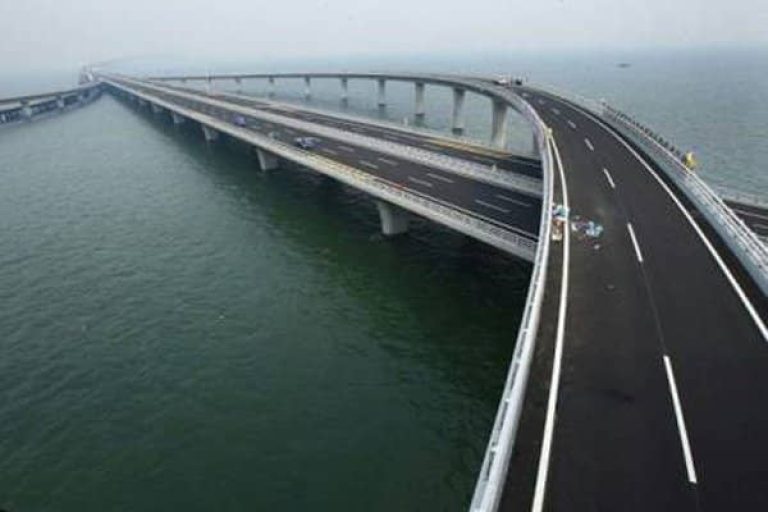
Three years after the Lagos State government chose a preferred bidder for the Fourth Mainland Bridge, the CCECC-CRCCIG Consortium, a Chinese civil engineering organization, work has not yet begun on the site.
This is just like how Mr. Babajide Sanwo-Olu, the governor of Lagos State, has gone from promising when the project will start to being quiet. He didn’t mention it during the New Year’s Thanksgiving ceremony a few days ago, even though he talked about a number of other state projects, according to the Saturday Guardian.
In December 2022, the state government announced the preferred bidder for the project. Then, on November 1, 2023, the Lagos State government, the African Export-Import Bank (Afreximbank), and Access Bank agreed to lend $1.35 billion for three major infrastructure projects in Lagos, including the fourth mainland bridge.
This is not true, even though the Chinese CCECC-CRCCIG Consortium was named the preferred bidder in December 2022 and Sanwo-Olu promised many times that construction would start in early 2023 and then again in March or April 2024.
But the flag-off hasn’t happened yet, even though the last date for starting work was 15 months ago.
But since those two important dates for the project, the state administration has gone from saying when the project will start to not saying anything at all about it.
Sanwo-Olu previously indicated that work would start in early 2023, but in January 2024, he said that work will start on the bridge in the first quarter of 2024, but it never did.
In a TV interview last year, Sanwo-Olu remarked, “Everyone who has given money to help us build the Fourth Mainland Bridge project, which costs about $2 billion, is asking for a sovereign guarantee.” They want you to get a promise from the central government. We can’t press it because we’re not the central government. it would mean going to the Federal Executive Council (FEC) and the National Assembly. So, it’s hard for us to go past this line.
The Fourth Mainland Bridge was first suggested in 2006, with plans to start building it in 2017 and finish it in 2019. However, it is still just a plan.
It is interesting to note that President Bola Tinubu’s message to Lagos Governor Babajide Sanwo-Olu on his 60th birthday included the building of the bridge.
In a statement from Bayo Onanuga, the president’s Special Adviser on Information and Strategy, Tinubu called Sanwo-Olu a devoted public servant who has kept true to his goal of changing Lagos.
Your vision has come to life in many important ways, such as finishing the Blue and Red Rail lines and getting ready for the Purple Line, which will serve the important Lekki corridor. Tinubu stated, “I urge you to stay on this path by putting important projects for Lagosians first, especially the long-awaited Fourth Mainland Bridge and the Freedom Way to Victoria Garden City (VGC) Road.”
The Fourth Mainland Bridge is a big 38-kilometer project that Lagos State hopes would change the way people move around. It is meant to connect Ajah and Ikorodu by a modern toll road with three toll plazas, nine interchanges, and a 4.5 km lagoon crossing. This bridge is projected to be the second longest in Africa.
The project was once planned to cost $2.2 billion, but that number was later changed to about $2.5 billion, which included forming a public-private partnership. However, it has been hard to get off the ground.
While giving a speech at the 2026 Lagos annual thanksgiving ceremony, Sanwo-Olu surprisingly did not mention the Fourth Mainland Bridge. Instead, he talked about a number of other projects that the state government would pay attention to, including making room for them in the 2026 budget.
“Under my leadership, we will keep building on the progress we’ve made over the past six and a half years, guided by our THEMES+ vision,” he said. We will finish and start several projects that will change things in various areas and portions of the State.
“The year 2026 is very important to me since it would be my last full year as Governor of Lagos State. Because of this, I am really motivated and determined to make this year count, both on purpose and with purpose. For all of us, it has to be a year of great purpose, importance, and profit. There are a lot of projects that we will be starting and using this year, but some of them are quite meaningful to me.
The Ojo General Hospital, the Odo Iya-Alaro Link Bridge, the new Massey Children’s Hospital, the Central Food Security Systems and Logistics Hub in Epe, the new Psychiatric Hospital in Ketu Ereyun, Epe, and the new Multi-Storey Office Complex in Alausa are all examples of these.
“In 2026, we will finish and open the following road infrastructure projects: The Igbogbo–Bola Ahmed Tinubu–Igbe Road, the Agric Isawo–Konu–Arepo Road, Phase One, the Gberigbe Road from Ewu Elepe through Gbodu Junction to Gberigbe Town, and the Adamo–Akanun–Agunfoye–Lugbusi Road are all in Ikorodu.
In Ikeja, the Opebi–Mende Link Bridge and the roads that lead to it. In Eti-Osa, the Eti-Osa/Lekki/Epe Expressway, Phase 2A, goes from Eleko Junction through Awoyaya to Greensprings and from Majek to Abraham Adesanya. The Magbon–Alade Township Roads in Ibeju-Lekki. The Ijegun–Ijagemo Road and the Akesan–Igando Road are also in Alimosho.
“This is not a complete list, as I’ve indicated. Lagosians will benefit from many other construction and rehabilitation projects in 2026. These include schools and hospitals, youth and sports centers, drainage and flood control systems, bus and ferry terminals, housing projects, water schemes, waste management plants, court buildings, and more.
“This year, our Green Line metro rail project, which will connect Marina to the Lekki Free Trade Zone (LFTZ), will make progress. It will change life and business along the eastern corridor of the state.” We started the Omi Eko project last year with help from development partners. It is another big transportation infrastructure project that we will move forward with in 2026. It will change the way we move water and work well with our plans to improve and expand our roads and railroads. Our 2026 budget, “The Budget of Shared Prosperity,” will support and make all of these programs and goals possible, Sanwo-Olu said.
About the Author