

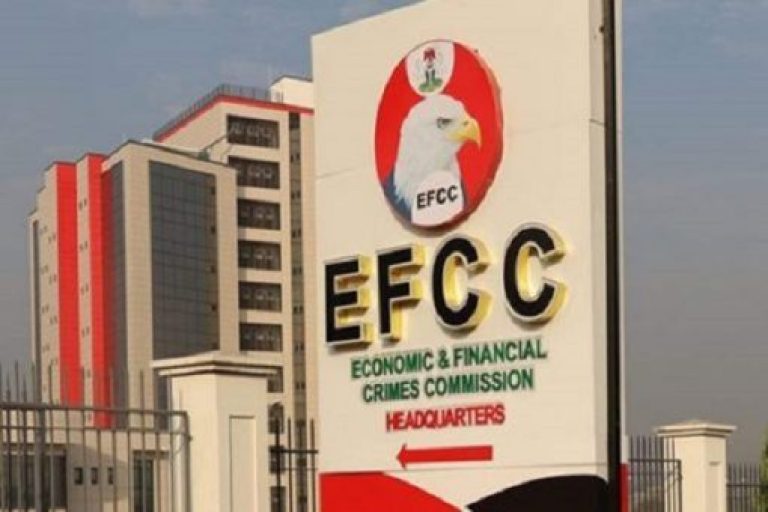
A number of banks and fintech firms that are reportedly involved in fraudulent schemes that duped Nigerians of N18.7 billion are the subject of an investigation by the Economic and Financial Crimes Commission (EFCC).
The Commission said in Abuja today that the scams, which included a phony investment scheme and a discount on plane tickets, revealed flaws in the nation’s banking system’s consumer due diligence and supervision.
In remarks to reporters, Wilson Uwujaren, the Director of Public Affairs for the EFCC, stated that the Commission had discovered “two distinct schemes being employed by fraudsters to scam Nigerians,” with financial institutions serving as crucial infrastructure.
Uwujaren claims that the first scam used a phony airline ticket discount offer to lure gullible tourists. He clarified
“Any unsuspecting foreign traveler will fall for a series of carefully crafted airline discount information used by these fraudsters.” They promote a discount program for buying airline tickets from a specific international carrier. “The payment module is made in a way that makes their victims believe that the money has been transferred to the airline’s account.” The passenger’s full bank account gets depleted as soon as the payment is completed.
According to the Daily Independent, he revealed that more than 700 victims lost N651,097,755 in total as a result of the airline discount scam.
Although the EFCC was able to collect and restore N33,628,000 to certain victims, he cautioned that the fraud is still going on, pointing out that foreign actors are using Bybit to transfer stolen money to safer locations after converting it into cryptocurrency.
False investment promises were used to get Nigerians to participate in the second, larger scheme, which featured Fred and Farid Investment Limited (FF Investment).
Over 200,000 victims were impacted, according to Uwujaren, and N18,088,901,272.35 was transferred through nine businesses that offered various fraudulent investment packages. Overall, he disclosed that banks were directly involved in the defrauding of over 900 Nigerians.
He went on to say that foreigners planned the operation and collaborated with three Nigerians who have since been detained and charged.
Michael Wetcas, Acting Director of the EFCC’s Abuja Zonal Directorate, and Abdulkarim Chukkol, Director of Investigations, gave additional information about the financial institutions’ involvement.
According to them, investigations revealed willful violations of banking protocols that made it possible to launder and transfer illicit proceeds overseas.
“A new generation bank and six Fintechs and Micro Finance Banks are involved in this,” they claim.
It is evident that the financial institutions violated banking protocols, enabling the scammers to securely convert their earnings into digital assets and relocate to secure locations.
A total of N18, 739, 999, 027.35k was transferred via our financial system without the banks conducting adequate due diligence on their clients, they said.
Even more concerning, EFCC investigations revealed that a single new-generation bank handled N162 billion worth of bitcoin transactions without conducting the necessary checks. In one extreme instance, it was reported that one customer had 960 bank accounts, all of which were allegedly used fraudulently.
The EFCC urged financial regulators to strictly enforce the rules for Suspicious Transaction Reports (STRs), Customer Due Diligence (CDD), and Know Your Customer (KYC). It cautioned that any fintech, microfinance, or deposit money bank discovered to be assisting fraudsters should be suspended and prosecuted.
The Commission assured Nigerians that it would step up efforts to combat financial crimes and money laundering, emphasizing that carelessness and neglecting to keep an eye on suspicious or structured transactions “would no longer be allowed.”
Additionally, Uwujaren called on financial institutions to improve their internal controls, cautioning that persistent failures would put the economy at increased risk of “leakages and compromises bleeding the economy.”
As investigations continue, the EFCC reiterated its commitment to safeguarding the integrity of Nigeria’s financial system and holding complicit institutions accountable.
About the Author