
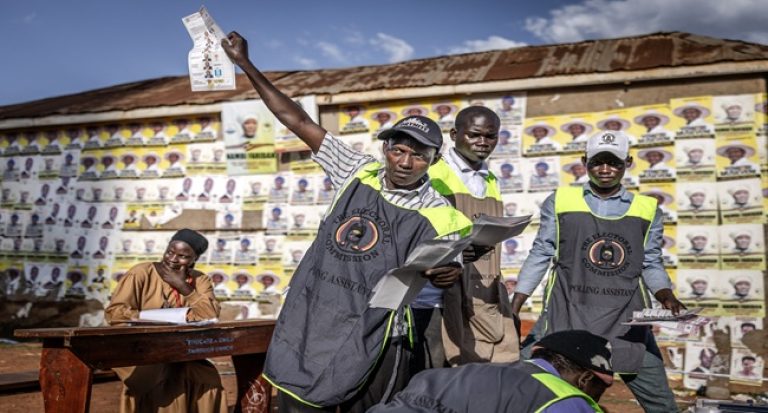
As President Yoweri Museveni tries to extend his 40 years in power, yesterday’s voting in Uganda was a shambles due to an internet blackout and lengthy delays caused by technical problems. Polls eventually closed.
Since he controls the whole state and security apparatus, 81-year-old Museveni—who ascended to power in 1986 leading a guerrilla army—is generally anticipated to secure a seventh term in government, according to AFP.
On the other hand, returning officers handed out ballots for Bobi Wine, the primary challenger—a singer-turned-politician—amidst thunderous cheers from a Kampala stadium in an opposition stronghold.
Rights organizations claim that the 43-year-old, who calls himself the “ghetto president” in reference to the urban slums where he spent his formative years, has been subjected to “brutal repression” during his campaign.
Within 48 hours, the official findings were expected.
Under the guise of the government-imposed internet ban this week, Wine accused the government of “massive ballot-stuffing” and the detention of several party executives.
Ballot boxes were late in arriving and biometric machines—used to verify voters’ identities—were malfunctioning, which caused several hours of delays in voting at several polling places across the nation. Some people blamed the malfunctions on the internet shutdown.
“We are conducting elections without light,” Wine remarked following his vote.
“The goal is to make it easier to rig the regime,” he declared. “The people of Uganda should resist,” we would say.
The voting, however, went off without a hitch. The Ugandan Red Cross had personnel stationed around the nation in the days leading up to the elections, and a representative from the organization informed our reporter that they had received “no substantive” allegations of violence.
Police and soldiers were out in force all day as officials sought to quell the kind of anti-government demonstrations that have rocked neighboring Tanzania and Kenya in recent months.
Even Museveni had problems with the voting equipment, so he pledged to look into it.
I made a mark with my right thumb. It was rejected by the machine. According to what he told reporters, “I put my left, and it did not accept it.” He went on to say that after scanning his face, the computer eventually let him cast his ballot.
Safeguarding Harmony
Hundreds of Wine’s backers were arrested in the hours before up to the vote, just as they had been in his 2021 campaign. At rallies, he sported a flak jacket and used terms like “war” and “military dictator” to characterize Museveni and the election.
Suppressing ten non-governmental organizations (NGOs), including those responsible for overseeing elections, has been criticized by Human Rights Watch.
The administration justified the internet shutdown by saying it was necessary to stop the spread of “misinformation” and “incitement to violence,” but the UN deemed it particularly worrisome.
Other prominent opposition figure Kizza Besigye is currently on trial for treason after being kidnapped in Kenya in 2024 and returned to a military court in Uganda. Besigye ran four times against Museveni.
Even though much was lost due to a never-ending series of huge corruption scandals, many Ugandans still hold Museveni in high esteem as the leader who brought order to the country after independence and supervised its fast economic development.
There is a high level of safety and stability across the nation. “The party is well-organized,” remarked Angee Abraham Lincoln, 42, a Museveni supporter who was waiting to cast his vote in Kampala.
Museveni has been granted a great deal of leeway by Western nations due to his willingness to comply with their neoliberal reform demands in the 1980s and his valuable cooperation in the US-led “war on terror” in the 2000s, particularly in terms of troop commitments to Somalia.
After casting his ballot, the president declared his support for “anyone who believes in Uganda… who believes in Africa.”
About the Author