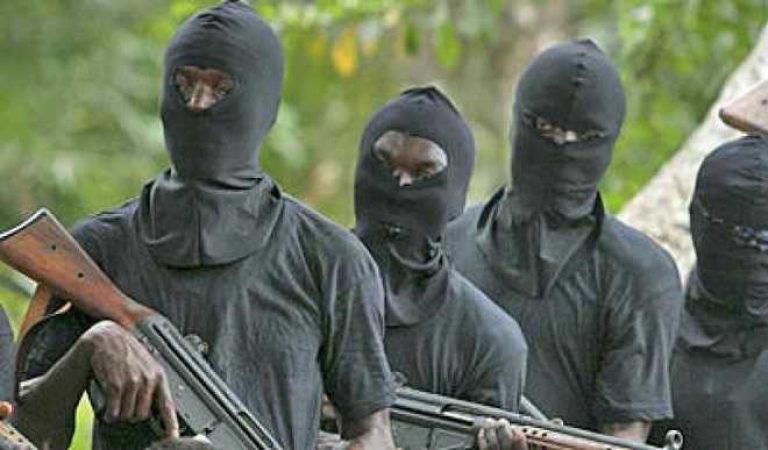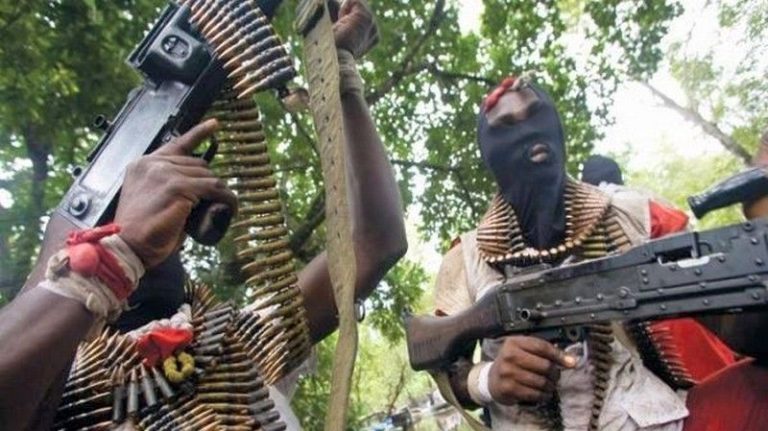

The Nigerian military is keeping an eye out for fighters from the West Africa Province who are escaping their hiding places as a result of the recent US airstrikes against Boko Haram and Islamic State.
On Christmas Day, US President Donald Trump declared that the US military had carried out deadly attacks against Islamic State sites in northwest Nigeria.
According to The PUNCH, the federal authorities verified the operation and described it as a continuation of ongoing counterterrorism collaboration.
Armed gangs were reported to have moved into other regions after the strikes.
According to a source, Daniel Abomtse, the Chairman of the Traditional Council in Benue State’s Gwer West Local Government Area, expressed alarm over what he called an invasion of armed herders into several towns following the attack.
Community leaders in Sokoto State’s Tangaza, Gudu, and portions of Illela also said that the armed groups had been clearly moving and dislocating.
Speaking under the condition of anonymity, some of them claimed that suspected bandits were observed traveling in smaller groups in the direction of isolated forest passages, while others were thought to be trying to enter nearby border settlements.
Senior military sources, however, told our correspondent yesterday that the military was monitoring the terrorists’ movements.
“We are aware that they are running away. We are working on that and have information about it. One official stated, “They are being watched over and their movements are being tracked.”
According to a different official, intelligence, surveillance, and reconnaissance activities were being carried out to keep an eye on the situation.
“Is it possible that we are unaware that they are escaping?” asked the official. We are tracking them via ISR, and we have the information.
Divergent views have been voiced by retired senior military leaders over the potential deployment of US troops to Nigeria.
In response to a CNN question about whether Nigeria may consider allowing US forces to enter the country, Foreign Affairs Minister Yusuf Tuggar recently stated that the Ministry of Defense will advise the government on potential next measures.
Brigadier-General Peter Aro (retd.), a former senior commander, stated that he opposes the stationing of US military in Nigeria and cautioned that doing so would have major legal, diplomatic, and social ramifications.
He stated that the deployment of foreign troops would have “profound” repercussions and that only a formal defense agreement authorized by the highest level of government could be used.
He asserted that the presence of foreign military personnel in Nigeria could exacerbate the country’s already precarious internal unity.
“I strongly oppose the deployment of US soldiers on Nigerian soil,” he declared. This is a significant issue that needs to be handled very carefully. From a legal and diplomatic perspective, foreign troops on the ground can only follow a formal Defense Pact that has been authorized at the highest levels of government, and even then, there would be serious repercussions.
Foreign forces might increase domestic mistrust, support rebel propaganda, and aggravate preexisting regional and religious sensitivities at a time when our nation is already struggling with brittle national cohesion. Reactions on social media indicate that even some northern intellectuals and elites are uneasy with this involvement, which says a lot.
Aro maintained that Nigeria already had enough ground forces, including the armed forces, police mobile units, and civil defense professionals, and that further US engagement did not necessitate US military presence.
According to him, the US could assist Nigeria in these areas without having to replace local troops on the ground: air power, surveillance, and precision attack capacity.
He went on to say that legitimacy and long-term stability depended on Nigerian authority over land operations.
Nonetheless, Brigadier General Bashir Adewinbi (retd.), another retired commander, advocated for increased security cooperation with the United States, stating that international cooperation was standard procedure.
He connected the Christmas Day hit to a collaborative Nigeria-US effort and claimed the National Security Adviser’s recent visit to the US was a part of continuous coordination.
According to Adewinbi, he would be in favor of the deployment of US troops if it was deemed necessary to enhance security, as long as proper diplomatic procedures and well-defined conditions of engagement were followed.
You may recall that the NSA traveled to America as a result. The strike on Christmas Day is a joint exercise between the United States and Nigeria. In any case, they are successful, efficient, and have accomplished a great deal in a brief amount of time.
“If the deployment of US troops to Nigeria is a means of resolving our issue, then it is cooperation if necessary.
It takes place between nations and global groups. Indeed, cooperation is the solution to the current global issue.
Furthermore, he stated that international alliances were meant to produce results and that such a collaboration would not lower the morale of Nigerian military.
According to him, Nigeria should be willing to cooperate with any nation if doing so would assist combat insecurity.
There is nothing wrong with working together. If they do show up, they ought to have explained the terms and conditions as well as their purpose. Morale cannot be lowered by it.
“When we move forward, we will tell you whether the move is right or not,” added Major General Dayo Olukoju (retd.).
Strategic errors cannot be made at this time.
Group Captain Sadique Shehu (retd.), a former spokesman for the Nigerian Air Force, criticized proposals that US troops be sent to Nigeria to support the country’s ongoing fight against terrorism.
“As a former military officer, I found the development concerning,” Shehu remarked, adding that it was unfortunate that such a notion was being discussed.
Nigeria should not rely on foreign troops to fight on its territory, he added, but it may go to external partners for help and technological support.
“It is really disheartening that some people are even considering that,” he remarked. I feel embarrassed as a male in the military. How did we get here? We acknowledge that we lack their technology, but if you are referring about their armies coming to defend us, then the nation is doomed.
However, he stated that it was unlikely that the United States would send a sizable military force to Nigeria, as was the case in Iraq or Afghanistan.
The deployment of small advising teams, which he acknowledged has been going on, was more likely, he said.
Shehu also addressed the reported US strikes in Sokoto, stating that there was currently no proof that any terrorists had been killed.
There is currently no proof that any terrorists have been killed, he stated. We don’t know if they murdered anyone, but we do know that there was an attack.
“Nigeria should make sure that Nigerian authorities communicate directly with citizens instead of depending on statements from foreign governments, and clearly define the terms of any security assistance received from foreign partners,” the retired officer continued.
What kind of agreement did they reach? I must clarify that the roof I’m inviting you to fix is the roof in my parlor, not the roof in my bedroom.
“You come and observe—this is what nations do. I regret to inform you that, in my opinion, we did not do that in Nigeria. It shouldn’t be Trump speaking to Nigerians when an attack occurs. It should be Nigerians speaking to Nigerians, in my opinion. We shouldn’t only pay attention to what Washington says.
Trump was the first to contact us following this attack. Is that correct? That shouldn’t be the case. Yes, we are grateful for their assistance, and we do need it. However, you have to lay out the guidelines for how that assistance will be given.
Riley Moore, a US congressman, has backed President Donald Trump, saying that the recent US airstrikes in Nigeria were meant to bring security and peace to the nation rather than conflict.
Moore stated in a post on X yesterday that the goal of the Christmas Day strikes against ISIS was to shield hundreds of Christians who were in danger of death and facing extreme violence.
Christians in Nigeria now have hope thanks to the united endeavor, he continued.
“President Trump is bringing peace and security to Nigeria and to the thousands of Christians who are subjected to terrible violence and death; he is not attempting to bring about war in Nigeria.”
Moore said, “The Christmas strikes against ISIS, coordinated with the Nigerian government, have given hope to the Christians in Nigeria.”
About the Author