
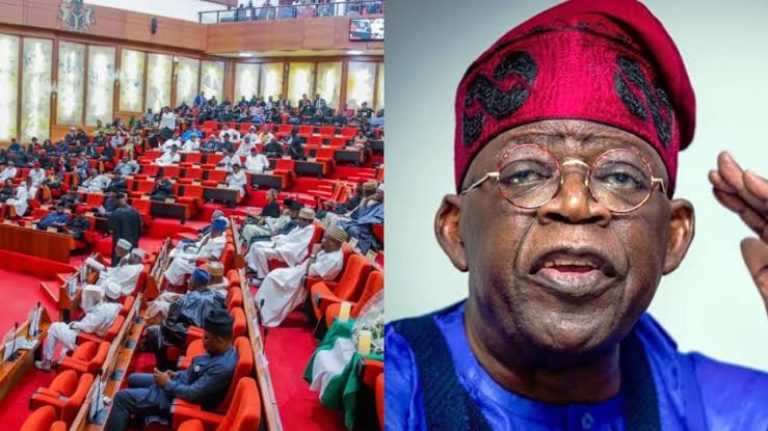
The Senate today increased the budget to ₦58.47 trillion, adding almost ₦292 billion to the executive estimate, and approved the Appropriations Bill for second reading, just five days after President Bola Ahmed Tinubu proposed ₦58.18 trillion for the 2026 fiscal year.
According to The Guardian, the higher reassessment brings the budget into line with the amount already authorized by the Federal Executive Council (FEC) during the 2026 estimates’ planning phase.
President Tinubu suggested a somewhat smaller amount of ₦58.18 trillion when he presented the draft budget to a joint session of the National Assembly on Friday.
Senator Adeola Olamilekan, the chairman of the Senate Committee on Appropriations, explained the disparity by pointing out that it was caused by small errors in the president’s presentation speech and accompanying documentation. He emphasized that the appropriation bill itself is still the final document that must be considered by lawmakers.
Adeola stated, “The appropriation bill contains the official budget figure for deliberation.”
“The National Assembly will accept the law itself as the authoritative figure, even though there may have been a few little errors in the president’s speech or accompanying materials. As a result, the official federal budget for 2026 is ₦58.472 trillion.
The National Assembly would confirm and finalize the actual budget size once discussions begin, he noted, adding that the fluctuation shouldn’t divert lawmakers or the public from the spending plan’s core content.
“The fact that the appropriation bill is the authoritative document should not be overshadowed by the disparity in figures between the bill and the President’s initial presentation,” he stated.
Citing the proposal’s strong capital component, emphasis on security, and focus on economic consolidation, the Senate, which granted the budget fast consideration, called it one of the strongest fiscal frameworks the nation has created in recent years.
Senate Leader Opeyemi Bamidele (Ekiti Central), who led the discussion, stated that the proposed Appropriation Act aims to authorize withdrawals from the Federation’s Consolidated Revenue Fund to finance government operations for the fiscal year that ends on December 31, 2026.
He remembered that on December 19, 2025, the law was presented to a combined session of the National Assembly, where it had already passed first reading.
The 2026 budget, according to Bamidele, is a “budget of consolidation,” intended to strengthen current measures and stabilize the economy.
He claims that the expenditure framework consists of ₦23.214 trillion for capital expenditures through contributions to the Development Fund, ₦15.909 trillion for debt servicing, ₦15.252 trillion for recurrent (non-debt) expenditures, and ₦4.097 trillion for statutory transfers.
With key areas including transportation, electricity, agriculture, housing, industrial development, and the digital economy, he claimed that the scale of the capital component indicates the administration’s emphasis on growth, productivity, and infrastructure development.
The Senate Leader informed his colleagues, “The capital allocation is designed to stimulate private investment, create jobs, and strengthen food and energy security.”
Regarding recurring spending, Bamidele stated that the ₦15.252 trillion provision was meant to guarantee effective government operations and service delivery. He also mentioned that the President had promised to implement stringent cost controls, enhance payroll management, and implement efficiency measures to reduce waste.
He acknowledged the substantial debt service allocation of ₦15.909 trillion, but stated that the Federal Government was working to lower borrowing over time by increasing revenue mobilization, broadening the tax base, and improving the performance of government-owned businesses.
He pointed out that the ₦4.097 trillion set aside for statutory transfers was essential to the stability of democratic administration and fulfilled constitutional duties to important institutions.
Bamidele added that anticipated revenues for 2026 were ₦34.33 trillion, and that the projected budget deficit, which was predicted to be 4.28 percent of GDP, stayed within the medium-term fiscal constraints already authorized by the National Assembly.
In their remarks, a number of senators commended the heavy focus on infrastructure, agriculture, healthcare, education, and security, emphasizing that peace and safety were essential to long-term economic expansion.
The ₦15.9 trillion debt servicing provision, according to Senator Mohammed Sani Musa (Niger East), is essential to maintaining economic confidence and maintaining Nigeria’s reputation with foreign development partners. He cautioned that nonpayment of debt commitments might cause economic instability.
Ahmed Lawan (Yobe North), a former Senate president, called the budget “historic and courageous,” pointing out that defense received the biggest portion, demonstrating the administration’s dedication to protecting people and property.
However, he issued a warning that political actions before to 2026 must not interfere with the execution of the budget, particularly during the year’s pivotal first quarter.
Other lawmakers emphasized that capital expenditures now make up almost 40% of the overall budget, which is a first for Nigeria’s budgetary history. They also emphasized the necessity of strict legislative monitoring to prevent implementation flaws that have weakened past budgets.
Insisting that successful implementation, not lofty numbers, would ultimately determine whether Nigerians felt the impact of the 2026 budget, the Senate decided to pass the bill for second reading and send it to the Committee on Appropriations for in-depth review at the end of the debate.
About the Author