
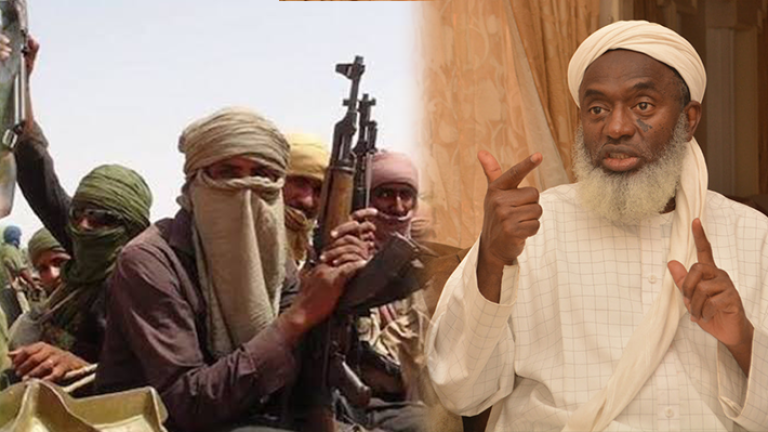
Sheikh Gumi, a controversial Islamic cleric, has said that kidnapping pupils is a “lesser evil” than killing troops. He says that Nigeria has to talk to robbers to stop more tragedy.
Gumi claimed in an interview with the BBC that kidnapping children is “evil,” but it is not as bad as murder, especially when the children are subsequently released safely.
“Saying that kidnapping kids is a lesser evil than killing your soldiers is absolutely a lesser evil. They are all bad, but killing is the worst. It’s not as bad as the other options. Not all bad things have the same amount of power.
He talked about past events, such the mass kidnapping in Kebbi State, and said that the victims were released without anyone dying.
“Well, it’s not as bad as what happened in Kebbi.” They took kids and let them go. They didn’t kill them.
The comments came after more than 315 individuals, including 303 kids and 12 instructors, were kidnapped in Niger State.
The PUNCH says that on Monday, December 7, the federal government said that 100 students would be freed. An earlier story said that 50 other students had escaped mere days after the kidnapping.
Gumi only said, “It’s an evil, and we pray that they escape,” when asked what he would say to their parents.
Gumi also stood by his long-held belief that talking to bandits is necessary. He said that working with bandits and other non-state actors is a smart way to keep the peace and save lives, and he added that “everybody negotiates with bandits.”
“I don’t know where they got that word [‘we don’t negotiate’]. The Bible doesn’t say that. It’s not in the Quran.
“In fact, it’s not even in practice. Everyone is bargaining with criminals, those who aren’t part of the government, and everyone else. So who got it, and how did they learn about it? We talk about peace and our strategic goals. We will do everything it takes to end the slaughter, even if it means negotiating.
The priest made it clear that he had not worked with bandits in the past without telling anyone.
“I went there with the police. I don’t go there by myself. “And I go there with the press,” he continued.
Gumi said that his final direct contacts with bandit groups were in 2021. He said he worked hard to bring different organizations together, but the federal government at the time “was not keen” on the idea.
He added that after the groups were formally labeled as terrorists, he stopped all contact with them.
Looking at the bigger picture of security, the ex-army captain said that Nigeria’s military can’t handle everything on its own.
“We need a strong army… But even the military says that 95% of our role in this civic instability and crime is kinetic. The remainder is the government, the politics, and the people who live there. “The military can’t do everything.”
Gumi also said that most bandits are Fulani herdsmen, not urban Fulani, and he urged people to make a clear difference between the two. He said that their fight was based on survival and raising cattle:
“They are in a war for their lives… Cattle are the center of their lives. They actually get them from their parents. They’ll say, “This cow came from my grandfather.” You need to tell the difference between the two: they are largely Fulani herdsmen, not the Fulani town.
Gumi’s comments highlight how hard it is to find the right balance between talking and enforcing the law in Nigeria, especially in the northwest, where kidnappings, bandit raids, and violence continue to tear communities apart.
About the Author