
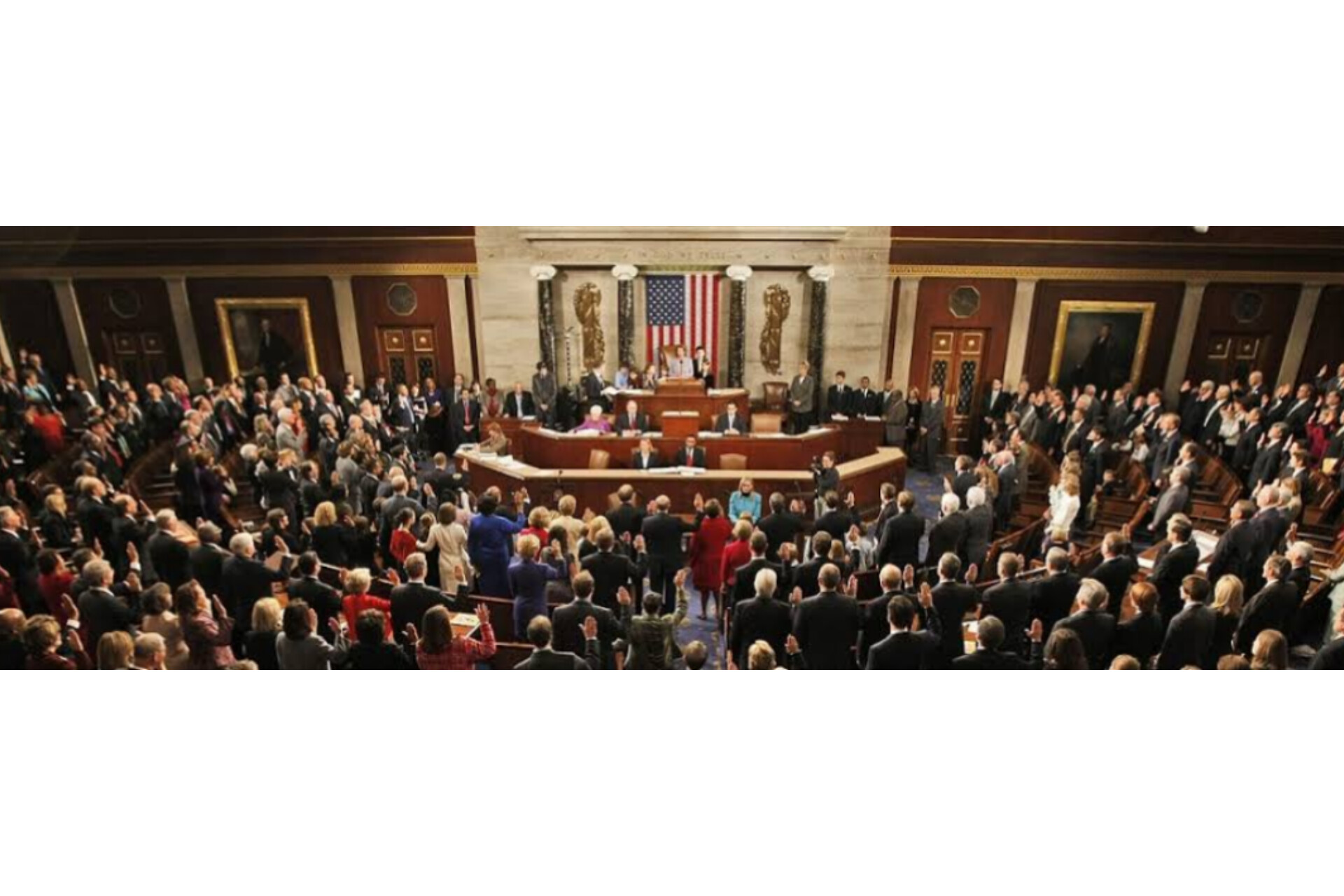
There were different opinions among lawmakers, religious leaders, officials from the United States Department, and witnesses at an open hearing yesterday by the United States House Foreign Affairs Subcommittee on Africa. The hearing was about President Donald Trump’s decision to call Nigeria a “Country of Particular Concern” because of reports of Christian genocide.
After the change, the President said that the US military will go into Nigeria “guns-a-blazing to completely wipe out the Islamic terrorists who are committing these horrible atrocities.”
The PUNCH says that the committee led by Chris Smith called the hearing to look into the extent of religious persecution in Nigeria and possible policy responses, such as targeted sanctions, humanitarian aid, and working with Nigerian authorities to stop more violence.
The first two panelists at the hearing in Room 2172 of the Rayburn House Office Building, which was streamed live online, were Jonathan Pratt, the Senior Bureau Official of the Bureau of African Affairs, and Jacob McGee, the Deputy Assistant Secretary of the Bureau of Democracy, Human Rights, and Labour. The lawmakers asked them many questions.
The second panel had talks by Ms. Nina Shea, the Director of the Center for Religious Freedom; Bishop Wilfred Anagbe of the Makurdi Catholic Diocese in Nigeria; and Ms. Oge Onubogu of the Center for Strategic and International Studies.
Chairman Chris Smith set the tone for the hearing by saying that 89 percent of all Christians killed across the world are in Nigeria, and that more than 52,000 Christians have been killed since 2009.
He said that extremist Fulani herdsmen were able to conduct rape, kidnapping, and murder without fear of punishment from Nigerian authority.
Smith said the killings were clearly “religiously motivated” and faulted the previous administration for making U.S. pressure weaker by taking Nigeria off the “Country of Particular Concern” list, even though the U.S. had suggested that it stay on the list. The Commission for International Religious Freedom.
He also made it clear that the U.S. will not be quiet while individuals are being persecuted and will keep fighting until those responsible are brought to justice.
He also used the strong and unsettling testimony of witnesses, such Bishop Wilfred Anagbe of the Catholic Diocese of Makurdi, to show how serious the problem is.
Jonathan Pratt, the Senior Bureau Official of the Bureau of African Affairs, said in his speech that the US was worried that the violent actions of extremist groups like Boko Haram, ISIS West Africa, ISIS Sahel, Al-Qaeda affiliate Ansaru, and Lakurawa were spreading from the North-East to other areas, especially Nigeria’s Middle Belt.
Pratt said, “Terrorists, separatists, bandits, and criminal militias are all over Nigeria, and attacks often target Christian communities.” He went on to say that the violence in the Middle Belt is a “problem of prioritization” by the government.
The US official said that even while Nigerian security forces are fighting terrorists and losing a lot of people in the North-East, more needs to be done to safeguard weak areas and hold those responsible accountable.
Pratt added, “The administration’s plan is to make protecting Christians a top priority for Nigeria, especially in the Middle Belt.”
He said that Nigeria, which is Africa’s largest democracy and an important partner in the region, has economic and security interests that are the same as those of the United States. Pratt stated that Washington is happy that Nigeria is eager to work together after being named a “Country of Particular Concern.” He also noted that Washington is looking forward to seeing these promises turn into real actions on the ground.
Pratt also said that the Trump administration is formulating a plan to encourage and force the Nigerian government to make Christian communities safer and increase religious freedom. The US State Department, Treasury, and possibly the Department of War will all be involved in the strategy to improve counter-terrorism and protection measures.
“The levels of violence and horrible things done to Christians and people of all faiths in Nigeria are terrible and threaten the right to religious freedom for everyone,” Pratt added.
“We are still willing to work with the Nigerians, but we also expect the Nigerian government to show that they are serious about this universal right by getting things done on the ground.”
Smith and Pratt’s first comments stirred off a range of responses.
During the session, Representative John James, who represents the people of Michigan’s 10th Congressional district and is a member of the Energy and Commerce Committee, said that the designation is needed to deal with what he called a deepening problem for Christians in Nigeria.
“One of the worst religious freedom crises in the world is happening in Nigeria.” James added, “I have been there and seen for myself how bad things are in what is now the deadliest place on earth for Christians.”
He went into detail about how bad the violence was.
“Almost 17,000 Christians have died since 2019.” Hundreds of people were killed in the first seven months of this year alone. These aren’t just one-time disasters; they’re part of a long-term trend of religious violence that the Nigerian government sometimes ignores or even supports.
“Extremist groups like Boko Haram, Fulani militants, and ISIS West Africa attack a lot, and the authorities don’t do much to stop them.” Christians live in continual fear and threat because no one has done anything about it.
James also talked about Nnamdi Kanu’s arrest, adding, “Religious persecution is linked to political repression and the weakening of institutions in Nigeria.” A clear example is the arrest of Mazi Nnamdi Kanu.
The Court of Appeals in Nigeria threw out the allegations against him in 2022 and told him to go free. The UN Working Group for Arbitrary Detention has also asked for his immediate release, but he is still in solitary confinement and his health is getting worse. He recently had to go to court by himself.
“Nigeria has made it clear that the law is optional and that Christians are fair game.” Just a few hours ago this morning, Kanu was found guilty on all counts, despite the pleadings and protests of numerous Nigerian lawmakers and people.
When asked if extremist groups had gotten into the Nigerian government, Senior Bureau Official Jonathan Pratt of the US Department of State’s Bureau of African Affairs responded, “I do not believe that jihadists have gotten into the government of Nigeria.”
James pushed the government for more information, saying, “Because when you look at the selective enforcement of the rule of law, you might wonder if there is any favoritism or looking the other way when groups are being specifically targeted, even though, as my colleague Moore said, they aren’t enforcing the rule of law about weapons.
“What has the Nigerian government done since President Trump’s pronouncement that the country was a “country of particular concern”? “
Pratt said, “They have taken the title very seriously.” There is currently a senior group here.
“This week, they will meet with the highest-ranking officials in the US government. We have already talked to the government in Abuja and Washington about the action plan, and I can say that so far, cooperation has been good.”
Congressman Bill Huizenga said that “radicalized Islamists” are still attacking Christians in Nigeria, and he criticized President Bola Tinubu’s administration for not doing enough to stop them.
Huizenga, who grew up around Nigerians and has been following the country’s security problems for years, claimed that both US officials and the media have downplayed violence tied to religion in Nigeria.
“I went to school with kids from Nigeria,” he added, stopping to try to calm down.
“We have neighbors who have been missionaries there, have family there, have friends there, and know what’s going on.
He stated, “But we have people in Congress who are denying that this is happening, or at least downplaying it.”
He claimed that Christians, moderate Muslims, and “anyone being terrorized by these radicalized Islamists in Nigeria” need more security since the Nigerian government “is not doing enough.”
Huizenga also asked how much humanitarian aid the US is giving to internally displaced people in Benue and Taraba states. He pointed out that Benue alone has “1.4 million” displaced people.
He ended his speech by mentioning a written statement from House Financial Services Committee Chairman French Hill, who underlined the importance of sanctions that can be enforced.
Johnny Olszewski, a member of the United States House of Representatives, has also said that he is very worried about the Nigerian government’s supposed failure to protect towns from attacks by insurgents.
He said, “The Nigerian government doesn’t have the resources to protect communities from groups that kill without reason.”
“This does not mean that the Nigerian government is not responsible.
Muslims and Christians have lived in fear of violent groups like Boko Haram and ISIS West Africa for far too long. So, for me, the main news here isn’t about Nigeria’s plans to persecute people based on their faith at the institutional level.
The member, who said he was a Christian, added that the debate about Nigeria should not be seen as the government persecuting people, but as a serious “capacity problem” that has left millions vulnerable to extremist groups.
“Jesus Christ is my Lord and Savior.” I’m fine with revealing that. I am also worried about how free people are to practice their religion in Nigeria and around the world.
“So, I want to be clear right away: violence against Christians in Nigeria is a big problem. Christians are being killed, and people are always afraid in their communities. He went on to say, “But this pain isn’t limited to just one religious group.”
The congressman said that terrorism in Nigeria affects individuals of all races, religions, and tribes, using President Donald Trump’s top adviser on Africa, Masabulo, as an example. He said that both Muslims and Christians have been attacked by Boko Haram and ISIS-West Africa.
He did, however, highlight that admitting this lack of capacity does not free Nigeria’s leaders from their duties. He warned that corruption, neglect, and failures in administration must be dealt with.
“The job of a government is to protect its people.” Leaders must be held accountable when they fail to do so, whether it is because of neglect, corruption, or bad governance. “But it’s a real question whether Nigerian institutions have the ability to keep the peace,” Olszewski said.
The member also asked if US strategy toward Nigeria was working, saying that threats of sanctions or military action were not enough and that more substantive help was needed.
“And we should be asking what the US is doing to help Nigeria build that capacity.” Are we really offering to work together, or are we merely threatening airstrikes and sanctions? Or are we instead thinking about giving money, training, and technical help to the institutions that stop violence from happening in the first place?
“So let’s work together to solve what’s wrong. “And I thank the ranking member for starting this hearing with more options for support,” he continued.
His comments come at a time when the world is once again paying attention to Nigeria’s security issues. This is because President Donald Trump just named Nigeria a “Country of Particular Concern.”
During the meeting, Representative Pramila Jayapal warned against presenting the violence in Nigeria as primarily affecting one religious community.
“But I appreciate that people have also seen that it’s not just Christians who are being persecuted. This is persecution of many groups. And I believe we need to be careful not to make it seem like Christians are the only ones being persecuted.
She replied, “That seems too simple to me, and it doesn’t take into account Nigeria’s diverse groups.”
Jayapal said that violence had afflicted both Christians and Muslims in Nigeria’s Middle Belt, citing research on what causes conflict there. She also said she was worried about how Trump reacted to a report that was shown on TV.
“I’m very worried that President Trump threatened to go guns-a-blazing in Nigeria and cut off all aid the day after he saw a clip on Fox News about the persecution of Christians there,” she said, adding that this would put health programs that are important for fighting malaria and HIV at risk.
Jayapal asked officials if any US military intervention in Nigeria was legal. “Can you tell me what gives the US military the right to attack Nigeria?” “She asked.
Jayapal asked if the government had thought about diplomatic options before Trump made his comments in public.
“Don’t you think it would have been better for the task force to talk about the options before the president went on Truth Social and said, ‘We’re going to go guns a-blazing into Nigeria?'” she asked. “She asked.
Pratt said that Washington had been working on security and development issues in Nigeria for a long time.
“We’ve been working on these issues in Nigeria for a long time.” There are a lot of programs in the country that help people. They did go through a review of foreign aid, but a lot of them are still going on, and we want to make sure we’re using them in a smart way to get the best results, he added.
In the end, Jayapal criticized what she called a confrontational approach.
She stated, “I just wish we would stick to that playbook instead of bullying and threatening a country that is very important to us and the region.”
She quoted former US Ambassador Kelly Currie as saying, “You can’t solve problems caused by men with guns by turning to men with guns for the solution.”
Bishop Wilfred Anagbe of the Diocese of Makurdi told the US House Subcommittee on Africa yesterday that Christianity is in danger of dying out in Nigeria’s Northern and Middle Belt regions.
The bishop claimed that Christians are going through one of the worst times in the country’s history since killings, mass displacement, and targeted attacks are still happening with “impunity.”
Anagbe told the MPs that “Christianity is at risk of disappearing in parts of Northern and Middle-Belt Nigeria in a very short time.” He said that the violence was part of a plan to destroy Christian communities and erase their cultural and religious identity.
The bishop noted that the ongoing crises, which include massacres, kidnappings, and widespread destruction, have gotten worse even though the US government has recently paid more attention to them, including reclassifying Nigeria as a Country of Particular Concern.
He said that move was “a serious, well-founded wake-up call.”
He told US senators, “Millions of displaced people are still living in camps and can’t go back to their ancestral lands,” as the humanitarian crisis got worse. This puts the survival of culture, religion, and the economy at risk.
He went on to say that women “endure sexual violence as a weapon,” and he warned that these kinds of techniques are meant to make sure “no more Christians will be born from so many traumatized women.”
Anagbe talked about a number of terrible events that had happened recently, including the attack on his hometown on May 22 that killed several of his relatives.
He claimed, “The local Catholic parish and the whole convent of Reverend Sisters of the Order of St. Clare were forced to move.”
He also talked about how someone tried to kill one of his priests, Father Solomon Atongo, on May 24.
“He was shot and left to die in a pool of his own blood. He was able to survive the attack, but he can’t walk freely because he has a broken bone.
The bishop talked about attacks in Plateau, Benue, Kaduna, and Kogi. He added that on June 13, 278 persons, including men, women, and children, were killed in Yelwata, Benue State.
He said, “The Holy Father, Pope Leo XIV, had to pray for the Nigerian government to even admit this evil.”
He said that the federal government had not done enough to deal with the problem.
He cautioned, “The Nigerian government’s silence and refusal to get involved in the killings and displacements has made the people feel even more abandoned.”
The bishop challenged lawmakers, “Who is killing the Muslims up north?” Is there a Christian militia in Nigeria that is displacing millions of people and taking over land? ”
The bishop says that extremist organizations, such Fulani militants, Boko Haram, and ISWAP, are now moving deeper south, making food insecurity worse and causing one of Africa’s biggest displacement problems.
He said, “Violence is moving south, displacing millions and destroying farmland.”
Anagbe thanked the group for its continuing interest and said again how much he appreciated President Trump.
He remarked, “On behalf of millions of Christians in Nigeria and around the world, we want to thank President Donald Trump for his brave leadership in making Nigeria a CPC.”
But he said that people should follow through on what they say.
He asked for targeted penalties, more humanitarian aid for people who have been forced to leave their homes, and the passage of the Nigerian Religious Freedom and Accountability Act, among other things.
He told the committee, “This point cannot be overstated because it is impunity that fuels the violence we suffer.”
He told his allies to fight against unfair laws in Nigeria and work to get rid of blasphemy laws.
Anagbe ended by saying that time is running out for Christian communities.
“The church can’t halt the killings by itself. It needs concerted action from the military, the government, and humanitarian groups.
His last plea was serious and urgent: “Mr. Chairman and members, we can’t wait any longer. Please take real steps based on the CPC designation. We all know that doing nothing makes the extremists even bolder.
But Congresswoman Sara Jacobs called President Donald Trump’s new vow to send troops to Nigeria “reckless.”
She said that it was wrong to only think at the situation in religious terms.
She stated, “Turning what’s happening into a purely religious story hides the real causes of violence and makes it harder to find good solutions. It can also lead to violence against the very groups that the Trump administration says it wants to protect.”
Jacobs said, “That’s why I’m worried about what President Trump is saying about this violence and threats to go into Nigeria ‘guns-a-blazing’ and kill terrorists.”
“We are already hearing tales of rising tensions between Christians and Muslims as a result of this speech. President Trump’s ultimatum is foolish, and any military intervention in Nigeria without the country’s permission would be against the law.
“Congress has not given the go-ahead for force in Nigeria to protect Christians, and any action without Nigeria’s permission is against international law.”
The lawmaker also said that a military-led approach could lead to more civilian deaths and a lack of accountability, which could lead to more violent extremism.
“We need to use more of the tools we have in our foreign policy toolbox if we really want to help Nigeria protect its people.”
She stated, “That means we need to use diplomacy and talk to Nigeria about how we can help them respond while also pushing for important changes in Nigeria’s institutions.”
Jacobs also stressed how important it is to fund programs that stop violence and deal with the underlying causes of conflict.
When asked if extremist groups had gotten into the Nigerian government, Senior Bureau Official Jonathan Pratt of the US Department of State’s Bureau of African Affairs responded, “I do not believe that the government of Nigeria has been infiltrated by jihadists.”
James pushed the government for more information, saying, “Because when you look at the selective enforcement of the rule of law, you might wonder if there is any favoritism or looking the other way when groups are being specifically targeted, even though, as my colleague Moore said, they aren’t enforcing the rule of law about weapons.
“What has the Nigerian government done since President Trump’s pronouncement that the country was a “country of particular concern”? “
“They have taken the title very seriously,” Pratt said. There is currently a senior group here.
“This week, they will meet with the highest-ranking officials in the US government. We have already talked to the government in Abuja and here in Washington about the action plan, and I can say that so far, the results have been good in terms of cooperation.”
About the Author