
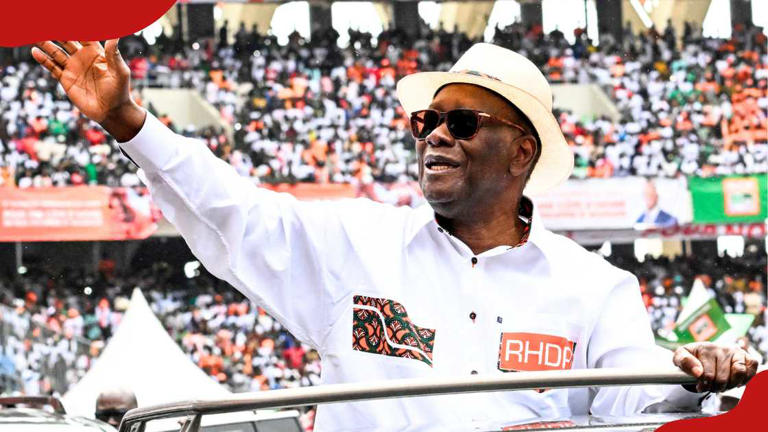
In an election marred by controversy, low voter turnout, and opposition exclusion, Alassane Ouattara, the long-serving leader of Ivory Coast, has successfully gained a fourth term as president.
On Monday, the electoral commission announced preliminary results showing that 83-year-old Ouattara had an overwhelming victory with 89.8 percent of the vote.
His former trade minister and closest competitor, Jean-Louis Billon, came in at 3.09%, while Simone Gbagbo, the ex-wife of Laurent Gbagbo, the president, achieved 2.42%.
Did the main opposition candidates in the 2025 election in the Ivory Coast face any obstacles?
Two prominent opposition figures, Laurent Gbagbo and former Credit Suisse boss Tidjane Thiam, decided to boycott the ballot after being forbidden from contesting, therefore the outcome was largely expected.
In light of the opposition’s demands for a boycott, the electoral board recorded a voter turnout of 50.1%, indicating broad voter apathy.
The Constitutional Council will confirm the final decision once it answers any legal petitions, but until then, the results are preliminary.
The election was criticized by opposition coalitions associated to Thiam and Gbagbo as a “civilian coup d’état,” according to BBC. They refused to acknowledge Ouattara’s victory and demanded a return to political discussion.
After the violent events surrounding the disputed 2010 vote—which resulted in the ouster and detention of then-president Laurent Gbagbo—Ouattara initially came to power in 2011.
A constitutional amendment in 2016 eliminated the two-term restriction on presidents, allowing Ouattara to run for reelection in 2020 and again in 2025.
Demonstrations in Ivory Coast following the election
Even though he received 94% of the vote in 2020 to run for re-election, demonstrations and boycotts still plagued his campaign.
There were four candidates in this year’s election, but some feel the process was unfair because two prominent opposition figures were disqualified. A felony conviction disqualified Gbagbo, while Thiam’s dual citizenship rendered him ineligible.
Some minor demonstrations were recorded in the south, which is often considered as a stronghold of the opposition, in the days leading up to the vote, as a result of the exclusion of these prominent candidates.
The candidate who can keep the country stable and lead it through economic and security crises is Ouattara, who has made this claim time and time again.
Concerning the employment of young people and the impact of rising costs of living, he has pledged new measures. But the leaders of the opposition say that his government is making things worse by increasing inequality and not doing anything about the skyrocketing costs, which is making the public even more angry.
About the Author