
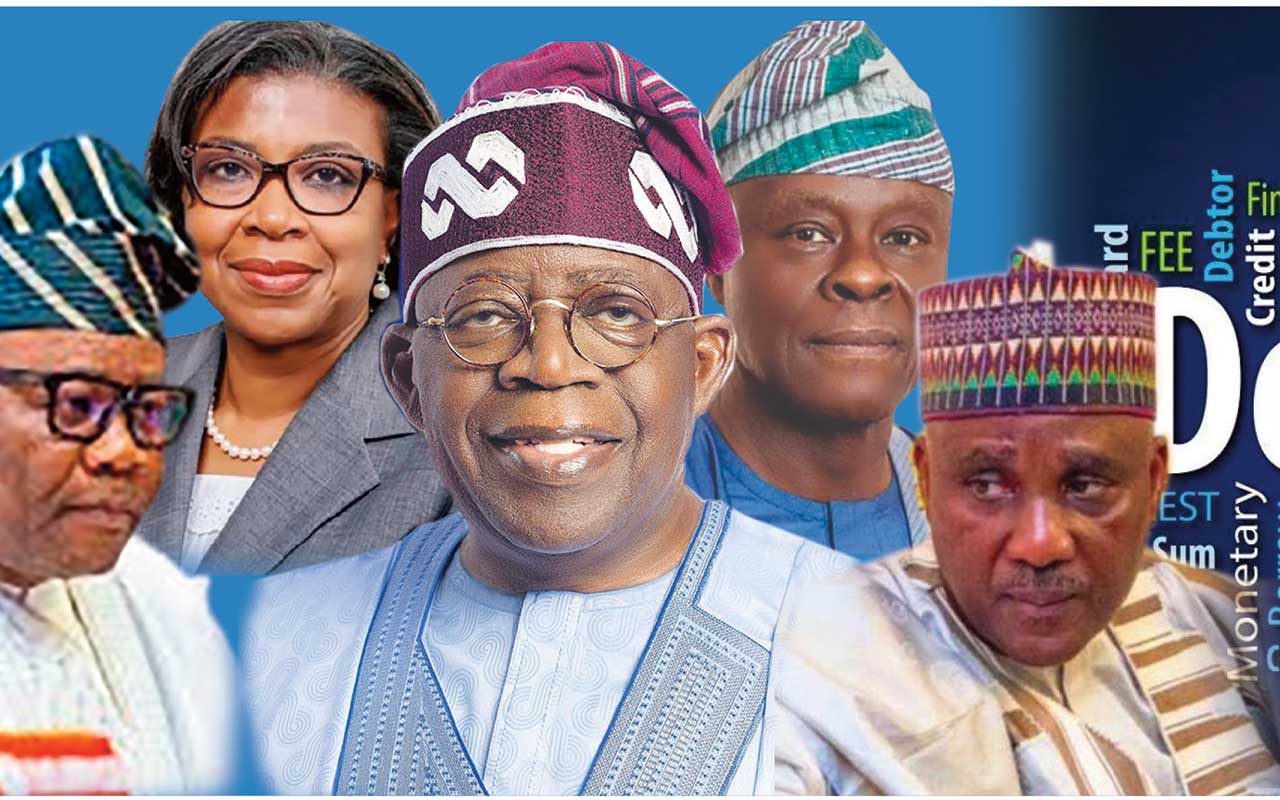
The Debt Management Office (DMO), the Labour Party (LP), and other groups have called for a more open culture of borrowing and paperwork as the All Progressives Congress (APC) fights back against worries about debt sustainability.
The Guardian writes that the DMO, which is in charge of managing the public debt, questions the transparency of the accumulation. Data in the public space puts the public debt stock at the end of the first quarter at N149.39 trillion.
The Office of the Auditor-General of the Federation (OAuGF) announced that it is looking into the number that is now in the public.
It’s hardly strange that both the DMO and the OAuGF are in this situation. Zainab Ahmed, who was the finance minister under the late President Muhammadu Buhari, said that some of the debts owed by states are not fully disclosed or documented in real time.
In fact, there are several cautions in the national debt numbers in this area, with some people warning that certain states are a year behind in updating the state of their debt.
At the 11th Annual Conference and General Assembly of the West Africa Association of Public Accounts Committees (WAAPAC) in Abuja yesterday, Patience Oniha, the DMO Director-General, called for strong debt management practices to make sure that policy decisions are based on accurate information. She also said that “transparency” is the way to go to achieve debt sustainability.
Maryam Omar, the Deputy Director of Policy Strategy and Risk Management, spoke for Oniha. She said that Nigeria is still one of the biggest borrowers in West Africa, along with Ghana, Côte d’Ivoire, and Senegal. This is because global interest rates are going up, commodity prices are unstable, and Nigeria’s ability to raise money is weak.
She said that higher borrowing costs were due to rising global interest rates, which have made it more expensive to get money from both foreign and domestic markets. This situation is made worse by insufficient domestic capacity.
She remarked, “Public debt in one country can spread to others because of regional connections and shocks in the global market.”
“High interest rates, unstable commodity prices, and uncertain global economic prospects make it harder to manage debt in the region.”
She told governments in the area to improve their data systems, especially their debt management information systems, and to get help from partners like the Commonwealth Secretariat.
“Our debt structure is quite vulnerable to the risk of foreign currency. Exchange rates change a lot, thus borrowing money from outside the country is very risky. She emphasized that the only way to move forward in a sustainable way is to strengthen revenue streams, be open, and be responsible.
Shaakaa Chira, the Auditor-General for the Federation, said that Nigeria’s national debt had reached N143.5 trillion by December 2024. This included N68.8 trillion in overseas debt and N74.6 trillion in domestic debt.
He said that even if the numbers are still being checked, they show how big the country’s financial problems are.
The Auditor-General talked about the role of the Supreme Audit Institution of Nigeria. He added that his office is devoted to making audit reports that are founded on facts and give the Public Accounts Committee accurate and reliable information.
He highlighted that the reports will be the main source of independent financial analysis on debt and will ensure that reporting is fair.
“As Auditor-General, I check to see if people are following the rules about borrowing money and being responsible with money.” I check to see if debt levels are sustainable and let people know when borrowed money isn’t being put to good use. “We check to see if the loans we make really help people through performance audits,” he said.
Chira said that his office helps Parliament by making detailed audit reports with separate sections on debt management, making sure that the results are made public in a timely and easy-to-read way, and making sure that any misuse or misreporting of debt is made public.
He remarked, “We are the Public Accounts Committee’s eyes and ears.”
“By being open about our reporting, we gain the trust of citizens and make debt oversight more credible.”
Grace Ike, the chairperson of the Nigeria Union of Journalists (NUJ), FCT Council, said that the media has to make audit results and legislative scrutiny louder so that debt accountability isn’t just up to parliament and auditors.
The Reps panel states that Abbas never accused Tinubu of borrowing too much money.
The House of Representatives Public Accounts Committee (PAC) denied accusations that Abbas said President Bola Tinubu’s administration was borrowing money carelessly and building up debts that couldn’t be proven.
In a statement, the committee called the claims wrong, deceptive, and untrue. They said that the Speaker’s comments, which were made by House Majority Leader Prof. Julius Ihonvbere, did not include any such accusation.
Joshua Afolabi, PAC’s Media Consultant, signed the statement. It said that strong conversations about debt sustainability in the West African sub-region had been “twisted for cheap political grandstanding.”
The statement said that Bamidele Salam, the Chairman of the Public Accounts Committee of the House of Representatives, told the media that covered the event to make the full video of the speaker’s speech available to anyone who wanted to see it. This was to clear up any doubts about what the speech said.
The statement said, “To make it clear, there was no difference of opinion between the Minister of Finance and Coordinating Minister of the Economy, Wale Edun, and the Speaker of the House of Representatives, Dr. Tajudeen Abbas, who both spoke at the event about Nigeria’s current debt and macroeconomic stability, which is the result of various ongoing reforms in Nigeria’s fiscal space.”
The APC’s attempts to twist the story, on the other hand, don’t bother the Labour Party. The group lead by Nenadi Usman praised Abbas yesterday for bravely saying that Tinubu’s continual borrowing has put Nigeria in a precarious situation.
Tony Akeni, the National Publicity Secretary (Interim), implored the Senate President, Godswill Akpabio, to put aside his political differences and join the demand to stop more reckless borrowing.
“In the first three months of 2025, Nigeria’s debt stock shot up from N121.7 trillion to N149.39 trillion. This raised the debt-to-GDP ratio to 52%, which is significantly beyond the legal limit of 40%.
“Even worse, debt servicing took up N8.93 trillion, or 61 percent of all government revenue, in just nine months.
The Labour Party declared, “These numbers are not just numbers. They are a death sentence for the economic future of Nigerians, both living and unborn.” It is clear that Tinubu’s borrowing has grown unsustainable when Speaker Abbas, a leader of the APC, admits this much.
The party said that Abbas has been involved in authorizing past loans, but his most recent action should be praised instead than criticized because it could assist slow down the APC administration’s financial irresponsibility.
It told Akpabio not to give in to the inclination to make his chamber a rubber stamp for the government.
“History will not forgive leaders who help mortgage the future of this country.” “Akpabio must remember that people who are hungry and poor will one day rise up against their oppressors,” it said.
The LP said that any new loan application that didn’t have a clear, demonstrable strategy for infrastructure, economic growth, and social impact had to be turned down straight away.
“Nigeria can’t keep getting into debt just to pay for waste, luxury, and political favors.” The statement said, “Now is the time to put Nigeria first.”
The discussion about debt sustainability comes just a week after the President assured Nigeria that his government has stopped borrowing because it was meeting its income goals.
The DMO also sold fresh bonds that week as part of its monthly auction program to help fill the N14 trillion hole in the 2025 budget.
Nigeria’s debt profile is still stable, even though the currency has lost value.
Some people have said that the current government is borrowing too much money, especially in response to former Kogi West Senator Dino Melaye. Sunday Dare, the President’s Special Adviser on Media and Public Communication, said that the ex-lawmaker had chosen “spectacle over substance.”
Melaye said on Arise Television on Monday that Tinubu has borrowed more aggressively than any of his predecessors.
“He has borrowed more than any other president in the country’s history. Why are you borrowing money if you have more than enough? He remarked, “We won’t be surprised if the president starts borrowing from OPay and Moniepoint very soon.”
Dare said that Nigeria’s soaring debt numbers were mostly due to the value of its currency going down, not because the country was borrowing too much.
“Here are the facts: The Debt Management Office says that Nigeria’s total public debt was N149.39 trillion on March 31, 2025. Dare stated, “The jump from last year is not because people borrowed too much money; it’s mostly because the naira is losing value.”
The president’s advisor said that the country’s debt-to-GDP ratio is still low compared to other African economies. “At 40–45%, Nigeria’s debt-to-GDP ratio is still moderate and much lower than South Africa’s 70% or Ghana’s 90% plus.” Dare said, “The real challenge is not runaway borrowing, but getting money.”
He says that Nigeria’s ability to satisfy its obligations is getting stronger since the government is collecting more money. He also says that borrowing is still a good way to expand and make changes.
“Encouragingly, revenues are going up, which makes it easier for us to meet our responsibilities. It is okay to borrow money to pay for growth and changes. He added, “Sustainability is what matters, not soundbites.”
Reno Omokri, who used to work for the president, also asserted that Nigeria’s entire debt had gone down by $16 billion since President Bola Tinubu took office.
Omokri wrote on X, which used to be called Twitter, claiming the country’s entire debt, which was $113 billion when President Tinubu took office, has now dropped to $97 billion.
“President Jonathan gave General Buhari a total of $63 billion in debt. President Tinubu took on $113 billion in debt from General Buhari. President Tinubu has cut Buhari’s debt from $113 billion to $97 billion. “Only two civilian governments have ever lowered Nigeria’s debt: the Obasanjo government and the Tinubu administration,” Omokri said.
About the Author