
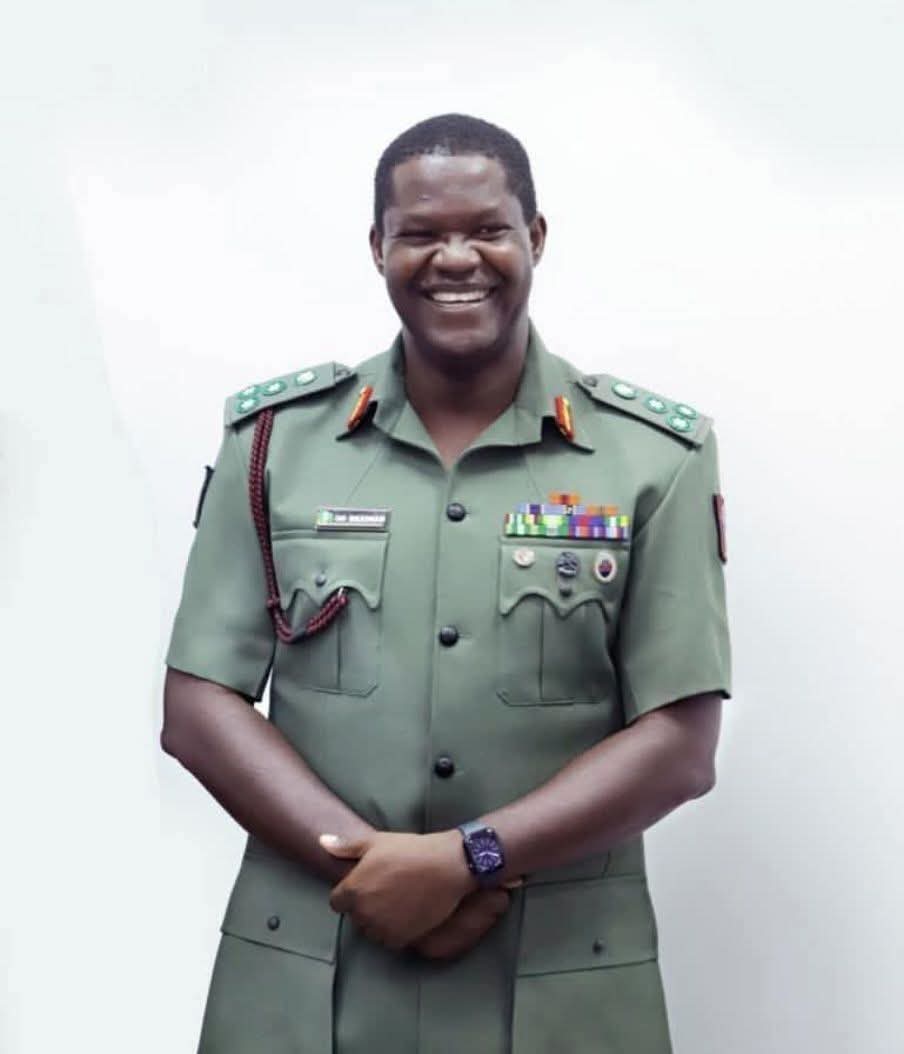
New information has come to light about the death of Brigadier General Oseni Braimah, the Commander of the 29 Task Force Brigade, after a fatal attack on a military base in Benisheikh, Borno State, around midnight.
Reports from Saturday PUNCH say that soldiers who survived said the attack was one of the worst in recent months.
The Nigerian Army said that the attack was successfully stopped and denied reports of heavy casualties and equipment failure. However, soldiers and residents said that the insurgents worked together to launch an attack that overwhelmed the troops and caused a lot of damage.
The attack happened around 12:30 a.m. on Thursday and was carried out by suspected Boko Haram and Islamic State West Africa Province fighters. They attacked several military positions at the same time in Benisheikh, a key town in Kaga Local Government Area along the Maiduguri-Damaturu highway.
Several eyewitnesses who talked to our reporter said that the rebels moved forward in large groups, hitting at least three military units before moving into civilian neighborhoods.
A soldier who survived the attack but asked to remain anonymous because he wasn’t allowed to talk to the press said that the scale and coordination were unlike anything he’d ever seen.
“We’re used to attacks that are planned out, but this one was different. They came from all around and in big groups at the same time. He said, “It felt like they had been studying our positions for weeks.”
Another survivor said that the assailants had more people, which changed the result of the fight.
“We stood our ground at first, but there were too many of them. They came at us from several sides. He stated, “It was like an ambush.”
He said that the troops’ morale started to collapse as rumors spread that other places had fallen and some soldiers had died.
“When we heard that our coworkers in other places had been overtaken, it shook us. Then someone yelled that the Brigade Commander was dead. He said, “That’s when the fear really set in.”
Sources indicated that the attack’s disorientation and psychological effects caused troops to stop working together, which made part of them have to retreat into the town.
It was said that the gunfight lasted more than an hour and a half, and there were several explosions that made both soldiers and civilians run for cover.
Braimah’s death
After the incident, some said that Brigadier General Braimah died because a Mine-Resistant Ambush Protected vehicle didn’t work right.
But military sources and people who knew the late general disagreed with this.
A source high up in the brigade said the story was false.
“The insurgents really did set the MRAP on fire during the attack.” It’s not true that he died because the car wouldn’t start. “The situation was much more complicated,” the person stated.
Another insider said that only those who were with the general at the time of the attack could give a full account, since many of them also killed in the attack.
“I know that the rebels attacked from many sides at once. It was like a strategy for an ambush. But as the gunfight got really bad, the terrorist group broke up. The source said, “What helped them was that there were too many of them.”
A former driver for the late general who went by the name Blacky backed up the story by saying that Braimah took great care of his vehicles.
General Braimah doesn’t mess around with repairs when it comes to maintenance. “Ask anyone in the 29 Task Force,” he stated.
He said, “I was General Braimah’s driver,” as he talked about his time working with the late commander. “Blacky, haven’t you already spent two years?” he questioned me one day. I told him I had done four years and six months. He was astonished and wanted to know why I hadn’t asked to rotate. That’s how he put my name in the hat. “I left the North-East less than a week ago.”
“Any time you complained to him about money, a pass, or whatever else, he would listen. I’m not covering him since I used to drive him around. He went on to remark, “What I’m saying is true.”
But another source within the formation said that there might be systemic problems, claiming that the unit’s culture of vehicle upkeep is inadequate.
“If something went wrong, the people in charge of keeping operational cars should be held responsible. The insider said, “There have been complaints before.”
Civilian death toll, damage
Mustapha Abu, a resident who spoke to our reporter, claimed that the attack was so bad that it caused terror across the town, and many people left their homes in the middle of the night.
“We heard tremendous blasts and gunfire all the time. It was scary. People were fleeing everywhere. He claimed, “Even soldiers ran into town to hide.”
Residents of Benisheikh said that there was a lot of damage beyond military losses, including the burning of shops, cars, and other civilian property.
“Many of them came to town and stayed with us, protecting us and telling us where to go. I believe that space gave the terrorists enough time to set fire to the buildings and steal military supplies. When I got to the camp after the attack, it was a mess.
“Shops and cars that belonged to citizens near the main roadways were set on fire. “People who were staying in the area near the Bensheikh secretariat because the Maiduguri–Damaturu road is closed every night were also affected. Both drivers and passengers left their cars and ran for safety,” Abu said.
“When I got to the camp after the attack, everything was awful. Cars were set on fire and structures were destroyed. “Even civilian stores weren’t safe,” said another neighbor, who wanted to be anonymous.
Sources indicated that the army’ brief exit from the town left a security gap that rebels used to steal from military bases and do more damage.
Army pushes back
The Headquarters of Operation Hadin Kai denied reports that the attack killed 17 soldiers, including the brigade commander.
Lt.-Col. Sani Uba, the Media Information Officer for the Northeast Joint Task Force, Operation Hadin Kai, said in a statement yesterday that the stories, which were often accompanied by irrelevant photographs and videos, were an intentional attempt to distort the truth and hurt ongoing military operations.
Uba said, “The official and verified report, which was sent out earlier through Defence Headquarters, clearly stated that two officers and two soldiers paid the ultimate price during the engagement.” Any other number that is being sent around is completely incorrect, deceptive, and not credible.
He said that the suggestion that the brigade commander’s car had broken down was also wrong.
He said, “The commander was riding in a high-quality Mine-Resistant Ambush Protected (MRAP) vehicle that was temporarily stuck in the heat of battle while he was actively coordinating the counter-assault.”
Uba added that the episode showed how intense the fight was and that there was leadership at the key moment, not that any equipment failed.
The spokesperson stressed that the military highly disapproved of twisting the truth and using these kinds of events for personal or political benefit or propaganda.
Uba, on the other hand, said that the forces of Operation Hadin Kai effectively fought off the onslaught, kept control of their area, and caused the terrorists to leave in a disorganized way.
A pattern that is worrying
Brigadier General Braimah’s death is just one more example of a high-ranking Nigerian military commander who has died in the continuing conflict in the North-East.
Security experts argue that these kinds of events bring up important issues regarding how to fight Boko Haram and ISWAP, how to obtain intelligence, and how to safeguard troops.
Several high-ranking officials have been slain in the same way in the past few years, frequently during ambushes or planned attacks on military units.
Brigadier General Musa Uba was in charge of the 25 Brigade of the Nigerian Army when he died in 2025.
Brigadier General Dzarma Zirkusu was another high-ranking officer who was killed.
Brigadier General Dzarma Zirkusu, another high-ranking officer, was also slain.
He and three other troops were killed when ISWAP rebels attacked them in Askira-Uba in November 2021.
Earlier this year, Zirkusu, who was from Adamawa State, was named Commander of the 28 Task Force Brigade in Chibok.
Boko Haram fighters attacked Colonel Dahiru Chiroma Bako near Wajiroko town in September 2020.
He eventually died from the injuries he got in the attack.
Lieutenant Colonel Muhammad Abu Ali died in November 2016, a year after he was promoted from Major.
Lieutenant Colonel Ibrahim Sakaba, another high-ranking officer, was slain in November 2018 when a military post in northern Borno was attacked. Several troops were also killed.
He was in charge of the 157 Task Force Battalion in Metele until he died.
His widow said in August 2021 that he was slain by other troops after he allegedly refused to take part in corruption. The Nigerian Army disputed these claims.
Tinubu comforts the military
In the meantime, President Bola Tinubu has said he is sad over the deaths of the military officers.
Bayo Onanuga, the president’s Special Adviser on Information and Strategy, sent out a statement on Thursday night that said what the president wanted to say.
Tinubu praised the troops for their bravery and strength, saying that they battled bravely to keep the attacks at bay and stop insurgents from taking over the areas they were protecting.
He also asked Nigerians and the media to support the Armed Forces in their fight against insecurity.
“From what I’ve heard, our armed forces have been carrying out long and intense land and air attacks on insurgents, killing many of their fighters and leaders.” The President remarked, “The insurgents’ counterattack shows how desperate they are.”
He told the military chiefs and soldiers on the front lines not to give up because Braimah had died. He also sent his condolences to the families of the soldiers who had died in the attack.
The president said that the federal government would honor the soldiers who died and that it was still committed to fighting terrorism and bringing peace back to the whole country.
About the Author