
Iran and the U.S. were getting ready for high-level talks, but their ceasefire was still tenuous today. Israel and Hezbollah were still fighting, and Tehran was still in control of the Strait of Hormuz.
There are still a lot of problems that could cause the truce and talks for a bigger settlement to end the war for good to fall through, according to AFP.
Iran’s semiofficial Tasnim news agency, which is sympathetic to the Revolutionary Guard, said that discussions slated for tomorrow would not proceed unless Israel ceased its attacks in Lebanon. U.S. President Donald Trump also said that Iran was “doing a very poor job” by not letting ships pass freely through the strait, which used to be the route for 20% of the world’s commercial oil.
Kuwait, on the other hand, stated that last night it was attacked by a drone that it blamed on Iran and its militia supporters in the area. The Revolutionary Guard, Iran’s paramilitary group, denied undertaking any strikes, but it has attacked other countries in the Middle East before without taking responsibility.
Still, it looked like things were moving forward for the discussions between Iran and the U.S. in Pakistan, as U.S. Vice President JD Vance was about to leave Washington. A U.S. official and someone who knows about the preparations but didn’t want to be named because of the sensitive nature of the issue said that talks between Israel and Lebanon are set to start next week in Washington.
Israel and Lebanon will talk to each other directly.
Israel’s insistence that the ceasefire in Iran does not include a stop in its fighting with Hezbollah, who joined the conflict to defend Iran, has put the pact in danger.
Lebanon’s Health Ministry said that on the day the ceasefire was announced, Israel bombed Beirut from the air, killing more than 300 people. It was the most deadly day in the country since the war started on February 28.
Trump said Tuesday that he told Israeli Prime Minister Benjamin Netanyahu to stop the operations.
The Israeli military announced early this morning that it targeted about 10 launchers in Lebanon that had fired rockets at northern Israel the day before.
Mohammad Bagher Qalibaf, the speaker of Iran’s parliament, said Wednesday that if Israel keeps attacking Hezbollah, there will be “explicit costs and STRONG responses.”
Netanyahu, on the other hand, claimed he gave the go-ahead for talks with Lebanon “as soon as possible” to disarm Hezbollah fighters and improve relations between the two countries, which have officially been at war since Israel was founded in 1948.
As of early Friday afternoon, the Lebanese government had not replied. Axios was the first to say when and where the conversations will take place.
Hezbollah leader Naim Kassem told Lebanese officials not to make “free concessions” in a statement that was the first since Israel said it would negotiate directly with Lebanon. However, he did not make a specific remark about the meetings.
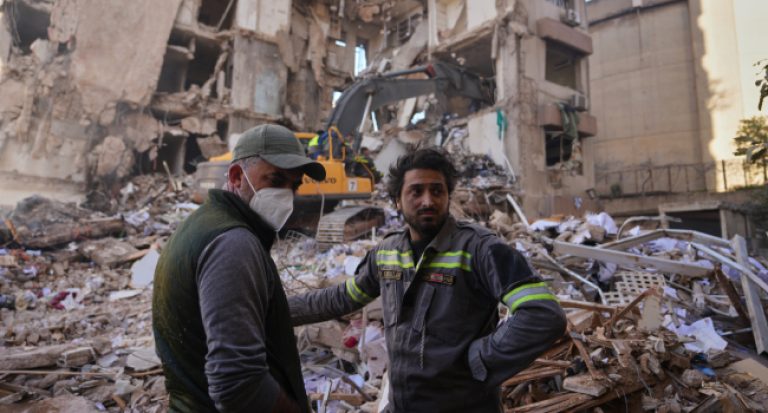
Two days after Israel’s heavy bombardment, residents were going through the ruins of their homes, looking for furniture and personal items that they might save. Some were thankful that they just lost their houses and things, not their loved ones, like others had.
Wissam Tabila, 35, stated, “Family is the only thing that matters.” “Anything else can be replaced.”
The Strait of Hormuz is still a problem.
Iran’s closing of the Strait of Hormuz has caused oil prices to spike, equities to fall, and the entire economy to go into a tailspin. Tehran’s dominance of the river has been its major strategic advantage in the war.
The price of Brent crude, which is the worldwide standard, was almost $97 today. This is more than 30% more than when the conflict started.
Before the war, more than 100 ships went through the strait every day, many of which were bringing oil to Asia. Since the ceasefire, only 12 people have been reported to have passed through.
A Botswana-flagged liquefied natural gas tanker tried to leave the Persian Gulf on a path ordered by the Revolutionary Guard, but ship-tracking data showed that it suddenly turned around early today. This shows how dangerous the situation is.
Sultan al-Jaber, the head of the United Arab Emirates’ biggest oil business, stated that over 230 oil tankers were waiting to travel through the strait and that they should be permitted “to navigate this corridor without condition.”
Donald Trump, the President of the United States, complained about this on his social media site, saying, “Iran is doing a very poor job, dishonorable some would say, of allowing Oil to go through the Strait of Hormuz.”
“That is not what we agreed on!” Trump wrote about the small number of ships that Iran has let through.
The ceasefire arrangement is still weak.
There are also still questions about what will happen to Iran’s missile and nuclear programs, which the U.S. and Israel tried to do rid of by going to war.
The U.S. says that Iran should never be able to develop nuclear bombs and wants to get rid of Tehran’s stockpile of highly enriched uranium, which might be used to make them. Iran says that its program is peaceful.
Trump has suggested that the U.S. would collaborate with Iran to get rid of the uranium, but Tehran hasn’t verified that.
Mohammad Eslami, the head of Iran’s nuclear agency, said yesterday that safeguarding Tehran’s right to enrich uranium is “necessary” for any talks about a truce.
A high-ranking Iranian medical officer told the state-run Iran newspaper that at than 3,000 people have died in Iran. The Iranian government hasn’t given a clear number of deaths from the conflict that lasted for weeks.
More than 1,888 people have died and 1 million have had to leave their homes in Lebanon. In the Gulf Arab states and the occupied West Bank, more than a dozen individuals have perished. In Israel, 23 civilians have died. Also, thirteen U.S. service members have died.
About the Author