
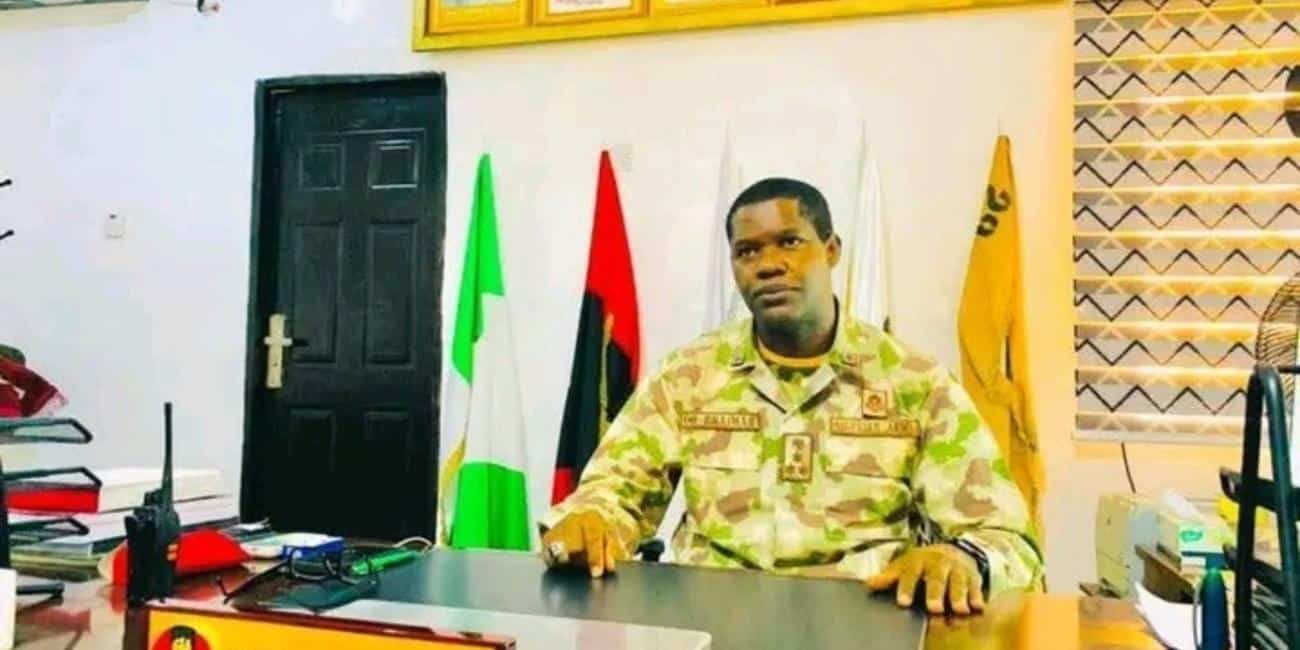
Early on Thursday, Brigadier General Oseni Omoh Braimah and 17 soldiers died in coordinated attacks by suspected members of the Islamic State of West Africa Province (ISWAP) on military formations in Benisheikh, Kaga Local Government Area, and Ngamdu and Pulka towns in the Gwoza LGA of Borno State.
Brig. Gen. Braimah, who died, was in charge of the 29 Task Force Brigade Headquarters in Benisheikh.
Reports say that the militants attacked the three military bases with heavy gunfire and explosives, killing at least 18 soldiers and officers, including the General, and seriously injuring several others.
Our source in Benisheikh town said that the insurgents reportedly fired at the military base from time to time, killing many people.
other sources told our correspondent that “the brigade commander, his second-in-command, the Imam of the Brigade, and several officers and soldiers were killed in the attack that lasted several hours.”
They said that a lot of ISWAP terrorists, as well as civilians and other security personnel, were also slain in the attacks that happened at the same time at midnight.
Sources said that the insurgents assaulted the town of Benisheikh about 1 a.m. on Thursday and set many trucks and other commercial vehicles on fire. Reports say that the attackers killed drivers and passengers who were only passing through and stayed for the night in the town because the Maiduguri-Damaturu Road is closed every night.
“Troops also killed a lot of insurgents in Benesheikh.” “Sadly, some security personnel, including the brigade commander, paid the ultimate price, and the terrorists took several vehicles,” a neighbor who asked to remain anonymous said.
A person from Benisheikh named Malam Lawal Benisheikh commented on Facebook, “Innalillahi wa Inna’illaihin raji’un.” Sadly, Boko Haram has once again killed the commander of Benishiehk.
“This sad event happened last night (Thursday) when a lot of insurgents attacked the military formation.” “May the souls of the fallen heroes rest in peace.”
Around 10:30 p.m. on Wednesday, the terrorists attacked Pulka and Bakin Ruwa, both in Gwoza LGA. They took over a military post and set fire to many pieces of equipment.
“Then, around 1 a.m., the terrorists attacked Benisheikh and Ngamdu towns again, taking over the 29 Task Force Brigade and destroying a number of military vehicles,” one of the individuals claimed.
Reports say that the terrorists also stole food from stores in Pulka town and damaged other buildings, such as the machineries and tools of a road construction company called Decency Associates. They also set fire to cars worth hundreds of millions of naira.
Thousands of residents from Ngoshe town are currently living in Pulka. They fled there after Boko Haram terrorists attacked their community a month ago.
People in the area said that the attack on Ngamdu, which is near to Benisheikh, looks like it was meant to keep reinforcements from getting to Benisheikh.
The attack on the Bakin Ruwa military base also served as a distraction for the attack on Pulka.
In the past few weeks, Boko Haram and ISWAP terrorists have attacked military and police bases in Borno State in a series of brutal and planned strikes that have killed soldiers, police officials, and civilians.
In March of last year, Boko Haram insurgents attacked the town of Ngoshe and set off explosions at the UMTH gate, the Post Office, and the Monday Market in Maiduguri, killing at least 25 people and hurting many more.
Military confirms that troops were killed
The military high command acknowledged that some people who worked for the 29 Task Force Brigade Headquarters in Benisheikh, Kaga Local Government Area of Borno State had been killed.
Michael Onoja, the Director of Defense Media Operations, said in a statement that the strike happened around 12:30 a.m. on the 9th of April, 2026.
General Onoja said that rebels tried to break through the military installation’s defensive perimeter.
He claimed that the brigade commander and the troops of Operation HADIN KAI fought back with “exceptional courage, professionalism, and superior firepower,” which made the assailants run away.
As part of the Armed Forces of Nigeria’s fight against terrorism, personnel from the 29 Task Force Brigade in Operation HADIN KAI were attacked by terrorists at the Brigade Headquarters in Benisheikh, Borno State.
“However, the troops, led by Brigadier General Oseni Braimah of the Commander 29 Brigade, showed incredible bravery, professionalism, and firepower.
The statement claimed, “In a well-coordinated counteraction, the insurgents were decisively engaged and forced to retreat in disarray, abandoning their mission.”
The high-ranking military officer said that the attack was a sign of desperation on the part of the insurgents, who had lost a lot of troops in recent military operations and were attacking well-defended military sites in vain.
The military said that personnel died in the event, but they did neither confirm or deny allegations that Brig. Gen. Braimah was one among the people who died.
“Sadly, the encounter cost the lives of a few courageous and honorable soldiers who gave their lives in the line of duty. “The Chief of Defence Staff honors their bravery, sacrifice, and unwavering commitment to the defense of the nation,” the statement said.
It claimed that the High Command has sent condolences to the families of the dead soldiers and asked people not to spread false information, especially on social media.
The Defense Headquarters also said that clearance operations were still going on to find rebels who were running away and stop them from reforming.
“The Armed Forces of Nigeria, along with other security agencies and stakeholders, are still committed to the fight against terrorism and insurgency.” It said, “Additional clearance and exploitation operations are going on in the general area to track and neutralize fleeing insurgents.”
What did Brig. Gen. Oseni Braimah do?
Brig. Gen. Oseni Braimah, who passed away, got a Bachelor of Arts degree in History from the Nigerian Defence Academy (NDA) and joined the Nigerian Army in September 2000.
He went to Benue State University from 2004 to 2006 and got a Master of Arts in International Relations and Strategic Studies. He also went to the National Defence University in Islamabad and got a Master’s in National Security Management and War Studies.
The late General got a Master of Arts in Defense Studies from King’s College in London between 2016 and 2017. Later, he got a diploma in strategic leadership and management from the Chartered Management Institute (CMI).
He worked as an Observer for the United Nations in the field from 2011 to 2012. He was also the Deputy Chief of Staff of the Guard Brigade Headquarters from January to December 2014.
From December 2014 to October 2015, he was the Commanding Officer of the 7 Guard Battalion. From October 2015 to December 2018, he was the Directing Staff of the Armed Forces Command and Staff College in Jaji, Kaduna State. He was then the College’s Chief Instructor from December 2018 to December 2019.
From December 2019 to May 2021, the late Brig. Gen. Braima was Chief J3 (DCOS G3) at the headquarters of Operation Hadin Kai in North East. From May 2021 to August 2024, he was the Defence Adviser in the Nigeria High Commission in Islamabad, Pakistan.
He was also the Chief of Staff at the 6 Division Headquarters of the Nigerian Army in Port Harcourt, Rivers State, from September 2024 to March 2025.
Brig. Gen. Braimah was the Brigade Commander of the 29 Task Force Brigade Headquarters in Benisheikh till he died on April 9.
The death of General Braimah brought the total number of high-ranking military commanders slain in the last three months to a higher figure. The results showed that majority of the killings were during attacks on military bases or ambushes by insurgents during clearance operations.
In early March, it was claimed that Boko Haram and the Islamic State West Africa Province (ISWAP) attacked multiple places in Borno State over the course of seven days, killing at least three commanding officers in control of advanced operations bases in the Nigerian military.
Major U.I. Mairiga was in charge of the Mayenti base, Lt-Col Umar Faruq was in charge of the Kukawa base and the 101 Brigade, and Lt-Col S.I. Iliyasu was in charge of Konduga.
Boko Haram militants attacked Major Mairiga’s camp in Mayenti, Bama LGA, on March 1 and murdered him. On March 3, 14 soldiers were reportedly killed in a coordinated attack on a military base in Ngoshe, Gwoza Local Government Area. More than 100 people were kidnapped, and a high-ranking military officer was killed.
On March 6, Boko Haram attacked again and killed Lt-Col Iliyasu, the Commanding Officer of the 222 Battalion in Konduga, and several other soldiers. Some members of the 21 Special Armoured Brigade, including Lieutenant J.O. Ejeh, were also murdered in an ambush that day.
On March 9, terrorists took seized a military camp in the Kukawa Local Government Area of Borno, murdering Lt-Col Faruq, the commanding commander, and numerous soldiers. Earlier in February, insurgents attacked the military base, but forces headed by the late Lt-Col Faruq fought them off, killing numerous terrorists, according to reports.
On January 28, Boko Haram insurgents ambushed a military unit near Damasak, killing seven troops, including the commanding officer. Reports say that the terrorists attacked a patrol squad, took the officer hostage, and then killed him and other members of the team.
The military has been doing more work in dangerous areas including the Sambisa Forest, the Timbuktu Triangle, the Mandara Mountains, and the Lake Chad Basin in the last few months.
The military said that many insurgent leaders and fighters have died in operations on many fronts, and that several key terrorist camps have also been destroyed.
“An unsafe pattern”
Dr. Musa Usman Konduga, a public analyst at the University of Maiduguri, said that the killing of Brig-Gen O Braimoh was “one killing too many.” He remembered that three commanding officers in Kukawa, Kunduga, and Banki were killed in similar ways in a short amount of time.
He claimed, “We also killed Brig-Gen Uba, who was in charge of Damboa, in Wajirko.” In just a few months, we lost a number of brave commanding officers who have served this country and are doing a lot to keep our communities safe.
“We don’t know if some criminals are making this pattern happen, or if the insurgents have some information that they are using to kill the commanders.”
“Some of us may not know, but a hazardous trend is forming, and it will affect the battlefield itself because if a commanding officer is killed, it will somehow lower the morale of his lieutenants.
“I’m not a soldier, but this will affect the men who work immediately under them because they will feel very unsafe. There is also a threat to peace since people are slowly losing faith in the military’s capacity to keep them safe. People are arguing that if these high-ranking policemen are being killed, no one is safe in the community. This is what people are saying about the communities.
The analyst suggested that the government needed to move quickly to fix the problem.
“The generals’ deaths were the main story, but the question is, how many other men were also killed in the process, besides the commanders?” The military high command may not be able to convey the media or the public this strategic information easily, but they have to do something about it. They need to figure out how to stop these bad habits from getting worse.
“I’ve said a few times that these insurgents are now quite mobile. They have organized and reorganized, and some of us think that they have added more people to their ranks and are moving around. So our soldiers need to be able to roam around and target these people as well. As long as these soldiers stay in one location waiting for them to come, this will never end.
“There has to be a lot of intelligence gathering, moving around, checking out the bushes, and following these people as they move from one community to another.” He answered, “That is the best way to end this crisis.”
Tinubu speaks out against the attack
President Bola Ahmed Tinubu has also said he is unhappy about the deaths of the “brave soldiers of the 29 Task Force Brigade, Operation HADIN KAI,” who were killed in a terrorist attack on their camp in Benisheikh.
Bayo Onanuga, the President’s Special Adviser on Information and Strategy, sent the condolence in a statement. President Tinubu also asked the media and the people of Nigeria to support the military in the fight against crime.
President Tinubu hailed the bravery and heroism of the military who fought bravely to drive out the terrorists and make sure that Boko Haram couldn’t take over the areas they guard.
The president told the heads of the Armed Forces and all soldiers on the front lines not to give up, but to remember how much the country appreciates their efforts.
“From what I’ve heard, our military has been carrying out long, intense land and air attacks on the insurgents, taking out many of their fighters and leaders.” The militants’ offensive shows that they are desperate.
“I send my condolences to the families of our brave soldiers, commanded by Brigadier-General Oseni Omoh Braimah, who gave their lives today in Borno State to protect our country.
“The government will always remember what they gave up. Their efforts will not be for nothing. Our troops on the front lines are brave and dedicated, which makes us more determined than ever to stop terrorism and all forms of violence in Nigeria.
“I also send my sympathies to the people and government of Borno State. The statement said, “The federal government will keep working with the state government to win the war and bring about lasting peace.”
Stop the killings now, the TUC warns Tinubu.
The Trade Union Congress (TUC) has told President Bola Tinubu to stop killing military officers, other security agents, and Nigerians right away. They also asked the government to put more emphasis on human life like other countries do.
Festus Osifo, the President of the TUC, said this at a news conference in Abuja. He also talked about the recent deaths in Plateau.
Osifo told the administration led by Tinubu to quickly give the frontline troops the best equipment and the correct technology so they can fight the militants.
He replied, “I’m sure you know that we’ve had problems with security in this country for at least 15 years now.” As a country, we’ve been dealing with that problem since about 2010, and it hasn’t gone away.
“You might remember that there was another attack in Plateau State, in Angwan Rukuba, Jos North, not too long ago, where dozens of Nigerians were slaughtered. Yes, this is too many deaths. It has happened before, and this time it was heartbreaking because people were just having fun when gunmen broke in and started shooting. Some of them died.
“It’s really sad to see Nigerians being killed like chickens.” It is horrible to witness people being slain in Nigeria in the same way that people are being slaughtered. When people die, we only put out news releases, visit them, and then go back the next day and do it again. This is becoming the standard.
“We must not forget to praise our security forces for what they have done. We thank them and then tell them to do more. We tell the political class to give them the tools they need to deal with these terrorists once and for all. On Thursday morning, Brigadier General Oseni Omoh Braimah and 17 soldiers died in coordinated attacks by suspected members of the Islamic State of West Africa Province (ISWAP) on military formations in Benisheikh, Kaga Local Government Area, and Ngamdu and Pulka town in the Gwoza LGA of Borno State.
Brig. Gen. Braimah was the head of the 29 Task Force Brigade Headquarters in Benisheikh before he died.
According to Daily Trust, the militants attacked the three military groups with heavy gunfire and explosives, killing at least 18 soldiers and officers, including the General, and leaving many others seriously hurt.
According to sources in Benisheikh town, the insurgents shot at the military base at random times, killing many people.
other sources told our correspondent that “the brigade commander, his second-in-command, the Imam of the Brigade, and several officers and soldiers were killed in the attack that lasted several hours.”
They said that a lot of ISWAP terrorists, as well as civilians and other security personnel, were also slain in the attacks that happened at the same time at midnight.
Sources said that the insurgents assaulted the town of Benisheikh about 1 a.m. on Thursday and set many trucks and other commercial vehicles on fire. Reports say that the attackers killed drivers and passengers who were only passing through and stayed for the night in the town because the Maiduguri-Damaturu Road is closed every night.
“Troops also killed a lot of insurgents in Benesheikh.” “Sadly, some security personnel, including the brigade commander, paid the ultimate price, and the terrorists took several vehicles,” a neighbor who asked to remain anonymous said.
A person from Benisheikh named Malam Lawal Benisheikh commented on Facebook, “Innalillahi wa Inna’illaihin raji’un.” Sadly, Boko Haram has once again killed the commander of Benishiehk.
“This sad event happened last night (Thursday) when a lot of insurgents attacked the military formation.” “May the souls of the fallen heroes rest in peace.”
Other villagers stated that the terrorists attacked Pulka and Bakin Ruwa, both in Gwoza LGA, around 10:30 p.m. on Wednesday. They took over a military post and set fire to many pieces of equipment.
“Then, around 1 a.m., the terrorists attacked the towns of Benisheikh and Ngamdu again and overran the 29 Task Force Brigade, destroying several military vehicles,” one of the individuals stated.
Reports say that the terrorists also stole food from stores in Pulka town and damaged other buildings, such as the machineries and tools of a road construction company called Decency Associates. They also set fire to vehicles worth hundreds of millions of naira.
Thousands of residents from Ngoshe town are currently living in Pulka. They fled there after Boko Haram terrorists attacked their community a month ago.
People in the area said that the attack on Ngamdu, which is near to Benisheikh, looks like it was meant to keep reinforcements from getting to Benisheikh.
The attack on the Bakin Ruwa military base also served as a distraction for the attack on Pulka.
In the past few weeks, Boko Haram and ISWAP terrorists have attacked military and police bases in Borno State in a series of brutal and planned strikes that have killed soldiers, police officials, and civilians.
In March of last year, Boko Haram insurgents attacked the town of Ngoshe and set off explosions at the UMTH gate, the Post Office, and the Monday Market in Maiduguri, killing at least 25 people and hurting many more.
Military confirms that troops were killed
The military high command acknowledged that some people who worked for the 29 Task Force Brigade Headquarters in Benisheikh, Kaga Local Government Area of Borno State had been killed.
Michael Onoja, the Director of Defense Media Operations, said in a statement that the strike happened around 12:30 a.m. on the 9th of April, 2026.
General Onoja said that rebels tried to break through the military installation’s defensive perimeter.
He claimed that the brigade commander and the troops of Operation HADIN KAI fought back with “exceptional courage, professionalism, and superior firepower,” which made the assailants run away.
As part of the Armed Forces of Nigeria’s fight against terrorism, personnel from the 29 Task Force Brigade in Operation HADIN KAI were attacked by terrorists at the Brigade Headquarters in Benisheikh, Borno State.
“However, the troops, led by Brigadier General Oseni Braimah of the Commander 29 Brigade, showed incredible bravery, professionalism, and firepower.
The statement claimed, “In a well-coordinated counteraction, the insurgents were decisively engaged and forced to retreat in disarray, abandoning their mission.”
The high-ranking military officer said that the attack was a sign of desperation on the part of the insurgents, who had lost a lot of troops in recent military operations and were attacking well-defended military sites in vain.
The military said that personnel died in the event, but they did neither confirm or deny allegations that Brig. Gen. Braimah was one among the people who died.
“Sadly, the encounter cost the lives of a few courageous and honorable soldiers who gave their lives in the line of duty. “The Chief of Defence Staff honors their bravery, sacrifice, and unwavering commitment to the defense of the nation,” the statement said.
It claimed that the High Command has sent condolences to the families of the dead soldiers and asked people not to spread false information, especially on social media.
The Defense Headquarters also said that clearance operations were still going on to find rebels who were running away and stop them from reforming.
“The Armed Forces of Nigeria, along with other security agencies and stakeholders, are still committed to the fight against terrorism and insurgency.” It said, “Additional clearance and exploitation operations are going on in the general area to track and neutralize fleeing insurgents.”
What did Brig. Gen. Oseni Braimah do?
Brig. Gen. Oseni Braimah, who passed away, got a Bachelor of Arts degree in History from the Nigerian Defence Academy (NDA) and joined the Nigerian Army in September 2000.
He went to Benue State University from 2004 to 2006 and got a Master of Arts in International Relations and Strategic Studies. He also went to the National Defence University in Islamabad and got a Master’s in National Security Management and War Studies.
The late General got a Master of Arts in Defense Studies from King’s College in London between 2016 and 2017. Later, he got a diploma in strategic leadership and management from the Chartered Management Institute (CMI).
He worked as an Observer for the United Nations in the field from 2011 to 2012. He was also the Deputy Chief of Staff of the Guard Brigade Headquarters from January to December 2014.
From December 2014 to October 2015, he was the Commanding Officer of the 7 Guard Battalion. From October 2015 to December 2018, he was the Directing Staff of the Armed Forces Command and Staff College in Jaji, Kaduna State. He was then the College’s Chief Instructor from December 2018 to December 2019.
From December 2019 to May 2021, the late Brig. Gen. Braima was Chief J3 (DCOS G3) at the headquarters of Operation Hadin Kai in North East. From May 2021 to August 2024, he was the Defence Adviser in the Nigeria High Commission in Islamabad, Pakistan.
He was also the Chief of Staff at the 6 Division Headquarters of the Nigerian Army in Port Harcourt, Rivers State, from September 2024 to March 2025.
Brig. Gen. Braimah was the Brigade Commander of the 29 Task Force Brigade Headquarters in Benisheikh till he died on April 9.
The death of General Braimah brought the total number of high-ranking military commanders slain in the last three months to a higher figure. The results showed that majority of the killings were during attacks on military bases or ambushes by insurgents during clearance operations.
In early March, it was claimed that Boko Haram and the Islamic State West Africa Province (ISWAP) attacked multiple places in Borno State over the course of seven days, killing at least three commanding officers in control of advanced operations bases in the Nigerian military.
Major U.I. Mairiga was in charge of the Mayenti base, Lt-Col Umar Faruq was in charge of the Kukawa base and the 101 Brigade, and Lt-Col S.I. Iliyasu was in charge of Konduga.
Boko Haram militants attacked Major Mairiga’s camp in Mayenti, Bama LGA, on March 1 and murdered him. On March 3, 14 soldiers were reportedly killed in a coordinated attack on a military base in Ngoshe, Gwoza Local Government Area. More than 100 people were kidnapped, and a high-ranking military officer was killed.
On March 6, Boko Haram attacked again and killed Lt-Col Iliyasu, the Commanding Officer of the 222 Battalion in Konduga, and several other soldiers. Some members of the 21 Special Armoured Brigade, including Lieutenant J.O. Ejeh, were also murdered in an ambush that day.
On March 9, terrorists took seized a military camp in the Kukawa Local Government Area of Borno, murdering Lt-Col Faruq, the commanding commander, and numerous soldiers. Earlier in February, insurgents attacked the military base, but forces headed by the late Lt-Col Faruq fought them off, killing numerous terrorists, according to reports.
On January 28, Boko Haram insurgents ambushed a military unit near Damasak, killing seven troops, including the commanding officer. Reports say that the terrorists attacked a patrol squad, took the officer hostage, and then killed him and other members of the team.
The military has been doing more work in dangerous areas including the Sambisa Forest, the Timbuktu Triangle, the Mandara Mountains, and the Lake Chad Basin in the last few months.
The military said that many insurgent leaders and fighters have died in operations on many fronts, and that several key terrorist camps have also been destroyed.
“An unsafe pattern”
Dr. Musa Usman Konduga, a public analyst at the University of Maiduguri, said that the killing of Brig-Gen O Braimoh was “one killing too many.” He remembered that three commanding officers in Kukawa, Kunduga, and Banki were killed in similar ways in a short amount of time.
He claimed, “We also killed Brig-Gen Uba, who was in charge of Damboa, in Wajirko.” In just a few months, we lost a number of brave commanding officers who have served this country and are doing a lot to keep our communities safe.
“We don’t know if some criminals are making this pattern happen, or if the insurgents have some information that they are using to kill the commanders.”
“Some of us may not know, but a hazardous trend is forming, and it will affect the battlefield itself because if a commanding officer is killed, it will somehow lower the morale of his lieutenants.
“I’m not a soldier, but this will affect the men who work immediately under them because they will feel very unsafe. There is also a threat to peace since people are slowly losing faith in the military’s capacity to keep them safe. People are arguing that if these high-ranking policemen are being killed, no one is safe in the community. This is what people are saying about the communities.
The analyst suggested that the government needed to move quickly to fix the problem.
“The generals’ deaths were the main story, but the question is, how many other men were also killed in the process, besides the commanders?” The military high command may not be able to convey the media or the public this strategic information easily, but they have to do something about it. They need to figure out how to stop these bad habits from getting worse.
“I’ve said a few times that these insurgents are now quite mobile. They have organized and reorganized, and some of us think that they have added more people to their ranks and are moving around. So our soldiers need to be able to roam around and target these people as well. As long as these soldiers stay in one location waiting for them to come, this will never end.
“There has to be a lot of intelligence gathering, moving around, checking out the bushes, and following these people as they move from one community to another.” He answered, “That is the best way to end this crisis.”
Tinubu speaks out against the attack
President Bola Ahmed Tinubu has also said he is unhappy about the deaths of the “brave soldiers of the 29 Task Force Brigade, Operation HADIN KAI,” who were killed in a terrorist attack on their camp in Benisheikh.
Bayo Onanuga, the President’s Special Adviser on Information and Strategy, sent the condolence in a statement. President Tinubu also asked the media and the people of Nigeria to support the military in the fight against crime.
President Tinubu hailed the bravery and heroism of the military who fought bravely to drive out the terrorists and make sure that Boko Haram couldn’t take over the areas they guard.
The president told the heads of the Armed Forces and all soldiers on the front lines not to give up, but to remember how much the country appreciates their efforts.
“From what I’ve heard, our military has been carrying out long, intense land and air attacks on the insurgents, taking out many of their fighters and leaders.” The militants’ offensive shows that they are desperate.
“I send my condolences to the families of our brave soldiers, commanded by Brigadier-General Oseni Omoh Braimah, who gave their lives today in Borno State to protect our country.
“The government will always remember what they gave up. Their efforts will not be for nothing. Our troops on the front lines are brave and dedicated, which makes us more determined than ever to stop terrorism and all forms of violence in Nigeria.
“I also send my sympathies to the people and government of Borno State. The statement said, “The federal government will keep working with the state government to win the war and bring about lasting peace.”
Stop the killings now, the TUC warns Tinubu.
The Trade Union Congress (TUC) has told President Bola Tinubu to stop killing military officers, other security agents, and Nigerians right away. They also asked the government to put more emphasis on human life like other countries do.
Festus Osifo, the President of the TUC, said this at a news conference in Abuja. He also talked about the recent deaths in Plateau.
Osifo told the administration led by Tinubu to quickly give the frontline troops the best equipment and the correct technology so they can fight the militants.
He replied, “I’m sure you know that we’ve had problems with security in this country for at least 15 years now.” As a country, we’ve been dealing with that problem since about 2010, and it hasn’t gone away.
“You might remember that there was another attack in Plateau State, in Angwan Rukuba, Jos North, not too long ago, where dozens of Nigerians were slaughtered. Yes, this is too many deaths. It has happened before, and this time it was heartbreaking because people were just having fun when gunmen broke in and started shooting. Some of them died.
“It’s really sad to see Nigerians being killed like chickens.” It is horrible to witness people being slain in Nigeria in the same way that people are being slaughtered. When people die, we only put out news releases, visit them, and then go back the next day and do it again. This is becoming the standard.
“We must not forget to praise our security forces for what they have done. After thanking them, we also tell them to do more. We tell the politicians to provide them the tools they need to finally stop these terrorists.
About the Author