
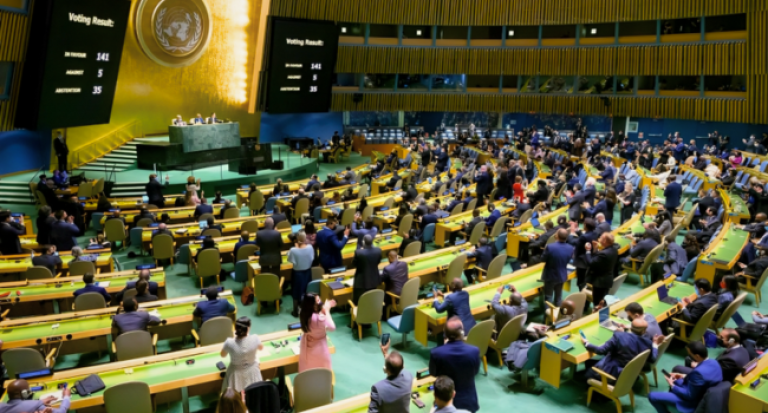
Today, the UN General Assembly will vote on a resolution that calls the transatlantic African slave trade “the gravest crime against humanity.” Supporters say this is a step toward healing and justice.
According to AFP, Ghana’s President John Mahama, who is one of the African Union’s most ardent champions of reparations for slavery, went to the United Nations headquarters to promote the “historic” gesture.
He told the UN yesterday that the resolution “allows us as a global community to collectively bear witness to the plight of more than 12.5 million men, women, and children whose homes, communities, names, families, hopes, dreams, futures, and lives were stolen from them over the course of 400 years.”
Mahama called it “a safeguard against forgetting.” He was talking about recent political initiatives in the US to suppress publications on the issue so that “students don’t learn the truth about…slavery, segregation, and racism.”
The draft resolution says that “the trafficking of enslaved Africans and racialized chattel enslavement of Africans” is the worst crime against humanity.
The text also talks on how slavery still affects society today through “the persistence of racial discrimination and neo-colonialism.”
“Not ranking pain”
Amma Adomaa Twum-Amoah, the African Union’s Commissioner for Health, Humanitarian Affairs, and Development, remarked that “to name these atrocities clearly is to remove the last veils of ambiguity from the historical record.”
“It is to say that what happened to Africans was not a tragic accident of history, but the result of policies that were meant to create today’s inequalities,” she went on. “Justice starts with calling things by their right names.”
But the resolution goes beyond merely saying that the slave trade happened. It asks countries that were implicated in the slave trade to take part in restorative justice.
Ghanaian Foreign Minister Samuel Okudzeto Ablakwa informed our reporter, “We know who were responsible for the transatlantic slave trade: Europeans and the United States of America.”
“We want all of them to apologize to Africa and everyone of African descent in a formal way.”
He remarked that “returning all the looted artifacts to the motherland” is one approach to get to restorative justice.
He also said that institutions should keep working on structural racism and that those who were hurt may get “compensation.”
Some members of the General Assembly also criticized the resolution because they thought the way it was worded could make suffering seem like a “hierarchy.”
He remarked, “We are not ranking suffering when we say that the transatlantic slave trade is the ‘gravest crime against humanity.’ We are not trying to make a hierarchy.”
He remarked, “What we are saying is that none of the horrible things that have happened in human history have been this widespread, this long-lasting, for over 300 years, and the effects of that are still being felt.”
“We are not putting suffering in order. We are not suggesting that our sorrow is more important than yours.
About the Author