
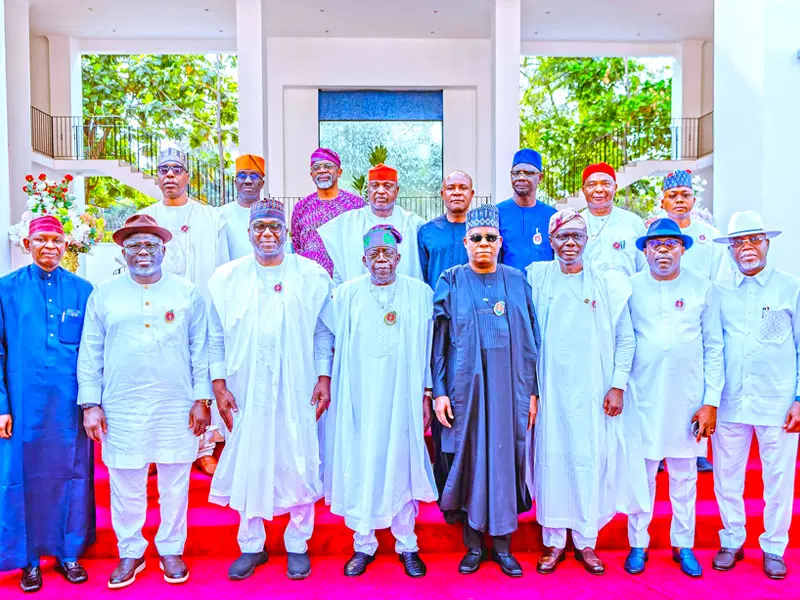
The push for state police got stronger over the weekend as escalating crime and violence across the country pulled governors, politicians, and other stakeholders into a heated discussion. Most states supported the idea, but some cautioned that it may lead to abuse, repression, and political exploitation.
The fault lines are apparent from the North to the South. Many states are already putting in place mechanisms for decentralized policing, but critics say Nigeria doesn’t have the protections in place to stop governors from using these groups as tools of control, says Vanguard.
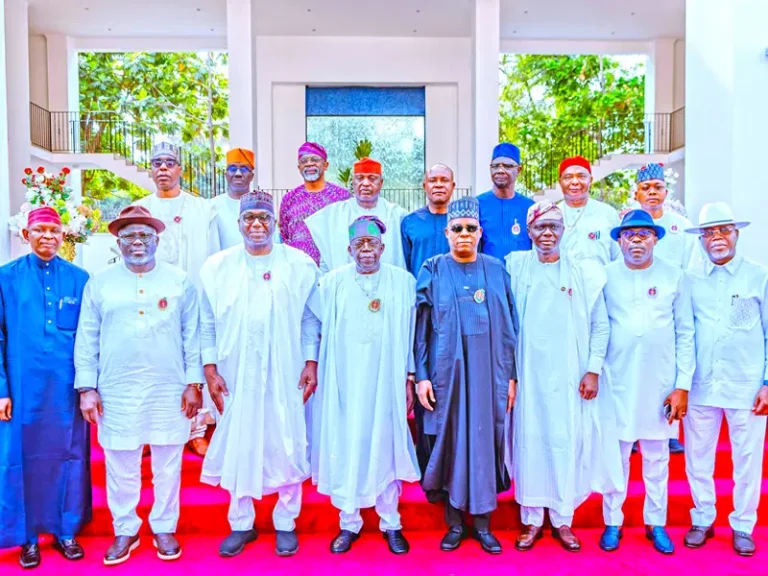
Governors from Ogun State, Dapo Abiodun, Plateau State, Caleb Mutfwang, Kano State, Abba Yusuf, Zamfara, Taraba, Kebbi, Adamawa, Nasarawa, and Kwara states all said that state police was the way to go and had started making plans for community policing. But Babagana Zulum, the governor of Borno State, and his Sokoto State counterpart, among others, said that Nigeria was not ready for state police.
The development comes at a time when the insurgency, banditry, kidnapping, and community violence are getting worse, putting a lot of stress on the centrally controlled Nigeria Police Force.
President Bola Tinubu has said many times that he wants state police to help keep people safe.
Olatunji Disu, the new Inspector General Police, recently formed a group to come up with ways to make the state police a reality.
In order for this to happen, the National Assembly must change the Constitution to allow state police, with the support of at least 24 or two-thirds of the 36 states of the federation.
North is split, but things are moving forward.
Support is spreading across the North, which is the area that has been impacted the most by instability, but there is still pushback.
Kaduna is in charge, training more than 300 people for its vigilance service. Plateau has hired roughly 1,400 people and formed an advisory group.
Governor Caleb Mutfwang said, “Now is the time to make state police,” saying it would help threats be dealt with more quickly.
Kano has also put more than 2,000 people on the streets as part of a neighborhood watch program. Governor Abba Yusuf said, “It makes us safer… we are professionalizing our community security approach.”
Zamfara, Taraba, Kebbi, Adamawa, Nasarawa, and Kwara all agree with the concept, and several have already given money to or expanded local security groups. But there is still a lot of hostility.
Prof. Babagana Zulum, the governor of Borno State, said, “Honestly, I will not support it.” Nigeria isn’t ready for state police yet.
“Some state governors can use it to wipe out other tribes… if half of the power is given… Nigeria will be in trouble.”
In Sokoto and other states, people said they were afraid of political intimidation.
A political leader said, “We need to be careful not to build something that could be used against our enemies.”
The South supports the migration and sets up structures.
Support is stronger in the South-West and South-South, where some states are already establishing structures that are thought to be the first steps toward state policing.
Dapo Abiodun, the governor of Ogun State, warned that state police are “non-negotiable.” Oyo, Ondo, and Ekiti said that groups like Amotekun have already built the groundwork.
Bayelsa, Delta, and Akwa Ibom are all working on community-based security systems in the South-South.
The Community Safety Corps in Bayelsa is already working, and the 5,000-member Ibom Community Watch in Akwa Ibom works with federal authorities.
Delta says it has put money into police infrastructure in all of its 25 councils.
Edo State, on the other hand, said it would wait for clear federal government rules. Even with the progress, worries remain.
Alagoa Morris, an environmentalist, said, “This climate is not yet mature… there is fear that state authorities will misuse it.”
As more and more people in the South-South agree on state police, the argument shows how hard it is to find the right balance between efficiency and accountability. Many people say that without robust protections, the plan might either make security stronger or give politicians more power.
Abia and others show they are ready
Azubuko Uda, a retired Deputy Inspector General of Police, declared in the South-East that Abia State was poised to lead in setting up state police. He said that decentralization would make funding, welfare, and operational efficiency better.
Afenifere says the National Assembly and the states must act.
Mr. Kole Omololu, the National Organizing Secretary of Afenifere, said that President Tinubu’s push for state police is vital, but it can’t happen without changing the constitution.
He said, “The burden of expedition lies more with the legislature than with the Executive,” and he pointed out that policing is still on the Exclusive Legislative List.
He said that the president “cannot, by executive fiat, create state police.” This is because Section 9 of the Constitution says that two-thirds of the National Assembly and at least 24 states Assembly must approve it.
Omololu, on the other hand, asked the Executive to send a “clearly drafted constitutional amendment bill” and told lawmakers to make the reform a top priority and governors to have their Assemblies ready for ratification.
The Senate is working to resolve concerns.
The Senate has, however, promised that Nigerians’ worries over this will be taken care of.
Senator Barau Jibrin, the Deputy President of the Senate, praised the Inspector General of Police, Olatunji Disu, for working with President Tinubu’s Renewed Hope Agenda to make sure the country is completely safe. He said this while meeting with members of the steering committee of the Nigeria Police Force in Abuja.
On March 4, 2026, he set up an eight-member team to come up with a plan for state police.
Senator Barau, who is in charge of the Senate Committee that is looking over the 1999 Constitution, met with the Committee chaired by its Chairman, Professor Olu Ogunsakin.
The Deputy Senate President told the committee to come up with ways to promote accountability, protect against abuse, and start a campaign to raise awareness. This was said in a statement by Ismail Mudashir, his Special Adviser on Media and Publicity.
He stated, “Most importantly, you need to work on a structure to make a strong public safety system and make the country safe.”
“During public hearings in the Senate about changes to the 1999 Constitution, Nigerians voiced their worries and misgivings about the creation of state police. We need to develop a system that eases their worries.
One of the bills being considered by the Committee on the Review of the 1999 Constitution would change the Constitution to allow for the creation of State and Community Police, which would improve local law enforcement and community involvement through a structured legal framework.
To encourage a wide range of people to take part and be included, the committee in charge of reviewing the Constitution, led by Senator Barau, held zonal public hearings in six places across the country’s six geopolitical zones. This gave everyone a chance to have their say in the amendment process.
Before, Professor Ogunsakin told Senator Barau about the committee’s job and asked the Senate for opinion and help in making the report better.
Why state police is necessary
Public analyst Ayo Fadaka supported the suggestion, saying that the lack of state police was “an aberration” and that security is naturally local and communal.
In the same way, stakeholders in the South-West, such as Stephen Adewale, the former chairman of the SDP in Ondo State, and Chief Bolaji Ayorinde, SAN, the chairman of the Oyo State Advisory Council, claimed that decentralized policing would make it easier to acquire information and respond quickly. They did, however, warn that funding, training, discipline, and accountability must be taken care of to stop abuse.
Experts say that reform is long overdue.
Security experts said that Nigeria’s vastness and diversity made decentralized policing unavoidable.
They also supported the idea, saying it will lead to better intelligence, faster response times, and more jobs. However, they warned against political intervention. Braimah Nasiru, a former NDLEA director, remarked, “The only fear… is abuse by people in power.”
The road ahead
As movement grows across the country, everyone agrees that success will depend on changes to the Constitution, political will, money, training, and robust oversight.
At this point, Nigeria is at a crossroads. “State police is possible,” said one stakeholder. The question is whether the political will matches the need for action.
About the Author