
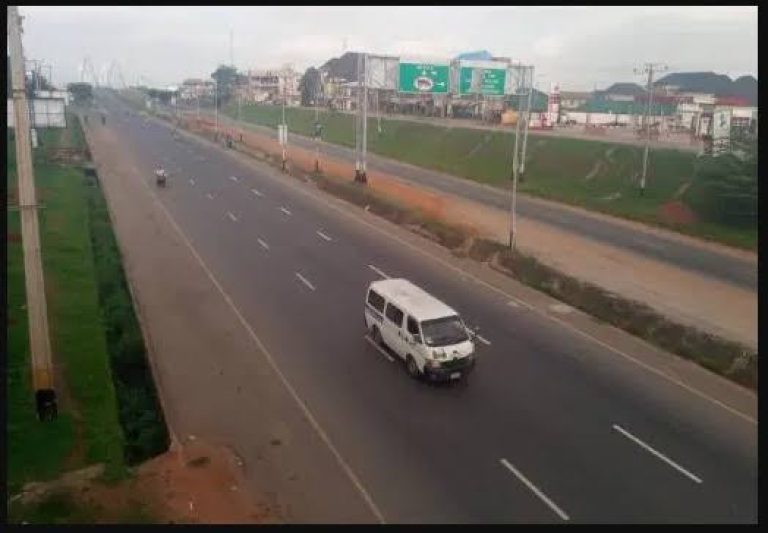
Before Easter, the federal government has said it will open the important 15-kilometer stretch of the Enugu–Onitsha Highway to traffic.
The Guardian says that the government says the move is meant to make transit easier and increase business in Nigeria’s South-East.
David Umahi, the Minister of Works, said this Wednesday while visiting federal road projects that are currently being built in Enugu State.
He expressed satisfaction with the pace and quality of work so far.
Umahi indicated that the part of the road that is almost finished would open on or before March 31, even if things like road markings and median curbs still need to be done.
He said that the order is part of the federal government’s promise to help road users right now while also making sure that infrastructure lasts for a long time.
He said that the Enugu–Onitsha and Enugu–Port Harcourt corridors are some of the most important roads in the South-East, but they have always had problems with traffic jams, tanker accidents, and bad road conditions.
He did, however, say that he was hopeful that the ongoing restoration operations will permanently change the pattern.
Umahi, on the other hand, has told the people of the South-East zone to be thankful to President Bola Tinubu for the huge amount of federal road work that is going on in the area.
During an inspection of current federal road projects in Enugu State yesterday, Umahi said this. He looked at how far along the projects were and claimed that the amount of road development in the area is worth trillions of naira.
He noted that rebuilding the Enugu–Onitsha Highway is still one of the most important things the current government has done in the area.
“This road is the most important one for the people of the South-East.” He remarked, “Before now, there were a lot of tanker accidents that killed people, but that’s becoming a thing of the past.”
He said that the 107-kilometer dual carriageway, which is 214 kilometers long in total, is being partly rebuilt with concrete to make sure it lasts.
“The truth is that around half of it will be done on concrete. Umahi said, “Even if the asphalt fails, at least a good part of the road will still be there.”
He also said that the project will incorporate solar-powered street lights to make the corridor safer.
About the Author