
On Friday, the Defence Headquarters said they were unhappy with how some of the media and the public were calling deadly criminals “bandits.” They said that insurgents and related crimes are terrorists that should not be glorified, including economic saboteurs whose actions have brought the country to its knees. He went on to say that these people can’t be called bandits; instead, they are terrorists who are waiting for the Nigerian troops to wipe them out completely.
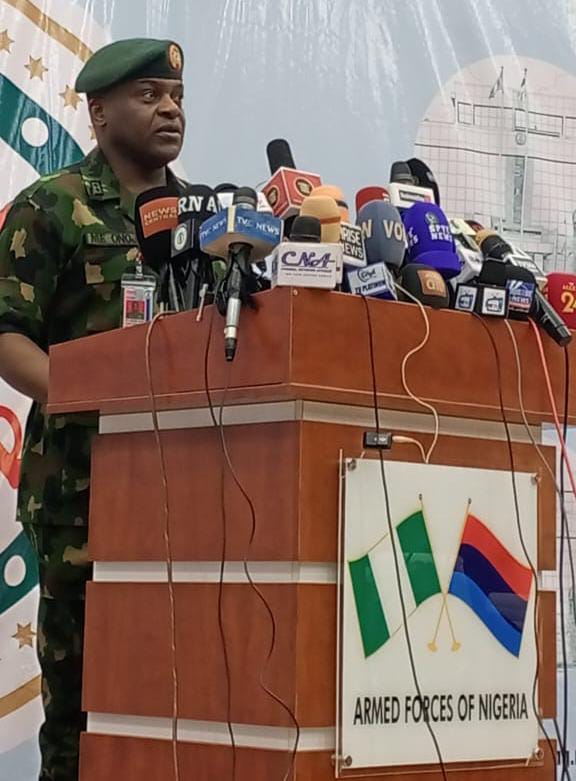
The Defence Headquarters made this point clear at the end-of-month media conference for February.
Major General Michael Onoja, the Director of Defence Media Operations, talked about some of the Armed Forces of Nigeria’s most important accomplishments and promised that the military would be open and accountable to the public. He also warned the media to be careful about how they use words and headlines that praise the country’s common enemy.
The DMO also said that terrorists required the air to spread their activities, but they encouraged reporters to be extra careful while reporting on crimes so that terrorists couldn’t carry out their nefarious goals, “which was to cause panic in society.”
Onoja also made it clear that the United States government is giving Nigeria military help for free and that this does not in any way harm the country’s sovereignty.
The Defence Headquarters (DHQ) indicated that the rise in terrorist attacks and killings in some parts of the country recently was because troops were putting pressure on them through robust operations.
Onoja also said that the brave troops were killing a lot of terrorists in significant operations that were still going on across the country.
He said, “You know, one of the things about terrorists is that when you put pressure on them, they are likely to target soft targets. I also want to let you know that that is what they are doing.” But we shouldn’t let that stop us; in time, the terrorists will be found and caught wherever they are.
“What’s going on is that because working with the US is putting pressure on them, they are now going after soft targets to make their operations bigger.
Gen. Onoja said that the US support was mainly for training Nigerian forces and making ongoing counter-terrorism measures stronger. He stressed that this cooperation should not be seen as strange.
He said, “The American government wants to fight terrorism, and the help it gives to Nigeria is free.”
He said that Nigeria’s territorial integrity and national security were still strong and that no part of the country’s sovereignty had been weakened.
He said, “Our sovereignty is intact.” Our land is still safe. No one is giving up our independence.
He told the public to think about how the partnership will help Nigeria’s operations instead of how many foreign workers would be involved.
He said that the cooperation over the past two months has already led to good results, and he expects additional achievements in the next few days.
General Onoja said that in February 2026, 312 terrorists were captured, many of them were killed, 409 abducted victims were rescued, and 46 rebels and their families gave up.
He says that Operation HADIN KAI made great progress against Boko Haram and ISWAP in the North-East. It killed several terrorists, arrested 85 suspects, and freed 104 kidnapped victims. Some of the most important tasks were stopping terrorist attacks and stopping supplies meant for insurgents. This messed up their logistics and made it easier for displaced people to return home.
Operation FANSAN YAMMA in the North-West effectively fought terrorism by using ground and air support to free 251 hostages and apprehend 36 suspects. The operation also got others in the neighborhood involved, which led to voluntary disarmament and the start of agro-security patrols to defend local farms.
In the North-Central region, Operation SAVANNAH SHIELD went after terrorist hideouts. This led to a lot of neutralizations and the creation of safer trade routes. Community intelligence and stakeholder forums were very important for keeping the peace and safety.
Operation ENDURING PEACE in Plateau State dealt with a number of security issues by stopping terrorists and starting initiatives to empower young people so they wouldn’t become radicalized. In the same way, Operation WHIRL STROKE dealt with banditry and kidnappings by improving community conversations and making markets safer.
Operation DELTA SAFE stepped up efforts to stop oil theft in the South-South. This led to the arrest of 59 offenders and the recovery of substantial amounts of stolen oil. Working together with environmental groups was meant to help people in the area make a living that would last.
Lastly, Operation UDO KA in the South-East targeted groups that were against the government. It led to the arrest of 54 offenders and the dismantling of their networks. The mission used both military action and community involvement to build trust in the community and lower violence.
Overall, the Armed Forces of Nigeria worked together and aggressively throughout all operational theaters, making major strides in the battle against terrorism and crime, which helped keep the country peaceful and stable.
General Onoja said that the Nigerian Armed Forces have been carrying out proactive, intelligence-led operations in several areas to effectively deal with threats from terrorists, armed bandits, and kidnappers. These coordinated efforts have led to major successes, such as taking out hostile actors, getting back a lot of weapons and ammunition, rescuing kidnapped people, breaking up criminal networks, and slowly restoring civil authority in areas that were previously affected.
The staff has shown amazing professionalism and discipline by following the norms of engagement and international humanitarian standards, even when threats are complicated and changing. The help and collaboration of regular Nigerians have been very important, and their reliable information has been a big part of the success of operations. The Armed Forces are determined to keep this momentum going, build on their successes, and make sure that civilians may live in peace and safety.
The achievements mentioned in February 2026 show a great desire to make Nigeria a safe place to live. As the holy months of Ramadan and Lent begin, the Armed Forces wish everyone well and urge people to be on the lookout for strange behavior and report it through the emergency line 193. It is important to work with security services to make sure that observances go off without a hitch.
General Olufemi Oluyede, speaking for the Chief of Defense Staff, thanked the military for their sacrifices, security and civil society partners for their help, and the Nigerian people and media for their trust and support. He stressed how important it was for them to work together to reach their goal.
About the Author