
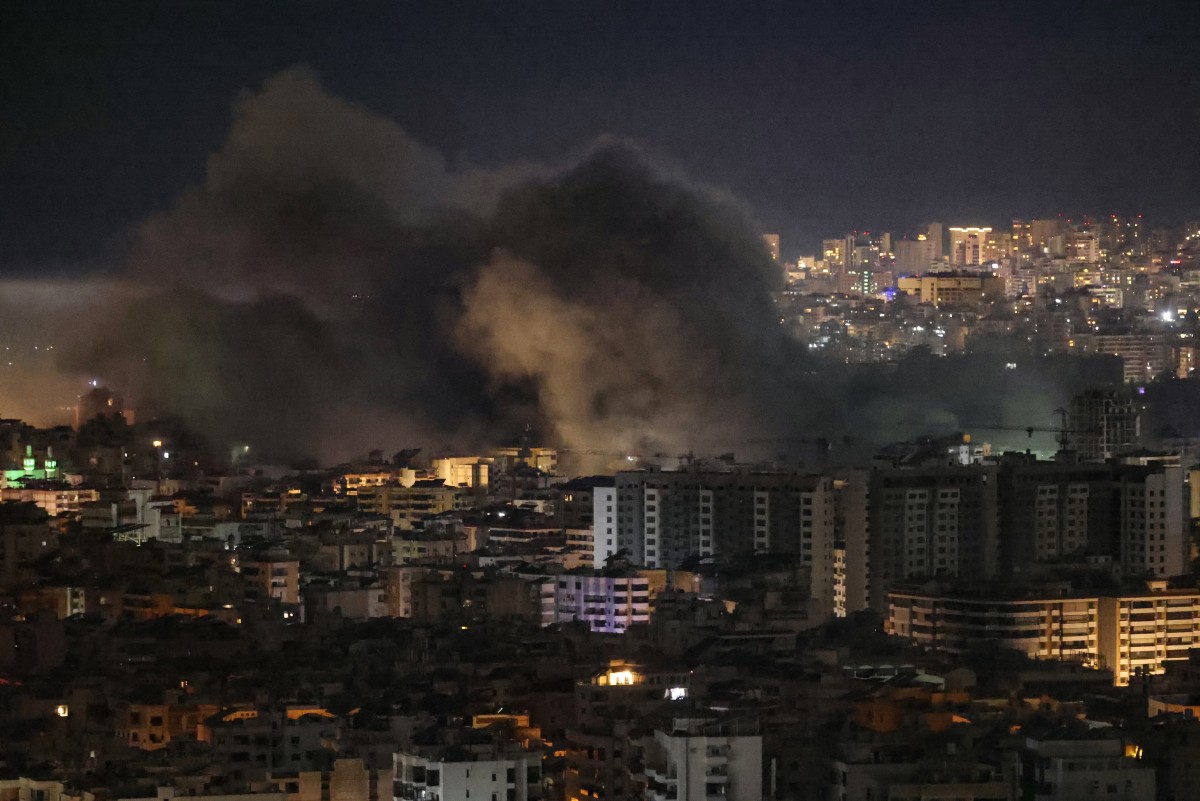
Smoke rises from the site of an Israeli airstrike that targeted Beiruts southern suburbs Haret Hreik neighborhood on March 5, 2026. An Israeli strike targeted the southern suburbs of Beirut late on March 5, according to Lebanese state media, following an Israeli evacuation warning. Lebanon was drawn into the Middle East war on March 2, when Hezbollah attacked Israel in response to the killing of Iran's supreme leader during US-Israeli strikes. (Photo by Ibrahim AMRO / AFP)
The war in Iran, which has expanded throughout the Middle East and beyond, is already in its seventh day. Israeli forces launched a “next phase” in the fight and bombarded the southern suburbs of Beirut.
According to AFP, the Israeli military had already sent out an unusual evacuation notice for the whole neighborhood, telling people to “save your lives and evacuate your residences immediately.” This caused people to panic and leave.
The war has affected places as far afield as the Sri Lankan coast, where a US submarine sank an Iranian warship, and Azerbaijan, which pledged to retaliate after a drone bombed an airport.
Politically, US President Donald Trump said that Mojtaba Khamenei, the son of the late Iranian supreme leader Ali Khamenei, could not take his father’s place because he is a “lightweight.”
“I have to be involved in the appointment, like with Delcy,” Trump said Axios in an interview. He was talking about Venezuela, where Delcy Rodriguez, the interim president, has worked with him since the US military raid that removed her boss, Nicolas Maduro.
“I don’t want Khamenei’s son.” Trump told the journal, “We want someone who will bring peace and harmony to Iran.” He said that if a better option wasn’t discovered, there would be more bloodshed in the future.
The comments show that they are willing to cooperate with someone from the Islamic Republic instead of completely overthrowing the government, even though Trump has told Iranians several times to rise up and take back their country.
Strikes in Beirut
Hezbollah attacked Israel on Monday to get back at them for killing Khamenei. This brought Lebanon into the growing conflict.
Israel replied with air attacks and pushed ground soldiers into certain Lebanese border communities. Yesterday, it hit the southern suburbs of Beirut, saying it was “striking Hezbollah infrastructure.”
People ran out from the area after the Israeli warning, and there were huge traffic jams on the fringes of the suburbs as people shot guns in the air and told people to evacuate as soon as possible.
Hundreds of families, many of them afraid and angry, walked around on a beach in Beirut after fleeing because they had nowhere else to go.
One man told our reporter, “We ran away from the suburbs; we were humiliated.” He did not want to offer his name.
Lebanese officials report that at least 123 people have died since Monday, 683 have been wounded, and as least 90,000 have had to leave their homes.
From Sri Lanka to Azerbaijan
Azerbaijan, which shares a border with Iran, said that a drone strike on an airport “will not go unanswered.” This made people worry that another country might join the fight.
Iran denied being behind the attack and blamed Israel, but it didn’t stop Azerbaijani President Ilham Aliyev from calling Tehran a “terrorist.”
Meanwhile, Australia sent two military planes to the theater, while Canada’s Prime Minister Mark Carney said he wouldn’t rule out his armed forces getting involved.
After more attacks on Iran’s capital, AFPTV footage showed cars that had been burned and buildings that had been damaged, with smoke still rising from some of them.
A 30-year-old man from Tehran told our reporter, “We’re going through a very important page of our history, and I’m not afraid.” “Right now, all we have is hope.”
A state-run foundation in Iran reported that the number of people killed by US and Israeli strikes on the country had climbed to 1,230, but our correspondent could not confirm this number.
Since the war started on Saturday, the US military has said that six of its soldiers had died.
Abbas Araghchi, Iran’s foreign minister, sounded combative yesterday when he said that Tehran had not asked for a ceasefire and that there was “no reason why we should negotiate with the US.”
He told NBC News in the US that they were sure they could face them and that it would be a terrible disaster for them if they did.
Israel, on the other hand, reported that 80% of Iran’s air defense equipment and 60% of its missile launchers had been destroyed.
Army director Eyal Zamir warned that Israel had “more surprises ahead” and that the campaign was entering a “next phase.”
The most recent missile attack from Iran caused a lot of explosions in Tel Aviv, as firefighters attempted to put out a fire in a residential building near Israel’s business center on Friday.
Gulf is under fire
The opulent Gulf monarchies, which are normally considered as safe places in a dangerous area, have not been spared by the battle. Iran has attacked towns and oil facilities.
Since the war started, 13 individuals have died in countries around the Gulf, seven of them civilians. This includes an 11-year-old girl in Kuwait.
Bahrain stated early today that Iran had attacked two hotels and an apartment complex in the capital, Manama, but that “no lives were lost.”
Saudi Arabia reported it has stopped three ballistic missiles from hitting an air base.
And Qatar reported yesterday that it stopped a missile attack as tremendous explosions, which our reporters say were the loudest yet, shook Doha and dense black smoke filled the sky.
Officials said that falling debris from an intercepted drone hurt six persons in the Emirati city of Abu Dhabi.
About the Author