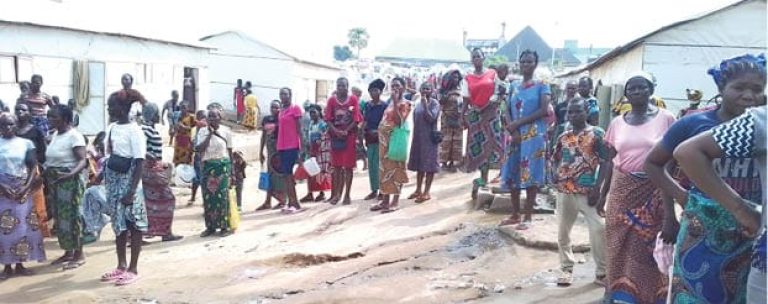

In a dusty field on the outskirts of Zimbabwe’s capital, Harare, young ladies, mothers with kids, and even men stood in line. They came to get shots of a new HIV prevention medicine that was released in the country on Thursday. It only needs to be given twice a year.
Zimbabwe is one of the first countries to use lenacapavir, a long-acting medicine that officials hope would halt the spread of HIV. Over the past two decades, HIV has killed tens of thousands of people in Zimbabwe.
Some health officials have called the medicine a turning point for high-risk groups because clinical studies show that it protects almost everyone. Some people say that converting scientific promise into a big effect will be hard because of problems with money, infrastructure, and keeping patients interested.
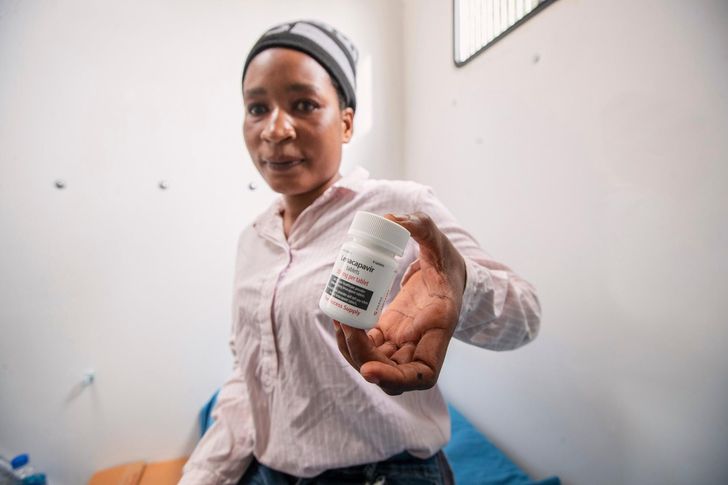
Constance Mukoloka stepped out of a mobile clinic in Zimbabwe, smiling with joy after getting one of the first dosages.
“I am safe; I can work with confidence now,” said the 27-year-old sex worker. She added that taking daily prophylactic preexposure prophylaxis (PrEP) pills often caused problems with customers and made it hard for her to take them regularly, which put her and others at danger.
Mukoloka is one of the first people to get lenacapavir in ten African countries thanks to donations. Health authorities and campaigners argue that if governments can get around the problems of cost and weak health systems, the medicine might change how HIV is prevented.
The United States President’s Emergency Plan for AIDS Relief (PEPFAR) and the Global Fund are working together to help lenacapavir go to certain high-risk nations. It was developed by Gilead Sciences in California.
In Zimbabwe, the injection is free for persons who are at high risk, like sex workers, young women and girls, gay men, and pregnant and breastfeeding women.
For Mukoloka, the medicine is more than just a convenience.
“When I took pills, customers would see a bottle of them and leave.” “They would never come back because they were scared,” she claimed. “They didn’t know the difference between treatment medications and PrEP. That stigma costs you money in the work we conduct.
In Zimbabwe, people have been able to get daily oral PrEP along with condoms, vaginal rings, and shorter-acting injectables for a long time. But sticking to it has been hard, especially for people who are stigmatized or have schedules that are hard to foresee.
“I look for clientele in beer halls. Mukoloka added, “Sometimes I would get drunk and forget to take my drugs.” “I would work all night and not have time sometimes. Some clients don’t want protection. They say, “Why should I use protection if I’ve already paid?”
Health officials think that lenacapavir’s low profile and long-lasting effects are very helpful for essential groups like sex workers, which will help stop the spread of HIV.
“Prevention has to work in real life.” Douglas Mombeshora, Zimbabwe’s health minister, said during the unveiling on Thursday, “If a health solution is too complicated, too demanding, or too visible, people just won’t use it.” “Lenacapavir is a new way of doing things.”
The medicine has also been made available in other southern African countries, such as Zambia and Eswatini.
Zimbabwe, Eswatini, and Zambia, which were formerly the world’s most HIV-infected countries, have become some of the best examples of how to contain the epidemic in recent years, meeting World Health Organization goals for testing, treatment, and viral suppression.
But even with these improvements, new infections are always a worry, especially among teenage girls and young women.
The United Nations children’s agency says that HIV rates among girls and young women aged 10 to 24 in sub-Saharan Africa are “persistently” three times higher than those of boys and young men of the same age. This is because of gender inequality, poverty, and unequal access to health care.
UNAIDS says that in 2024, women and girls of all ages made up 63% of all new HIV infections in sub-Saharan Africa. In all other parts of the world, around 73% of new infections in 2024 happened to men and boys.
Authorities in Zimbabwe believe that some 46,000 patients at 24 sites will benefit from the first phase of the lenacapavir rollout. This is only a small part of the possible demand in a country with about 15 million people.
We don’t know anything about the next step yet. The ministry says it believes that more people will be able to get the vaccine as more doses come in from donors. It also wants to have its own doses for a mass deployment, but like many other African governments, it doesn’t have the money.
Health authorities, scientists, and campaigners are worried that the drug’s early promise in Africa, which has more than 1.5 billion people, will be hurt by practical issues, especially because it costs a lot for governments to spread it out to a lot of people.
Kenya acquired its first 21,000 doses of lenacapavir this week. The government claimed that the injectable would be available for a negotiated price of roughly $54 per person per year, which is still a lot of money for many people.
Gilead Sciences has indicated it will sell its drug to low- and middle-income nations that are significantly afflicted by HIV without making a profit.
Bellinda Thibela, who works for the international advocacy group Health GAP on health justice and access, said that the move was “a bit comforting” but not nearly enough on its own on a continent where health systems have heavily relied on outside funding that is running out, especially after U.S. President Donald Trump cut foreign aid.
Thibela noted that countries who were “80 percent to 90 percent dependent on U.S. funding” would still have problems. “What’s the point of lowering the price if there aren’t enough staff and equipment in clinics?”
Many doctors say that lenacapavir is a big step forward, but they caution that it should be used in addition to, not instead of, other preventative methods.
“Condoms are still very important. Enerst Chikwati, the Zimbabwe program director for AIDS Healthcare Foundation, said, “They are cheap and they also stop other sexually transmitted infections.”
But for some who had it early, like Mukoloka, the drug’s effects are already very strong.
“I’m very happy. She added, “I can feel safe for six whole months.”
About the Author