
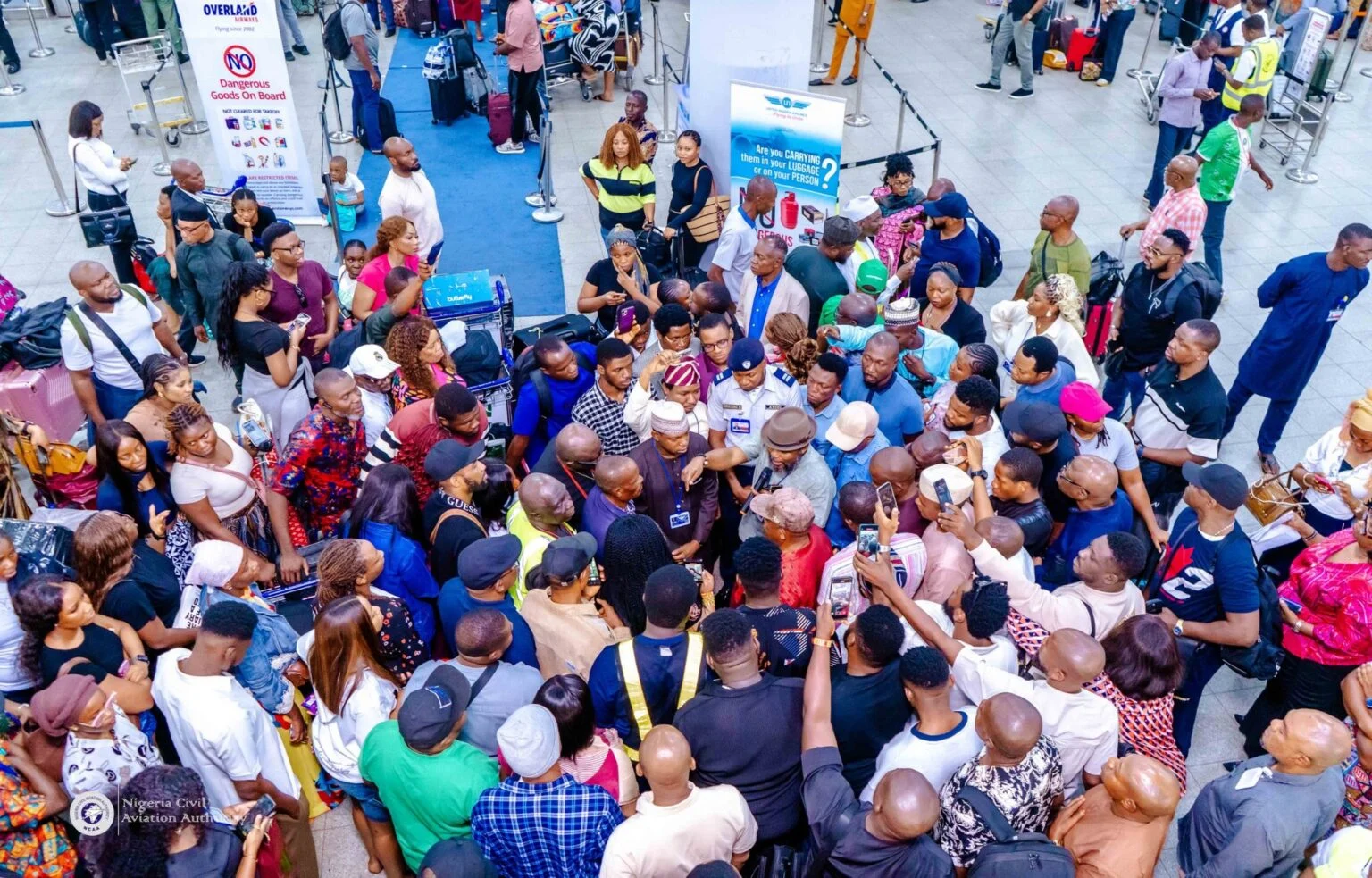
The continuing confrontation between the US and Israel and Iran has left Nigerians trying to get to or from Qatar, Israel, Iran, Iraq, Syria, Kuwait, and the United Arab Emirates stuck.
According to Sunday PUNCH, the scenario has made airlines including Air France, Air India, Turkish Airlines, Norwegian, Air Algerie, Qatar Airways, Emirates, and Lufthansa cancel a lot of flights.
After the bombings on Iran, the country attacked US military outposts in Jordan, Saudi Arabia, Kuwait, Bahrain, and other places.
People trying to fly out of Nigeria on Qatar Airways were barred from doing so yesterday morning.
Airspaces closed
It was learned that a lot of flights between Middle Eastern nations were canceled on Saturday because various countries closed their airspace after the US, Israel, and Iran attacked and counterattacked.
The civil aviation authority reported that Syria shut down part of its airspace along the southern border with Israel for 12 hours.
Reports say that Jordan’s Air Force was doing maneuvers to protect the airspace over the kingdom.
Kuwait shut down its airspace, and later its military said it had shot down missiles that were coming in.
Rosaviatsia, Russia’s air transport regulator, warned that all commercial flights to Israel and Iran would be canceled until further notice because of the attacks.
Nigerian passengers stuck
Earlier yesterday, passengers who were already on a Qatar Airways flight told our reporter that the airline had taken all of the passengers off the plane because they said the airspace in Doha was restricted.
One of them added, “I had so many plans for this trip.” They suddenly said that the airport in Doha isn’t responding, and to be honest, I don’t even know what that means. I want to know whether they can change our route so that we don’t have to go through Doha. This is a very unpleasant condition.
Another passenger, who was traveling with a family member, stated, “With this news, only God knows when my sister will be able to go back to school.” We know this is a real problem, yet it hurts a lot.
Qatar Airways Group said in a statement yesterday that flights would be temporarily stopped because Qatari airspace was closed.
The airline made it clear that its flights to and from Doha were only temporarily stopped because Qatari airspace was closed.
The statement said in part, “We always put the safety of our passengers and employees first, and we are sorry for any trouble this may have caused.”
Air India also stopped flying to all places in the Middle East.
Air India tweeted on its X account, “Due to the changing situation in some parts of the Middle East, all Air India flights to all Middle Eastern destinations have been canceled.”
Damilola Ogunyeye, the Chairman of the International Airlines Operators Committee, said that airlines flying out of the volatile areas were starting to cancel flights after airspace was closed.
Ogunyeye stated, “The world is in a bad place right now. It makes traveling harder and people will start to trust air travel less.” When things happen in the sky, there is no place to park, so it’s sad, but we can only hope that everything will soon go back to normal.
“Today, Qatar and Emirates both canceled because they don’t want to take any chances. Safety comes first in aviation.” We don’t take chances, even when we don’t know how bad things could get. We can only hope that things get better quickly and that peace returns to the areas that are having problems.
Yinka Folami, the President of the National Association of Nigeria Travel Agents, also reported that travelers were stuck after their travel arrangements were canceled.
“Yes, airlines have started sending people back home,” he added. This morning, Qatar Airways told people to get off the plane and go home since the airspace was closed. You know that safety is the most important thing in aviation, and there are dangers in the skies.
The Federal Airports Authority of Nigeria said in a statement yesterday that the continuous restrictions were making it hard for international flights to and from Nigeria to run smoothly.
The agency said that a number of scheduled flights between Nigerian airports and Middle Eastern cities have been canceled or delayed as airlines change their routes to avoid war zones.
FAAN told customers who were affected to keep in touch with their airlines to get the most up-to-date information.
The statement said, “Passengers who are affected by these delays are strongly advised to contact their airlines directly for the most up-to-date information on flight status, rebooking options, and more.”
The agency said it was working closely with airline operators and international aviation regulators to keep an eye on things and make sure passenger safety stayed the top priority.
“FAAN is still keeping an eye on the situation with the help of the right aviation authorities and airline operators and will let you know when there are any changes.
“We’re sorry for the trouble and thank the traveling public for their understanding and cooperation,” the authority said.
US President Donald Trump called the attacks on Iran’s capital, Tehran, and other places “major combat operations.”
The attacks began after the US and Iran were unable to reach an agreement on Iran’s suspected nuclear and ballistic missile programs.
This happened after weeks of Trump making threats and eight months after the US and Israel fought Iran for 12 days.
Iran has fired missiles at northern Israel and US military bases in the Middle East in response.
There isn’t much information right now on the deaths and damage in Iran and Israel.
The FG warns Nigerians living in Iran and the Gulf states.
The federal government has also advised Nigerians living in Iran and the Gulf countries nearby.
Kimiebi Ebienfa, the Ministry of Foreign Affairs’ spokesperson, said in a statement yesterday that the government was keeping a close eye on the “evolving and volatile situation in the Middle East.”
The ministry warned that the rising tension might lead to more violence and told Nigerians in impacted areas to be careful.
The government told Nigerians to always be on the lookout and stay away from vulnerable areas.
The ministry added, “Stay away from places that are known to be strategic, military, or government installations, as these could be potential flashpoints.”
“It is strongly suggested that Nigerians limit their travel and movement within the country until the security situation becomes clearer and more stable.” Stay away from big groups of people and public protests.
“Citizens are strongly urged to follow all security and safety rules set by the local government to keep themselves safe. The statement continued, “Remember that working with local law enforcement is the most important thing for safety.”
It was also advised that Nigerians stay up to date by getting information from reliable sources and not spreading false information.
The ministry said that Nigerian embassies in Tehran and other Gulf nations, such as Qatar, Bahrain, Kuwait, the United Arab Emirates, and Saudi Arabia, had been contacted to help with consular matters.
The ministry told Nigerians that it will keep an eye on the situation and give them updates.
Former ambassadors forecast oil prices to go up
Former Nigerian ambassadors said that rising tensions between Iran and Israel, with the help of the US, might cause oil prices to rise around the world and make it harder to keep the peace and keep people safe.
The former ambassadors told our reporter that the scenario was a “complex show of power” that would have big effects on Nigeria’s economy and diplomacy and on the rest of the world.
Mohammed Mabdul, a former Nigerian ambassador to Algeria, said that the long-running tension in the Middle East had reached a fragile point because of strategic rivalries and political problems that had not been solved.
He said that Western powers, especially the United States, have always backed Israel, but many Arab countries that support the Palestinian cause don’t have the political resolve to go up against Israel directly.
He said that Iran sees itself as a protector of Palestinian rights and has enough military power to fight Israel, though he called that power “limited.”
“The United States wants to make sure that the Iranians don’t get nuclear weapons that they can use to destroy Israel.” Mabdul said, “So, they will do anything to protect Israel’s interests.”
Mabdul underlined the huge economic concerns, especially when it comes to global oil supplies, outside the battlefield.
“About two-thirds of the world’s oil goes through the Strait of Hormuz.” There is no other route that would be good for business if they decide to restrict that one. Mabdul remarked, “If the oil can’t get through the Strait of Hormuz, then the price of oil will go up.”
He also said that any problems with the waterway or attacks on oil tankers will have a big effect on trade and energy markets around the world.
Former Ambassador Godknows Igali also said that the escalation was very worrying and warned that more military buildup in the area could lead to a bigger war.
He urged for urgent global diplomacy and said that the United Nations Security Council should meet right now, even though he wasn’t sure how well it would work because the US has veto power.
Igali also said he was worried about sending more American troops and vessels to the Gulf region.
“Aircraft carriers are everywhere.” He said, “If Iran keeps attacking, America will attack again, Israel will attack, and this will turn into a bigger war.”
Igali talked about what this means for Nigeria. Many Nigerians work as doctors, engineers, nurses, and in many other fields, including oil and gas, in all three countries involved in the issue. If tensions get worse, this might lead to a consular emergency.
He went on to say that Iran, Nigeria, and the US all produce oil and that Iran’s attitude will certainly lead to higher oil prices.
He admitted that higher oil prices could help Nigeria’s economy as an oil-producing country.
Igali stated, “Raising oil prices means we’ll make more money, and prices have already gone up because of the situation between America and Iran.”
But he warned that the bigger problems with energy around the world could cancel out any short-term advantages.
Yemi Faronbi, a former Nigerian ambassador to the Philippines, also said that while the battle could bring Nigeria a lot of money, the fact that the outcome is so uncertain is quite worrying.
He warned that Iran would probably attack American bases in the Middle East, in places like the UAE, Qatar, and Saudi Arabia. This would widen the war and make the world less stable.
Faronbi said that Nigeria’s diplomatic ties with the US might make the country a target.
Faronbi stated, “Because of the kind of relationship we are building with America, we think Iran will attack Nigeria as a likely ally of America.”
He said that developing countries like Nigeria need a “predictable economic environment and a stable world market” to flourish, not the “accidental” income that comes from global strife.
Faronbi said that Iran’s membership in BRICS and close links with China make the world economy very unstable.
He stated, “If Nigeria is seen as drifting too far into the American orbit during this war, it could lose the support of other important economic partners, which could lead to diplomatic sabotage that hurts trade and infrastructure loans.”
Abdulrazaq Hamzat, a security specialist and Executive Director of the Foundation for Peace Professionals, told the federal government to stop following the country’s long-standing policy of not being associated with any one country.
He said that recent events throughout the world showed how important it was to adopt a more interest-driven diplomatic stance.
After gaining independence in the 1960s, Nigeria took a neutral position, joining a group of countries that wanted to stay out of the Cold War’s Western and Eastern blocs.
The policy’s goals were to protect sovereignty, encourage African unity, and keep diplomatic options open.
Hamzat said in a statement Tuesday, “The world has moved beyond being neutral during the Cold War.” Non-alignment used to defend Nigeria’s independence, but now it seems like hesitation.
“The US strike on Iran indicates that the world is changing all the time. Nigeria can’t afford to stray.
“We need to stop drifting and start talking. Our foreign policy needs to do more than just give us photo ops and empty statements; it needs to give us security, jobs, technology transfer, and strategic leverage.”
He said that Nigeria’s persistent reliance on symbolic neutrality makes it harder for the country to negotiate security cooperation, trade deals, and energy collaborations.
Hamzat said that Nigeria’s importance on the world stage could drop if it doesn’t keep up with changes in the world. Nigerians trying to get to or from Qatar, Israel, Iran, Iraq, Syria, Kuwait, and the United Arab Emirates have been stuck because of the ongoing war between the US and Israel and Iran.
According to Sunday PUNCH, the scenario has made airlines including Air France, Air India, Turkish Airlines, Norwegian, Air Algerie, Qatar Airways, Emirates, and Lufthansa cancel a lot of flights.
Iran targeted US military bases in Qatar, Kuwait, Bahrain, Jordan, Saudi Arabia, and other places after the airstrikes.
People trying to fly out of Nigeria on Qatar Airways were barred from doing so yesterday morning.
Airspaces closed
It was learned that a lot of flights between Middle Eastern nations were canceled on Saturday because various countries closed their airspace after the US, Israel, and Iran attacked and counterattacked.
The civil aviation authority reported that Syria shut down part of its airspace along the southern border with Israel for 12 hours.
Reports say that Jordan’s Air Force was doing maneuvers to protect the airspace over the kingdom.
Kuwait shut down its airspace, and later its military said it had shot down missiles that were coming in.
Rosaviatsia, Russia’s air transport regulator, warned that all commercial flights to Israel and Iran would be canceled until further notice because of the attacks.
Nigerian passengers stuck
Earlier yesterday, passengers who were already on a Qatar Airways flight told our reporter that the airline had taken all of the passengers off the plane because they said the airspace in Doha was restricted.
One of them added, “I had so many plans for this trip.” They suddenly said that the airport in Doha isn’t responding, and to be honest, I don’t even know what that means. I want to know whether they can change our route so that we don’t have to go through Doha. This is a very unpleasant condition.
Another passenger, who was traveling with a family member, stated, “With this news, only God knows when my sister will be able to go back to school.” We know this is a real problem, yet it hurts a lot.
Qatar Airways Group said in a statement yesterday that flights would be temporarily stopped because Qatari airspace was closed.
The airline made it clear that its flights to and from Doha were only temporarily stopped because Qatari airspace was closed.
The statement said in part, “We always put the safety of our passengers and employees first, and we are sorry for any trouble this may have caused.”
Air India also stopped flying to all places in the Middle East.
Air India tweeted on its X account, “Due to the changing situation in some parts of the Middle East, all Air India flights to all Middle Eastern destinations have been canceled.”
Damilola Ogunyeye, the Chairman of the International Airlines Operators Committee, said that airlines flying out of the volatile areas were starting to cancel flights after airspace was closed.
Ogunyeye stated, “The world is in a bad place right now. It makes traveling harder and people will start to trust air travel less.” When things happen in the sky, there is no place to park, so it’s sad, but we can only hope that everything will soon go back to normal.
“Today, Qatar and Emirates both canceled because they don’t want to take any chances. Safety comes first in aviation.” We don’t take chances, even when we don’t know how bad things could get. We can only hope that things get better quickly and that peace returns to the areas that are having problems.
Yinka Folami, the President of the National Association of Nigeria Travel Agents, also reported that travelers were stuck after their travel arrangements were canceled.
“Yes, airlines have started sending people back home,” he added. This morning, Qatar Airways told people to get off the plane and go home since the airspace was closed. You know that safety is the most important thing in aviation, and there are dangers in the skies.
The Federal Airports Authority of Nigeria said in a statement yesterday that the continuous restrictions were making it hard for international flights to and from Nigeria to run smoothly.
The agency said that a number of scheduled flights between Nigerian airports and Middle Eastern cities have been canceled or delayed as airlines change their routes to avoid war zones.
FAAN told customers who were affected to keep in touch with their airlines to get the most up-to-date information.
The statement said, “Passengers who are affected by these delays are strongly advised to contact their airlines directly for the most up-to-date information on flight status, rebooking options, and more.”
The agency said it was working closely with airline operators and international aviation regulators to keep an eye on things and make sure passenger safety stayed the top priority.
“FAAN is still keeping an eye on the situation with the help of the right aviation authorities and airline operators and will let you know when there are any changes.
“We’re sorry for the trouble and thank the traveling public for their understanding and cooperation,” the authority said.
US President Donald Trump called the attacks on Iran’s capital, Tehran, and other places “major combat operations.”
The attacks began after the US and Iran were unable to reach an agreement on Iran’s suspected nuclear and ballistic missile programs.
This happened after weeks of Trump making threats and eight months after the US and Israel fought Iran for 12 days.
Iran has fired missiles at northern Israel and US military bases in the Middle East in response.
There isn’t much information right now on the deaths and damage in Iran and Israel.
The FG warns Nigerians living in Iran and the Gulf states.
The federal government has also advised Nigerians living in Iran and the Gulf countries nearby.
Kimiebi Ebienfa, the Ministry of Foreign Affairs’ spokesperson, said in a statement yesterday that the government was keeping a close eye on the “evolving and volatile situation in the Middle East.”
The ministry warned that the rising tension might lead to more violence and told Nigerians in impacted areas to be careful.
The government told Nigerians to always be on the lookout and stay away from vulnerable areas.
The ministry added, “Stay away from places that are known to be strategic, military, or government installations, as these could be potential flashpoints.”
“It is strongly suggested that Nigerians limit their travel and movement within the country until the security situation becomes clearer and more stable.” Stay away from big groups of people and public protests.
“Citizens are strongly urged to follow all security and safety rules set by the local government to keep themselves safe. The statement continued, “Remember that working with local law enforcement is the most important thing for safety.”
It was also advised that Nigerians stay up to date by getting information from reliable sources and not spreading false information.
The ministry said that Nigerian embassies in Tehran and other Gulf nations, such as Qatar, Bahrain, Kuwait, the United Arab Emirates, and Saudi Arabia, had been contacted to help with consular matters.
The ministry told Nigerians that it will keep an eye on the situation and give them updates.
Former ambassadors forecast oil prices to go up
Former Nigerian ambassadors said that rising tensions between Iran and Israel, with the help of the US, might cause oil prices to rise around the world and make it harder to keep the peace and keep people safe.
The former ambassadors told our reporter that the scenario was a “complex show of power” that would have big effects on Nigeria’s economy and diplomacy and on the rest of the world.
Mohammed Mabdul, a former Nigerian ambassador to Algeria, said that the long-running tension in the Middle East had reached a fragile point because of strategic rivalries and political problems that had not been solved.
He said that Western powers, especially the United States, have always backed Israel, but many Arab countries that support the Palestinian cause don’t have the political resolve to go up against Israel directly.
He said that Iran sees itself as a protector of Palestinian rights and has enough military power to fight Israel, though he called that power “limited.”
“The United States wants to make sure that the Iranians don’t get nuclear weapons that they can use to destroy Israel.” Mabdul said, “So, they will do anything to protect Israel’s interests.”
Mabdul underlined the huge economic concerns, especially when it comes to global oil supplies, outside the battlefield.
“About two-thirds of the world’s oil goes through the Strait of Hormuz.” There is no other route that would be good for business if they decide to restrict that one. Mabdul remarked, “If the oil can’t get through the Strait of Hormuz, then the price of oil will go up.”
He also said that any problems with the waterway or attacks on oil tankers will have a big effect on trade and energy markets around the world.
Former Ambassador Godknows Igali also said that the escalation was very worrying and warned that more military buildup in the area could lead to a bigger war.
He urged for urgent global diplomacy and said that the United Nations Security Council should meet right now, even though he wasn’t sure how well it would work because the US has veto power.
Igali also said he was worried about sending more American troops and vessels to the Gulf region.
“Aircraft carriers are everywhere.” He said, “If Iran keeps attacking, America will attack again, Israel will attack, and this will turn into a bigger war.”
Igali talked about what this means for Nigeria. Many Nigerians work as doctors, engineers, nurses, and in many other fields, including oil and gas, in all three countries involved in the issue. If tensions get worse, this might lead to a consular emergency.
He went on to say that Iran, Nigeria, and the US all produce oil and that Iran’s attitude will certainly lead to higher oil prices.
He admitted that higher oil prices could help Nigeria’s economy as an oil-producing country.
Igali stated, “Raising oil prices means we’ll make more money, and prices have already gone up because of the situation between America and Iran.”
But he warned that the bigger problems with energy around the world could cancel out any short-term advantages.
Yemi Faronbi, a former Nigerian ambassador to the Philippines, also said that while the battle could bring Nigeria a lot of money, the fact that the outcome is so uncertain is quite worrying.
He warned that Iran would probably attack American bases in the Middle East, in places like the UAE, Qatar, and Saudi Arabia. This would widen the war and make the world less stable.
Faronbi said that Nigeria’s diplomatic ties with the US might make the country a target.
Faronbi stated, “Because of the kind of relationship we are building with America, we think Iran will attack Nigeria as a likely ally of America.”
He said that developing countries like Nigeria need a “predictable economic environment and a stable world market” to flourish, not the “accidental” income that comes from global strife.
Faronbi said that Iran’s membership in BRICS and close links with China make the world economy very unstable.
He stated, “If Nigeria is seen as drifting too far into the American orbit during this war, it could lose the support of other important economic partners, which could lead to diplomatic sabotage that hurts trade and infrastructure loans.”
Abdulrazaq Hamzat, a security specialist and Executive Director of the Foundation for Peace Professionals, told the federal government to stop following the country’s long-standing policy of not being associated with any one country.
He said that recent events throughout the world showed how important it was to adopt a more interest-driven diplomatic stance.
After gaining independence in the 1960s, Nigeria took a neutral position, joining a group of countries that wanted to stay out of the Cold War’s Western and Eastern blocs.
The policy’s goals were to protect sovereignty, encourage African unity, and keep diplomatic options open.
Hamzat said in a statement Tuesday, “The world has moved beyond being neutral during the Cold War.” Non-alignment used to defend Nigeria’s independence, but now it seems like hesitation.
“The US strike on Iran indicates that the world is changing all the time. Nigeria can’t afford to stray.
“We need to stop drifting and start talking. Our foreign policy needs to do more than just give us photo ops and empty statements; it needs to give us security, jobs, technology transfer, and strategic leverage.”
He said that Nigeria’s continuous use of symbolic neutrality makes it harder for the country to negotiate better deals in security cooperation, commerce, and energy collaborations.
Hamzat said that Nigeria’s importance on the world stage could go down if it doesn’t keep up with how quickly things are changing around the world.
About the Author