
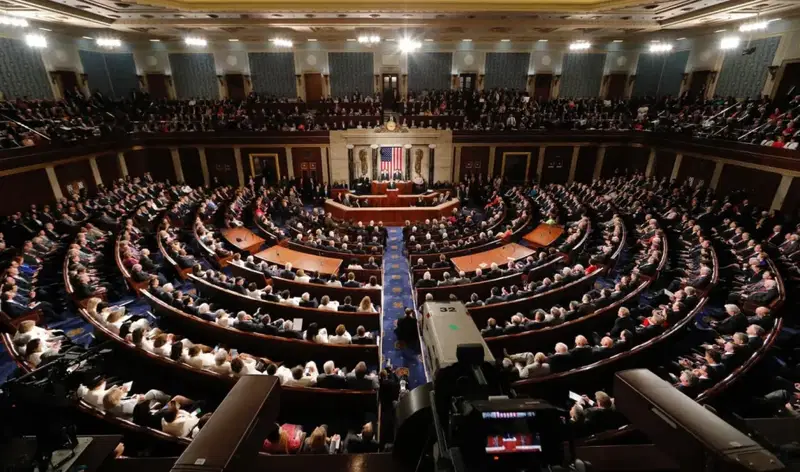
The US Congress has suggested steps to stop the growing persecution of Christians in Nigeria. These include making the country’s institutions stronger, better enforcement, better ways to stop money laundering, and support for legal changes.
Vanguard says that President Donald Trump put up a Rep panel to look into the persecution of Christians in Nigeria and send him the report.
But the federal government quickly responded by saying that Nigeria did not have a policy against religious persecution. They called the situation an opportunity for both countries to work together more closely and more broadly.
However, US lawmakers once again urged the president to use the Country of Particular Concern (CPC) presidential directive to name and shame those who commit violence against Christians, punish them with sanctions, and keep the visa restrictions in place against them.
The Congress’s suggestions, which came from the House Foreign Affairs Committee and the House Appropriations Committee, came after months of looking into claims of Christian genocide in Nigeria after Trump named Nigeria a Country of Particular Concern again.
The MPs said that Nigeria was the most dangerous location in the world for Christians and asked for the repeal of sharia codes and blasphemy laws in Nigeria’s northern states, which had been used to crush dissent and target minorities.
They told the Trump administration to use its power to force Fulani herdsmen to give up their weapons, maybe by stopping beef exports to nations like Ghana, South Africa, and Senegal.
To fight the power of extremist groups, MPs asked the government to let farmers protect themselves legally and to set up programs to break up networks that help terrorists get money.
The Congress also suggested that the US military get rid of Russian weapons and replace them with American ones, and that the US work to stop China’s influence in Nigeria, especially “their destabilizing practice of paying protection money to Fulani militias.”
They also suggested that the US should require a “GAO audit report” on how well aid to Nigeria is working to make sure that the money is being used in a clear and responsible way.
The lawmakers told the US government to hold back some US funds until the Nigerian government took clear steps to stop violence against Christians. They also asked the US to work with other countries, such as France, Hungary, and the UK, to end the violence against Christians.
In a statement that went along with the proposals, the MPs added, “After decades of persecution, Nigeria is the most dangerous place in the world to be a Christian.” Fulani militias and terrorist groups are constantly attacking Christians with guns, killing tens of thousands of them, including pastors and priests, destroying thousands of churches and schools, and kidnapping others.
“Blasphemy laws in Nigeria’s northern states are used to stop people from speaking out and disagreeing, go after Christians and other minorities, and justify so-called ‘convictions’ without due process.”
“President Trump’s brave move and Congress’s attention have created a once-in-a-lifetime chance for real change to fix this crisis that has been going on for 20 years.”
They told the Nigerian government to show political resolve, including by using their own money, to stop the violence right away and then do rid of it completely.
They also said, “Now is the time for the United States and Nigeria to redefine their strategic partnership to make both countries safer, stronger, and more prosperous.”
The Suggestions
*Make a deal between the US and Nigeria to protect weak Christian communities from violent attacks, stop jihadist terrorism in the area, boost economic cooperation, and fight enemies in the area, such as the Chinese Communist Party and the Russian Federation. The government of Nigeria should agree to the following in such an agreement:
Co-fund humanitarian aid from donors, including through faith-based groups, and put underserved populations of Internally Displaced Persons (IDPs) and their host communities first, notably in the mostly Christian Middle Belt region;
Support and respond to early warning systems that stop attacks and kidnappings. This includes sending enough trained security officers to the Middle Belt so they can respond quickly and effectively, and punishing those who reject the warnings.
*Get the Fulani militias off of confiscated, productive farmland and let displaced communities go back to their homes on their own. This will reduce the need for humanitarian aid and lead to economic growth through higher agricultural productivity.
*Keep working together on security with the US and give up Russian military gear in exchange for American military gear through sales and loans.
*Giving the Nigerian government technical help to lower and then get rid of violence from armed Fulani militias. This includes creating a program for demobilization, disarmament, and reintegration to deal with illegal weapons and make communities safer while letting farmers defend themselves legally:
Supporting the new Ministry of Livestock and ranching programs, as well as genuine land reform measures; and improving the willingness, technical skills, and recruiting of the military and security services to stop and respond to violent attacks.
*Complete cooperation against terrorism to get rid of foreign terrorist groups that directly threaten the United States, including giving them extra defense equipment and using the right drawdown authorities.
*Stop foreign countries from taking advantage of China’s unlawful mining operations and their dangerous habit of paying Fulani militias for protection.
Rep. Riley M. Moore said in a statement on his X handle, “After today’s (yesterday’s) productive meeting at the White House, I want to thank President Trump for redesignating Nigeria as a Country of Particular Concern and for his administration’s commitment to protecting our brothers and sisters in Christ from persecution and addressing the broader security challenges plaguing Nigeria.
“Since President Trump named Nigeria a CPC and asked me to head a congressional inquiry, I have worked hard with my colleagues to put together the report we gave today.
“I also want to thank Tom Cole, the chairman of the House Appropriations Committee; Mario Diaz-Balart, the vice chairman; Brian Mast, the chairman of the Foreign Affairs Committee; and Chris Smith, a congressman, for their leadership on this thorough investigation and for sending this report to the White House.
“I went to Nigeria with a bipartisan group and saw for myself the terrible things that Christians have to deal with and the problems that the Nigerian government has to deal with.
We have given a clear picture of the threat environment in Nigeria and the terrible persecution Christians face through Congressional hearings, expert testimony, meetings with Internally Displaced Persons, hearing from religious leaders, and talking to high-level Nigerian government officials.
“This report lays out specific methods to hold people accountable, fight radical Islamic terrorism, and collaborate with the Nigerian government to make Nigeria safe for everyone.
“Our Christian brothers and sisters have been suffering in silence for too long.” The world is watching today, and I urge the Nigerian government to use this chance to enhance and deepen its ties with the United States.
“Both of our great nations will benefit from doing so.” We need to work together to solve these urgent security problems and stop violence against Christians.
CAN says that US pressure on Sharia could cause problems in Nigeria.
In response to the report from yesterday, the Christian Association of Nigeria (CAN) said that proposals by a US congressional panel for Nigeria to get rid of its Sharia and blasphemy laws could make religious tensions worse and make the country less stable.
The Christian group wants a new, people-driven constitution instead of getting rid of Sharia elements. They say that only a new constitutional framework, not little changes, could accurately reflect Nigeria’s complicated religious and ethnic reality.
A top CAN official told our reporter in private that international pressure needs to be handled with caution and responsibility because it is a sensitive issue.
“This is a very touchy subject.” You can see that the process for changing the Constitution could cause a lot of stress.
At a recent meeting of the Nigeria Inter-Religious Council (NIREC), several Muslim clerics vehemently contended that Sharia was a way of life and part of the culture of some northern regions, and that it cannot simply be repealed or removed from the Constitution.
That’s why we think this issue needs to be dealt with in a very responsible and wise way. It could make the country less stable if it is not managed properly.
“Religion is quite touchy, and there are both uneducated and extreme followers in both the Christian and Muslim societies. So even how the media talks about this problem needs to be very careful.
“Instead of focusing on getting rid of Sharia law, what we have always called for is a new constitution for Nigeria.
“The country needs a constitution that really comes from the people and takes into account the requirements of all parts of the country. All religions should be treated fairly, and the needs of ethnic and minority groups should also be taken into account.
“We must not let anyone use Sharia as a shield to do wrong.” We are not suggesting that Sharia is not vital, though. We are worried that some people use it to defend different kinds of abuse.
“We believe that Nigeria needs a new constitution that truly reflects the desire of the people. We think that the 1999 Constitution is defective because it came from military dictatorship and that changes alone may not be enough to fix the bigger issues.
“Instead of getting rid of certain laws, we want a new constitution that takes everyone’s needs into account.” The CAN official stated, “If Sharia is recognized, other religious legal systems, like canon law, should also be protected and guaranteed by the constitution.”
About the Author