

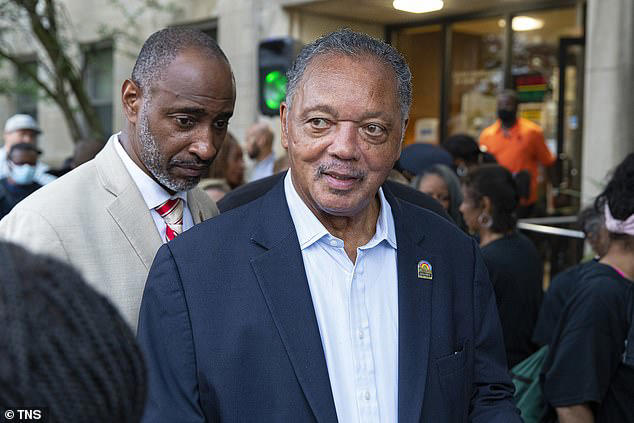
Jesse Jackson, a famous civil rights leader, has died at the age of 84.
Jackson’s family said he died peacefully on Tuesday morning with loved ones around him, but they didn’t say what caused his death right away.
The Jackson family said in a statement, “Our father was a servant leader, not just to our family but also to the oppressed, the voiceless, and the people who are often ignored around the world.”
“We shared him with the world, and in return, the world became part of our family.” His strong belief in love, fairness, and equality inspired millions. Please honor his memory by continuing to fight for the values he lived by.
He is survived by his wife of more than 60 years, Jacqueline Brown, and six children.
Jackson said in 2017 that he has Parkinson’s disease. He went to Northwestern Medicine in Chicago for outpatient treatment for the disease for at least two years before he told the world about it.
In August 2021, he went to the hospital for COVID-19. In November, he went back to the hospital after falling and hitting his head while helping Howard University students protest bad housing conditions on campus.
Jesse Jackson was born in the Jim Crow South in 1941. He would go on to become one of the most important political leaders of the late twentieth century.
He became well-known as one of the first followers of Martin Luther King Jr. and one of the most well-known civil rights activists in the country.
In 1984, Jesse Jackson posed for a presidential candidate photo in Tallahassee, Florida.
Civil rights leader Jesse Jackson Sr. and activist Rosa Parks raise their hands in victory during a speech in 1965. Jackson took part in the Selma to Montgomery marches that year. People who saw him there claimed he stood out.Former UN Ambassador Andrew Young, who was then a top aide to King, said, “He took charge right away.” “It felt like he came in and wouldn’t get in line even though people were already in line. He would start to get people in line.
He started Operation PUSH—People United to Save Humanity—in 1971. The name was later altered to People United to Serve Humanity. The purpose was to fight for civil rights, social justice, and political activity. The New York Times said, “It would take him very, very far.”
PUSH’s goal was to put pressure on politicians to make things better for black and poor people of all races. PUSH would win franchises, supply contracts, and jobs for many minorities by boycotting (or threatening to boycott) white-owned businesses.
Jackson spearheaded successful boycotts against Anheuser-Busch, Coca-Cola, Heublein, Burger King, and Seven Up. These boycotts eventually resulted to additional jobs for minorities.
Jackson started the Rainbow Coalition in 1984. Its goal was to get equal rights for women, African Americans, and gay people, as well as organize initiatives for housing, social services, and voter registration. In 1996, the two groups came together to establish the Rainbow/PUSH Coalition.
He competed for the Democratic presidential nomination twice, once in 1984 and again in 1988.
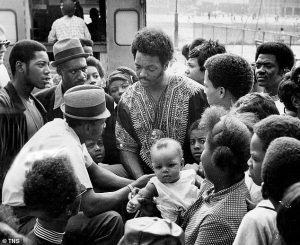
At a Chicago rally in 1966, Jesse Jackson (second from right) stood next to Martin Luther King Jr.
In 1984, Jackson stepped down as head of Operation PUSH to run for president of the United States.
He was the third African American to run for office on a major political party ticket. Shirley Chisholm ran for the Democratic nomination in 1972, and Frederick Douglass got one roll call vote at the Republican National Convention in 1888.
People quickly wrote Jackson off as a fringe contender, but he surprised political experts by coming in third in the primary, behind Senator Gary Hart and Vice President Walter Mondale.
He garnered more than 18% of the primary vote in a few primaries and caucuses in the first race. He won 11 primaries and caucuses four years later.
A New York Times story from the time of his second candidacy for the White House said, “Most political analysts give him little chance of being nominated, partly because he is black and partly because of his unretrenched liberalism.”
The civil rights activist who led the way got 6.9 million votes and won the primary in 11 states. The New York Times labeled 1988 “the Year of Jackson” because he did even better than expected, double his prior results.
Jackson had an impact on worldwide issues throughout the 1980s and 1990s. In 1983, he went to Syria to get the release of Robert Goodman, an American Navy pilot who had been taken prisoner.
Fidel Castro invited Jackson to Cuba in June 1984 to negotiate the release of 22 Americans who were being incarcerated there. When he forced the Cuban president to go to church with him on Sunday during his visit, he made a big deal out of it.
Jackson went to Iraq just before the 1991 Persian Gulf War to ask Saddam Hussein to let go of 20 Americans and Britons he was keeping hostage as a “human shield.”
Jackson’s relatives said he died peacefully on Tuesday morning, surrounded by family and friends.
Jesse Jackson was born in the Jim Crow South in 1941. He would later become one of the most important political leaders of the late 20th century.
As President Bill Clinton’s special envoy to Kenya in 1997, Jackson went there to meet with the president to talk about free and fair elections.
Two years later, the up-and-coming politician helped get three prisoners of war who were taken on the Macedonian border while patrolling with a UN peacekeeping unit released.
Clinton’s administration did not approve of the talks with the Yugoslavian president during the height of the Kosovo War.
In 2000, President Clinton gave Jesse Jackson the Presidential Medal of Freedom and praised him for his “keen intellect and loving heart.” Clinton remarked during the event, “For a chance, I don’t have to follow Jesse Jackson.”
About the Author